





New Delhi, 20th of February, 2026 : The India AI Impact Summit 2026 welcomed another vibrant day at Bharat Mandapam, where visitors streamed into the halls, sparking conversations and exploring innovations across the venue.

From early interactions at the exhibition booths to animated discussions between innovators and policymakers, the day moved at a lively pace. Small groups gathered around live demonstrations and emphasized one key message: AI is no longer confined to prototypes. It is finding its way into everyday systems.
The focus remained simple and direct, how Artificial Intelligence (AI) is reflecting Government’s continued emphasis on translating emerging technologies into practical public applications. Across the venue, ideas were not just presented; they were shown, tested and discussed with real-world applications in focus.

It was with hands-on spirit and open exchange, that the AI Summit evolved beyond dialogue into a solutions-driven forum where ideas were translated into clear and practical applications. The Summit brings together startups, researchers, industry leaders and innovators working across different sectors. It reflects a wider national effort to turn AI research into practical solutions that can be used in transport, education, governance, infrastructure and more.

Coaching with AI
As visitors step into the exhibition hall, a group of students gathers around a screen displaying a study dashboard.
The platform is SATHEE (Self Assessment, Test and Help for Entrance Exams), an initiative of the Ministry of Education and IIT Kanpur. Launched in 2023, it provides completely free personal AI-powered preparation and mentorship support for eight major competitive examinations: JEE, NEET, CLAT, ICAR, CUET, SSC, RRB and IBPS.
SATHEE offers AI-based doubt resolution, Study Plan Generators, Confusion Detection Tools and Automatic transcript summarization. Recognising that students do not always study during fixed hours, the team integrated AI-powered features to support flexible learning. “We realised students don’t always study from 10 to 6. So, we added AI features such as AI Conventional Tour, Mnemonics and memory aids especially helpful for Gen Z learners and AI Visual Problem Solver so they can study at home, anytime”, Mr. Dhruv Garg, (Software Engineer at IIT Kanpur) explains.

Students can generate personalised study plans based on available study hours in selected subjects. The system extracts key formulas and summaries from lecture transcripts and highlights recurring conceptual confusion. The content is currently available in 13 Indian languages, with further expansion underway.
Mr. Garg also highlights that- early implementation in selected government schools has shown encouraging outcomes with upto 50% increase in JEE and 80%increase in NEET qualifiers. The emphasis is on extending access, particularly for students who may not have the means for private coaching.
Turning Cameras into AI based Intelligent Systems
A short walk away, the conversation shifts from education to surveillance systems.
At the stall of a decade old, Gurugram-based iiris: Value Catalysts, Mr. Zia Ahmad, Manager – Security Design, explains the firm’s approach of integrating AI in the traditional security solutions. “Let’s say you have a warehouse or real estate property. We begin with its comprehensive security risk assessment and design AI Based security solutions tailored to the requirements.” he says.
Rather than replacing hardware, “iiris” enhances conventional camera ecosystems with AI-driven software. He pointed out that “Earlier, surveillance systems relied heavily on manual monitoring. If an incident occurred, the entire recording had to be reviewed, making the process extremely time-consuming and resource-intensive.”
Mr. Ahmad explains: Now, with AI-enabled tools, a single command can retrieve all relevant information at once. Intelligent filtering narrows footage instantly based on attributes such as clothing colour or time span, while integrated systems linking cameras, motion sensors and other devices generate real-time alerts, significantly enhancing speed and efficiency of response.

The firm is currently conducting security risk assessments for major infrastructure projects, including Vrindavan Chandrodaya Mandir, World’s tallest Temple3in Mathura. The emphasis, Mr. Ahmad notes, remains on structured risk mitigation supported by experienced professionals using AI.
Watching the Tracks before they fall
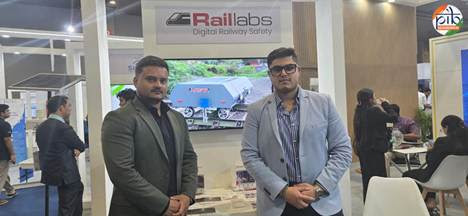
Co-Founder of RailLabs: Railway Digital Safety, Mr. Sumit Anand points to Arista, the autonomous track inspection robot with pride. Raillabs’ Arista revolutionises track maintenance by providing autonomous, AI-driven inspection capabilities.
He says “It is trained based on its surroundings. We primarily use ultrasonic flaw detection to identify cracks in the railway track, both surface-level and internal cracks”. The robot also uses lasers for track profiling and AI-based vision cameras to detect cracks, Mr. Anand explains further that “Let us say fish plates are missing, bolts are absent, or there are other structural defects, the system will detect them all.”
This significantly increases inspection efficiency, by upto 200% compared to what is currently being done today by manual means, he adds.
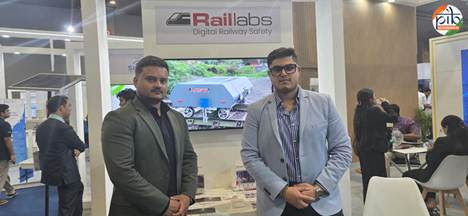
Standing nearby, Mr. Nischal Ranjan, Operational Manager at RailLabs, describes another product named ChakrVue which is already in the market. According to him, it is a wheel shelling prediction system which predicts whether a train or coach wheel may chip or shell, preventing derailments. The product is already operational in 20 LHB and Tejas coaches across cities including Mumbai, Agartala and Ranchi.
He says “by identifying potential wheel defects before failure, the system strengthens preventive railway safety.” For the team, digital safety is not about replacing human oversight but reinforcing it with precision.
“Even a crack above two millimetres can be dangerous,” he says, explaining why early detection is not a technical luxury but a safety necessity.
Together these products promise to significantly enhance the safety ecosystem in the railways by early detection and preventing derailments. Use of AI in such practical scenarios can generate high quality results in real life.
Around these stories, the AI Summit gradually gathers momentum. Screens light up across the hall. Demonstration units hum softly. Policymakers, students, technologists and industry representatives move between stalls, pausing to ask questions and observe live demonstrations.
| Conclusion |
As evening approaches and the hall lights soften, visitors continue to linger, exatmining interfaces and asking questions. The Summit does not promise instant change. Rather, it reflects the steady integration of intelligent systems into sectors that shape everyday life. In transport corridors, temple complexes, classrooms and many more, AI is being layered into existing frameworks to enhance efficiency, access and safety.


More Stories
Vice-President Launches Various Humanitarian Initiatives Of Mata Amritanandamayi Math.
Nanomedicine To Drive The Next Generation Of Precision Medicine And Personalised Healthcare: Dr. Jitendra Singh.
Durga Puja 2026 : Kolkata Baguiati Rail Pukur United Club Durga Puja Celebrating It’s 73rd Year Of Durga Puja With The Theme ‘Collage’ – A Durga Puja Pandal Made From Recycled Newspapers.