





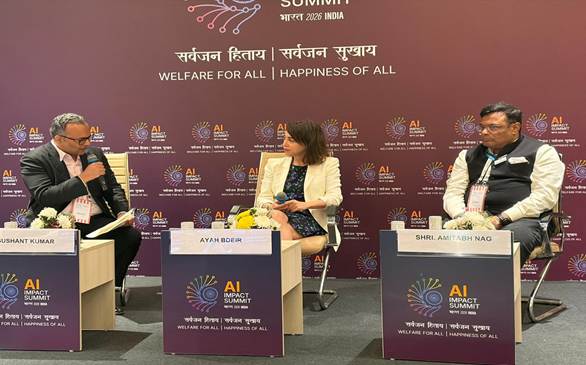
New Delhi, Delhi, 21st of February, 2026 : Demonstrating India’s commitment to building inclusive and locally relevant AI systems, a session titled “Making AI for Everyone: The Case for Personal, Local, Multilingual AI” was organised at Bharat Mandapam on 20th February.
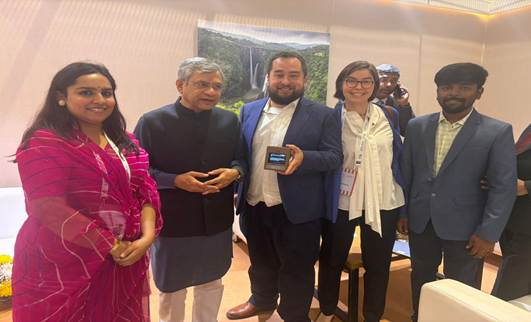
The session featured a live demonstration of a first-in-class open-source handheld multilingual AI prototype developed in collaboration with Digital India BHASHINI Division, Current AI, and Kalpa Impact. The compact, voice-first device is designed as a privacy-preserving, locally deployable system capable of functioning in low- or zero-connectivity environments. By processing multilingual interactions directly on-device, it enables real-time querying across languages without reliance on continuous internet access.
The prototype reflects India’s commitment to building AI systems that are inclusive, culturally rooted, and linguistically diverse. Designed as a public-interest assistive technology, the device demonstrates how open-source AI hardware can be secure, accessible, and scalable, particularly for rural and underserved geographies. The live demonstration highlighted practical multilingual use cases and its potential applicability across India’s diverse language ecosystem.
The prototype was also presented to the Union Minister for Electronics and Information Technology, Shri Ashwini Vaishnaw, by the BHASHINI team. The Minister appreciated the efforts toward developing inclusive, multilingual, and locally deployable AI solutions aligned with the vision of “AI for All.”
The collaboration represents a strategic global partnership model, combining India’s digital public infrastructure approach and linguistic AI stack with international open hardware innovation. As part of this initiative, a Global Innovation Challenge has been announced to encourage engineering students and early-career professionals to build upon the open-source prototype, further strengthening India’s innovation ecosystem.
The session also underscored the importance of preventing AI monoculture and ensuring that emerging AI systems preserve linguistic and cultural diversity while remaining globally interoperable.
This initiative reinforces India’s position as a leader in inclusive, multilingual, and privacy-preserving AI development, offering a scalable model for equitable and responsible AI innovation worldwide.




More Stories
Echoes of Assam : Rodali Bora’s Mission To Share Her Heritage In The UK.
INDIA – Sri Lanka Annual Bilateral Maritime Exercise (SLINEX-26).
Resolved To Elevate India To The No. 1 Position In Global Silk Production: Shri Giriraj Singh, Union Minister Of Textiles.