




New Delhi, Delhi, 24th of February, 2026 : The Indo-German Science & Technology Centre (IGSTC) organised the Strategic Conclave 2026 on “Integrated Water Resource Management” at Vigyan Bhawan, New Delhi, bringing together policymakers, scientists, conservationists and international partners to deliberate on sustainable water governance and technological cooperation.
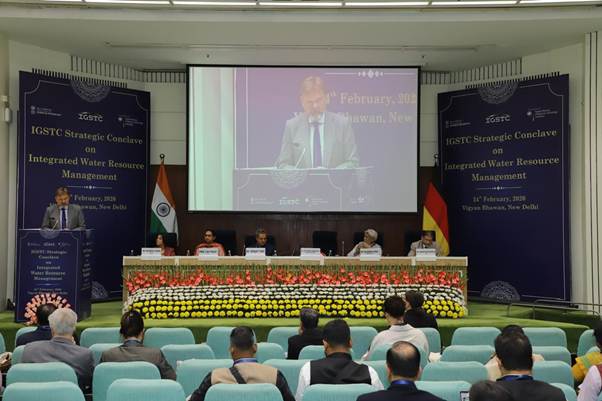
Dr. Kusumita Arora Director, IGSTC shared that this conclave is an attempt to bring key stakeholders toa common discussion forum: leaders from government sector, conservation specialists and academic researchers, as wee industry experts. Through its ‘2+2 projects’ Model, IGSTC breaks down silos by uniting academia and industry from both India and Germany. This unique collaboration ensures that research does not remain confined to journals but translates directly into industrial solutions and scalable public infrastructure.
Delivering the opening address, Renowned conservationist Dr. Rajendra Singh also known as “Waterman of India” focused on community-led water conservation models and traditional wisdom in water harvesting. He highlighted the significance of restoring rivers, reviving traditional water bodies and empowering local communities to manage water resources sustainably. Stressing that water governance must be people-centric, he underscored that long-term sustainability depends not only on engineering solutions but also on societal participation, behavioural change and grassroots ownership of water resources.
Speaking at the occasion, Dr. Vikrant Tyagi, GIZ, emphasised the urgent need for scientific and technological interventions in addressing water stress and wastewater management challenges. He underlined the importance of decentralised treatment systems, circular water economy approaches and integration of advanced treatment technologies for ensuring safe and sustainable water access. Highlighting the role of academia, he stressed that research must move beyond laboratory innovation toward scalable field-level implementation, particularly in urban and peri-urban contexts facing acute water scarcity.
Prof. Ligy Philip (IIT Madras) highlighted scientific and systems-based approaches to water sustainability. She emphasised the urgency of remediating pollution due to new emerging chemicals in water.
In his address, H.E. Dr. Philipp Ackermann, Ambassador of Germany to India, highlighted the deepening Indo-German partnership in science, sustainability and climate resilience. He noted that water management is a shared global challenge and stressed the importance of bilateral collaboration in research, innovation and policy frameworks. Emphasising Germany’s commitment to joint technology development and knowledge exchange, he reaffirmed support for strengthening Indo-German cooperation through platforms such as IGSTC, particularly in areas of climate adaptation, environmental technologies and sustainable infrastructure.
Delivering the closing remarks, Dr. Arindam Bhattacharyya, Department of Science and Technology (DST), highlighted the strategic importance of integrated water resource management in the context of climate change, rapid urbanisation and increasing industrial demand. He emphasised that water challenges are multi-sectoral and require interdisciplinary approaches combining technology, governance and community engagement. He underlined the need for translational research, pilot deployments and policy integration to ensure that technological solutions effectively address ground-level challenges.
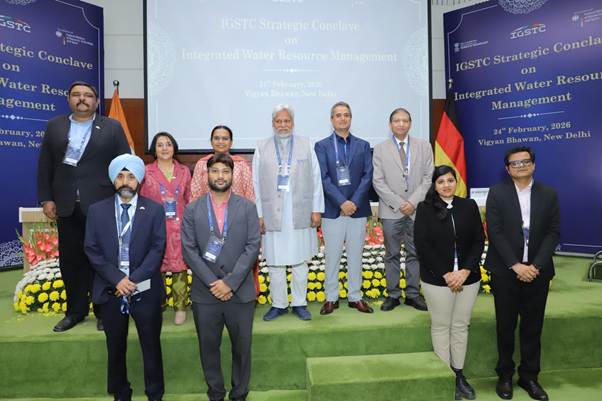
The Conclave reinforced the importance of international collaboration in advancing sustainable water technologies and resilient water governance frameworks. Through this conclave, IGSTC make it clear that it views integrated water management as a priority area under climate resilience and sustainability missions, focusing on technology development, system integration and scalable demonstration projects. Through IGSTC and other bilateral platforms, DST aims to foster joint research initiatives, promote industry-academia partnerships, and accelerate the deployment of innovative water solutions that support environmental sustainability, public health and long-term resource security. The discussions underscored that integrated approaches combining scientific excellence, community participation and international cooperation will be critical in ensuring water security for future generations.



More Stories
Over 3,000 Participate In Fortis Hospital, Bannerghatta Road’s ‘Pinkstrong’ 3K Walkathon For Breast Cancer Awareness.
19 Manipal University Jaipur Researchers Feature In Stanford–Elsevier Top 2% Scientists List; Number Of MUJ Researchers Doubles Compared To Previous Year.
Northeast India’s Rich Handloom, Handicraft And Cultural Heritage Showcased At Itanagar.