





New Delhi, Delhi, 15th of March, 2026 : Over the past eleven years, India has witnessed a remarkable expansion of its metro rail network, making it one of the largest in the world. From just a handful of operational lines in a few cities, the network has grown to cover more than twenty urban centres, crossing the milestone of 1,000 kilometres of metro network. This expansion has transformed the way people travel in cities, offering faster, cleaner, and more reliable journeys while also easing congestion on roads.
Metro rail today stands as a symbol of progress and modern living. By reducing dependence on private vehicles, it lowers household transport costs and contributes to a healthier environment. More than just a mode of travel, metro investments have become engines of growth – supporting jobs, improving access to education and healthcare and enhancing the overall well‑being of families across India’s rapidly growing cities.
Metro Rail Expansion in India: Scale and Coverage
India’s metro journey is defined not only by its scale, but also by the transformative technologies and innovations that are reshaping urban mobility. From high‑speed regional trains and underwater tunnels to eco‑friendly water metros, the country has pioneered solutions that blend safety, sustainability and modern engineering. With world‑class signalling, smart ticketing, driverless operations and energy‑efficient practices, these systems are setting new benchmarks for faster, greener and safer transport.

- India’s Expanding Metro Footprint: From a limited presence in a few cities, metro has now expanded into a nationwide network which is among the largest in the world.
- Widespread Coverage: Metro services today operate in major cities such as Delhi & NCR, Mumbai, Bengaluru, Kolkata, Hyderabad, Chennai, Lucknow, Pune, Ahmedabad and many others.
- Operational Scale: About 1,095 km of metro rail lines (including 55 km of the Delhi–Meerut RRTS) are now functional across 26 cities.
- Global Standing: India has become the third-largest operational metro network in the world reflecting its commitment to modern urban transport.
- Growth since 2014: The operational metro/RRTS network has expanded from 248 km in 2014 to 1,095 km in 2025.
- Government push: Since 2014, 38 metro rail projects covering 1,051 km have been sanctioned with an estimated cost of ₹3.44 lakh crore.
- City expansion: Metro services have grown from just 5 cities in 2014 to 26 cities in 2025, bringing world-class mobility closer to citizens across India.
- Landmark achievements & innovations: India’s metro journey has not only been about expansion but also about pioneering innovations in urban transport. In recent years, the country has achieved several firsts that showcase its technological strength and commitment to sustainable and eco‑friendly mobility.
- Namo Bharat Train
- India’s first state‑of‑the‑art semi high‑speed Namo Bharat regional train was operationalised in October 2023.
- It operates at a speed of 160 km/h with a design speed of 180 km/h.
- The train has been deployed on the Delhi–Meerut corridor, marking a new era in fast and modern regional connectivity.
- Underwater Metro
- In 2024, India achieved a historic milestone with the launch of its first underwater metro tunnel in Kolkata, connecting Esplanade to Howrah Maidan beneath the Hooghly River.
- This engineering marvel stands as a proud symbol of India’s advancing technological capabilities and infrastructural strength.
- Water Metro
- In April 2023, Kochi, Kerala became the first city in India to introduce a Water Metro.
- The system connects 10 islands using electric‑hybrid boats, offering seamless, eco‑friendly transport and setting a benchmark for sustainable urban mobility.
- Smart Solutions for Safer, Greener and Faster Metros: India’s metro and Namo Bharat Regional Rapid Transit System (RRTS) projects have witnessed remarkable progress, bringing in world‑class technologies that strengthen safety, boost efficiency and advance sustainability.
- European Train Control System (ETCS): For the first time in the world, Namo Bharat trains on the Delhi–Meerut RRTS corridor are using a Hybrid level-III radio‑based signalling system on Long Term Evolution (LTE) backbone. This advanced technology makes train operations smarter and safer giving passengers a new level of security and confidence in their journey.
- Platform Screen Doors (PSD): Developed jointly by BEL and NCRTC to improve safety and reduce accidents, Platform Screen Doors (PSDs) keep platforms safe by opening only when trains stop correctly, preventing accidents and trespassing.
- National Common Mobility Card (NCMC): “One Nation–One Card” functional in 11 metro projects and 11 bus corporations, enabling seamless travel; included in PM‑eBus Sewa guidelines.
- QR Ticketing: Mobile app‑based QR system for easy digital ticket booking.
- Unmanned Train Operations (UTO): Driverless trains running on Delhi Metro’s Pink and Magenta Lines, improving efficiency.
- Indigenous ATS (i‑ATS): India’s first locally developed Automatic Train Supervision system, implemented on Delhi Metro’s Red Line by DMRC and BEL.
- Energy Efficiency: Metros use regenerative braking and install solar panels, saving power and reducing carbon emissions for sustainable operations.
Infrastructure Spending and Integration with National Plans
India’s infrastructure investment has risen sharply with the Union Budget 2024‑25 allocating a record ₹11.21 lakh crore for capital expenditure equivalent to 3.1% of GDP. Aligned with this investment push, the annual metro budget for 2025‑26 stands at ₹29,550 crore in comparison to the ₹5,798 crore allocated in 2013‑14, demonstrating how enhanced spending is driving the rapid expansion of metro networks nationwide.
Metro projects are being embedded within the PM GatiShakti National Master Plan to ensure seamless integration with metro projects, while the Network Planning Group (NPG) also regularly reviews metro rail and aviation projects together reinforcing their role in integrated transport planning.
- The National Infrastructure Pipeline (NIP) has prioritized metro corridors as critical urban assets, aligning them with India’s long-term growth vision.
- India now has the world’s third-largest metro network reflecting how sustained infrastructure investment is strengthening urban mobility and ease of living.
PMEAC Findings on Metro Rail’s Impact on Urban Households
Recently, in January 2026, the study titled Golden Decade of Infrastructure Development in India with Special Reference to Metro Rail Network was prepared by Economic Advisory Council to the Prime Minister (EAC‑PM). It highlights how India’s rapid infrastructure expansion supported by the PM GatiShakti plan is strengthening India’s metro rail systems and positioning them among the world’s leading networks. Drawing on official data and comparative analysis across cities, the study underscores the wider economic and social benefits of metro development, from financial stability to sustainable urban growth.
- Key Outcomes: The study shows that India’s infrastructure expansion, especially metro rail, is delivering benefits beyond mobility by reshaping household finances and reducing reliance on private vehicles. Rising capital investment and sustainable transit systems are strengthening economic resilience, positioning metro rail as a cornerstone of national development.
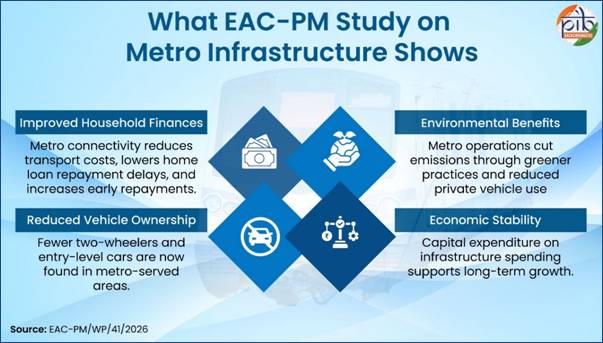
- Improved household financial discipline: Metro connectivity reduces transport costs, which lowers loan repayment delays and increases early repayment of home loans.
- City‑specific impacts:
- In Hyderabad, missed payments on home loans have fallen by 1.7%, while early repayments have risen by 1.8%.
- In Bengaluru, loan repayment delays decline by 2.4%, whereas early home loan repayments rise by 3.5%.
- In Delhi, missed payments drop by 4.42%, with early repayments of mortgages up by 1.38%.
- Reduced reliance on private vehicles: Vehicle registration data shows fewer new two‑wheelers and entry‑level cars in metro‑served areas, confirming a shift away from costly private transport.
- Lower household indebtedness: With reduced recurring transport expenses, households carry lighter debt burdens and manage liquidity more effectively.
- Contribution to financial stability: Improved repayment behaviour and fewer defaults strengthen the overall financial system.
- Broader infrastructure gains: Rising capital expenditure on infrastructure creates strong growth multipliers, supports productivity, enhances sustainability, and boosts long‑term economic competitiveness.
- Environmental sustainability: Adoption of regenerative braking, solar panels and green metro stations reduces emissions and supports India’s climate goals.
- Study Insight: The study reflects that India’s decade of infrastructure expansion, especially metro rail growth, is not only transforming urban mobility but also strengthening household finances and reducing debt stress. By lowering transport costs, metros are improving loan repayment behaviour and supporting financial stability. Rising capital expenditure and sustainable practices further position infrastructure as a key driver of long‑term economic growth and resilience.
India’s metro expansion over the past decade reflects a strong commitment to modern, inclusive urban development. The EAC-PM study confirms that metro infrastructure not only improves mobility but also strengthens household finances and supports long-term economic stability. With rising capital investment and integrated planning, metro systems are becoming key drivers of sustainable growth. This progress marks a significant step toward a more connected and resilient India.




More Stories
New Batch Of Nursing Students Begins Journey Towards Excellence In Healthcare At East Point Nursing Institutions.
Suraksha Invites Expressions Of Interest For ‘Adion’, A 5 Lakh Sq. Ft. Invitation-Only Private Members’ Club At Wish Town, Noida.
Unleashing The Potential Of Youth Through Wakf : Mohammed Naif Ali, Trustee, Anowaruddin Wakf Estate.