





New Delhi, Delhi, 18th of August, 2026 : There is a phrase the British left behind, almost as an afterthought, when they packed up and sailed home in 1947: the “steel frame.” That is what they called the Indian Civil Service, the administrative skeleton on which the Raj hung its authority. Steel does not bend easily, and that was the point. It was built to hold an empire steady, not to listen to the people it governed. For decades after Independence, we inherited that frame, gave it a new name, dressed it in khadi, and told ourselves it was now our own. But a frame built to control is not automatically a frame built to serve. And for the first many decades of our republic, India kept living inside the architecture of its coloniser, filing the same forms in triplicate, standing in the same queues before the same raised platforms, waiting for a “saheb” to decide its fate.
I have spent much of my own working life inside this frame, first as a citizen and as a professional, then as someone entrusted with the charge of Personnel, Public Grievances and Pensions in Govt of India, the department whose very job is to examine the steel and ask what needs to be reforged. So when I am asked whether India has reformed its bureaucracy, my answer is neither the defensiveness of someone protecting an institution, nor the cynicism of someone who has given up on it. It is the answer of someone who has watched, quite literally from the inside, twelve years of quiet but determined re-engineering of a system that had not been meaningfully touched since independence, and may have remained untouched even now if Sh Narendra Modi, known for his path-breaking thinking, had not taken over as the 15th Prime Minister of India.
Consider where we began. In 2014, a citizen’s grievance to the central government took, on average, 157 days to be resolved, if it was resolved at all. Filing it meant navigating a system with barely ten thousand grievance officers spread across the country, most of them unreachable, all of them unaccountable to any real deadline. A young man queuing outside a government office for a job, a widow chasing her husband’s pension file, a farmer wanting to know why his crop insurance claim had vanished into some ministry’s cupboard, all of them met the same wall: a system designed to make citizens wait, and officials who could shrug without consequence. This was not merely inefficiency. It was the last living relic of an administration built to be feared rather than accessed.
The comparison with today is not a matter of opinion; it is written into the numbers. That 157-day grievance disposal time has fallen to 15 days. The number of grievances the system handles has grown nearly ninefold, from about 3 lakh a year to nearly 27 lakh, and the number of officers empowered to redress them has grown more than tenfold, to over a lakh. In March this year alone, the Central Secretariat crossed the one-lakh-grievances-redressed mark for the forty-fifth month running. We built CPGRAMS, the Centralised Public Grievances Redress and Monitoring System, into a platform that now speaks in twenty-two languages, reads a citizen’s complaint using artificial intelligence to route it to the right desk, and even lets a farmer in a remote hamlet lodge a complaint by voice, in his own tongue, through a chatbot we named, quite deliberately, Samadhan Didi, “the sister who brings solutions.” A villager who once needed to travel to a district office and hope for the best can now do this from a Common Service Centre in his own panchayat, and the twentieth of every month is set aside as a CSC-CPGRAMS day precisely so that this promise reaches the last mile.
But the deeper change, the one I consider the true reform of the steel frame, is not digital plumbing. It is a change in the philosophy of how we build our civil servants in the first place. For seventy years, the government ran on what could be called a “rule-based” culture: an official was judged by whether he had followed the correct procedure, not by whether he had solved the citizen’s problem. In 2020, we launched Mission Karmayogi, the National Programme for Civil Services Capacity Building, precisely to shift this to a “role-based” culture, where an officer is trained and evaluated according to what her job actually demands of her, not according to which colonial-era rulebook she can quote. Today, over 1.65 crore government employees, from a village-level clerk to a Secretary to the Government of India, learn on a common digital platform called iGOT Karmayogi, which now carries more than five thousand courses in Hindi and seventeen other Indian languages. For the first time, we have formally linked this learning to an officer’s Annual Performance Appraisal Report, the yearly assessment on which promotions ride, so that continuous learning is no longer a virtue one practises out of goodness but a metric tied directly to one’s career. This is performance accountability, not as a slogan but as a mechanism.
We have also worked, quietly but persistently, to strip the colonial residue out of how officers are recruited and trained. Since 2016, interviews for lower and middle-rung government jobs, Group C and non-gazetted Group B posts, the very positions where an interview traditionally meant favouritism and, too often, a bribe, have been abolished across central government offices, and twenty-four states and eight Union Territories have followed suit. We did away with the old requirement that a candidate be countersigned and vouched for by a Gazetted Officer before being trusted to fill a government form, a colonial-era practice that presumed every citizen guilty of forgery until proven otherwise. We let successful candidates join their new jobs provisionally while police verification catches up, rather than making them wait months for a bureaucratic formality. We have repealed over sixteen hundred obsolete laws that had outlived every purpose except reminding us who once ruled us. And when I meet young officers today, I tell them plainly what I told a room of them earlier this year: that the biggest reform still needed is in the mind, in shedding what I called, without hesitation, our “colonial mentality.” When the Prime Minister moved our ministry itself out of North Block, a building whose very stones were laid to administer an empire, into the new Kartavya Bhawan, it was not merely a change of address. It was a statement that duty, kartavya, and not control, should be the working word of the Indian state.
There is a quieter reform running alongside all of this, aimed not at the citizen outside the office but at the women who keep the office running from within. For most of independent India’s history, a woman in government service who lost a child at birth had no formal leave to grieve; today she is entitled to sixty days of Special Maternity Leave, an entitlement we extended in 2022 with what I can only call an overdue sense of compassion, and which we have since opened to mothers who build their families through surrogacy as well. We let Child Care Leave travel with a mother wherever her posting takes her, allow her to use it even for foreign travel, and give a single mother up to six spells of it in a calendar year rather than the rigid three permitted to others. A woman who finds the courage to report sexual harassment at her workplace is now entitled to ninety days of leave while the inquiry into her complaint runs its course, leave that is not deducted from her own account. Women officers living with disability receive a monthly allowance to help raise a newborn, and the education allowance for a differently-abled child of any government employee has been doubled. None of this will appear in a GDP chart, but it appears in whether a woman chooses to stay in government service through the years that once quietly pushed her out of it, and in whether the civil service can honestly say that gender equity is something it practises, not merely something it observes once a year on a banner.
None of this matters, of course, unless it changes something in the life of an ordinary citizen, and it does. It is there in the more than twelve lakh appointment letters handed out through Rozgar Melas in the last few years, delivered without the old currency of contacts and influence. It is there in a Common Foundation Course at Mussoorie where an IAS officer and an IPS officer train side by side instead of guarding their separate silos, so that when they meet a citizen years later, they act as one government rather than three competing departments. It is there in a pensioner who can now generate a Digital Life Certificate from her home instead of standing in a bank queue, in a young aspirant who registers once on a UPSC portal instead of filling the same form for every examination, in the OBC representation in government service that has risen from nineteen to twenty-seven per cent since 2014. The steel frame the British left us was never going to be dismantled overnight, nor should it be; institutions carry memory, and memory has its uses. What we have tried to do, these twelve years, is reforge it, quietly, service by service, rule by rule, so that the frame that once held up an empire now holds up something closer to what our Constitution actually promised its people: a government that serves rather than rules, and answers rather than merely presides.
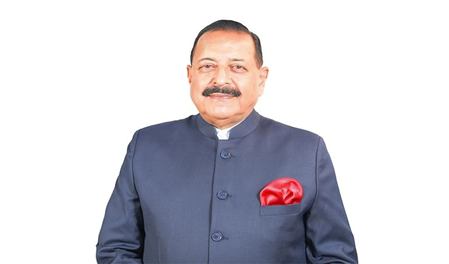
(The author is Union Minister of State (Independent Charge) for Science & Technology, Earth Sciences, and MoS, Prime Minister’s Office, Personnel, Atomic Energy & Space, Government of India)


More Stories
World Sight Day: ‘Walk In My Boots’ At IIM Nagpur Brings Students Together For A Memorable Exchange Of Roles.
India Could Be Among First Countries To Roll Out 6G : Jio.
National Medical Library Organises 5th ERMED Consortium National Training-Cum-Conference On “Digital Health Resources: Redefining Access Through Libraries.