





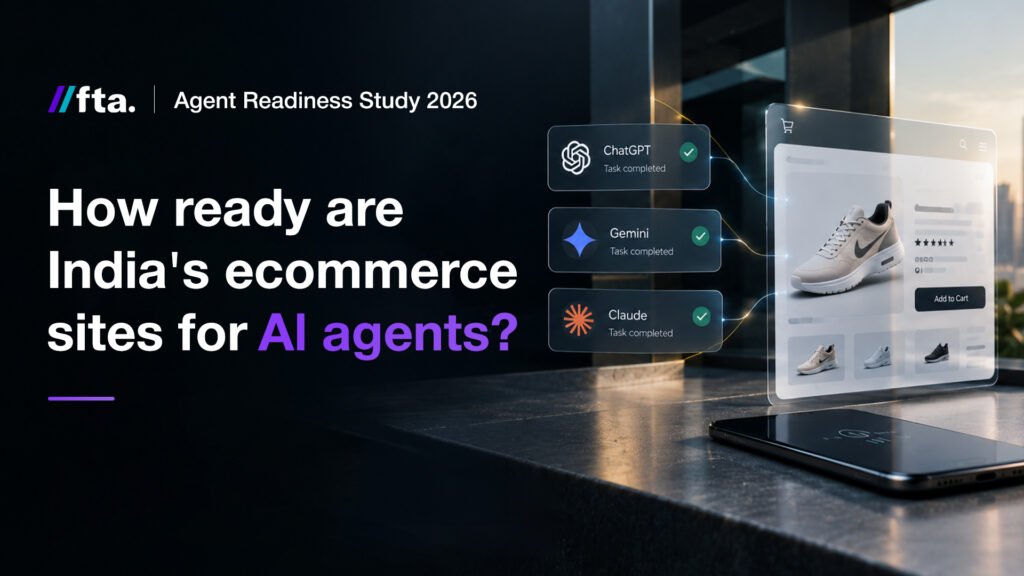
New Delhi, Delhi, 6th of October, 2026 : FTA Global, a new-age marketing operating system company, today released its FTA Agent Readiness Study 2026, examining how prepared India’s ecommerce ecosystem is for the growing role of AI agents in product discovery, comparison and purchase journeys.
The study found that AI agents successfully completed 358 of 450 shopping tasks, or 80%, across 50 Indian ecommerce websites. Return-window queries recorded the highest completion rate at 91%, followed by delivery charges at 74% and product-and-price discovery at 73%.
The five highest-scoring sites in the study were boAt (95/100), Flipkart (92/100), Mamaearth (92/100), Moglix (92/100) and Truemeds (91/100), spanning electronics, marketplaces, beauty, B2B ecommerce and pharmacy. The leading sites generally allowed agents to access their content, exposed key information through server-side HTML and used structured product data containing information such as price and stock.
Key findings
· Unclear information was a bigger barrier than blocking: Of the 92 tasks that agents could not complete, 26 failed because the answer was not clearly stated on the website, while 13 failed because content required JavaScript. Only 11 failed because of blocking or site errors.
· Generic bot blocks did not necessarily stop major AI agents: While 21 of the 50 websites blocked or failed FTA Global’s generic cloud crawler, real AI agents completed 77% of tasks on sites that fully blocked the crawler, compared with 82% on sites that remained open.
· Return and delivery information is largely missing from structured data: Only 3 of 24 product pages included return policy information in their schema, while just 2 included delivery details. This can leave AI agents searching through policy pages and interpreting information that may be unclear or inconsistent.
· AI agents do not always agree when policies are complicated: All three agents returned the same return-window answer on 29 of the 50 sites. On 13 sites, they provided different answers, generally because the website had multiple rules or contradictory information.
· The average FTA Agent Readiness Score was 43 out of 100: Of the 42 sites that could be fully scored, 12 scored 80 or above, while 18 scored below 20. The study assessed websites across Reach, Read, Understand and Act, while the Trust pillar was excluded because it requires human review.
Commenting on the findings, Senthil Kumar Hariram, Founder and Managing Director, FTA Global, said, “AI agents are changing what it means for an ecommerce website to be discoverable. It is no longer enough for a product page to work for a human who can interpret a layout or understand a complicated return policy. An AI agent needs the information to be accessible, explicit and consistent. Our study shows that some of the biggest barriers are basic questions such as what is the price, what does delivery cost, and what is the return window. As AI agents become part of the buying journey, brands will need to design their digital experiences for both humans and machines.”
The findings point to a broader shift in ecommerce as AI agents increasingly become part of the customer journey. Traditional search visibility has largely focused on whether a page can be crawled, indexed and ranked. AI-driven discovery introduces another layer: whether an agent can find, understand and act on the information presented by a website.
FTA Global’s study evaluates this through four core dimensions: Reach, Read, Understand and Act, examining whether AI systems can access a website, read its important information, understand product and policy details, and interact with the site to complete actions.
What ecommerce brands need to address
Based on the findings, FTA Global recommends that ecommerce businesses prioritise clarity and accessibility of essential shopping information. This includes making delivery charges and return windows explicit, ensuring product names, prices, stock and variants are available without requiring JavaScript execution, keeping robots.txt rules accessible to shopping and AI search agents, and reviewing firewall and CDN configurations.
The FTA Agent Readiness Study 2026 was conducted in two parts. FTA Global crawled 50 Indian ecommerce websites on September 26, 2026, examining their accessibility, server-side content, structured data, interactive elements and emerging AI standards. On September 27, 2026, Claude, GPT and Gemini were each given the same three shopping tasks across all 50 sites, resulting in 450 real-agent tasks.
The 50 sites represent a selection of leading Indian ecommerce businesses across categories and are not a ranking of the top 50 ecommerce companies by revenue.
To access the complete “FTA Agent Readiness Study 2026”, visit:
About FTA Global (https://www.ftaglobal.in/):
FTA Global is a Search Engineering company that helps brands become visible across search engines, AI assistants and modern discovery systems, where decisions increasingly happen before the click. Its integrated model combines Search Engineering for organic and AI visibility, Demand Labs for enterprise B2B growth, Performance Labs for B2C acquisition, FTA Prime for startup marketing, and Creative Labs for storytelling.
At its core is a proprietary, patent-pending visibility platform built on ICP-based persona modelling that tracks how brands appear across AI environments. FTA Global works with enterprises worldwide and has more than 80 professionals across Mumbai, Bengaluru and Gurugram. Its advisory board spans retail, ecommerce, BFSI, life sciences, healthcare, education, aviation and technology, along with professors from George Washington University in the USA.



More Stories
Think Dal Means Just Toor And Masoor? 5 Pulses That Deserve A Place In Your Kitchen.
Tech Mahindra Expands Agentic AI Readiness With Google Cloud Gemini Enterprise.
Indian Singer, Songwriter And Music Composer Vishal Dadlani Sells Commercial Unit In Mumbai For Rs. 3.34 Crore : Square Yards.