




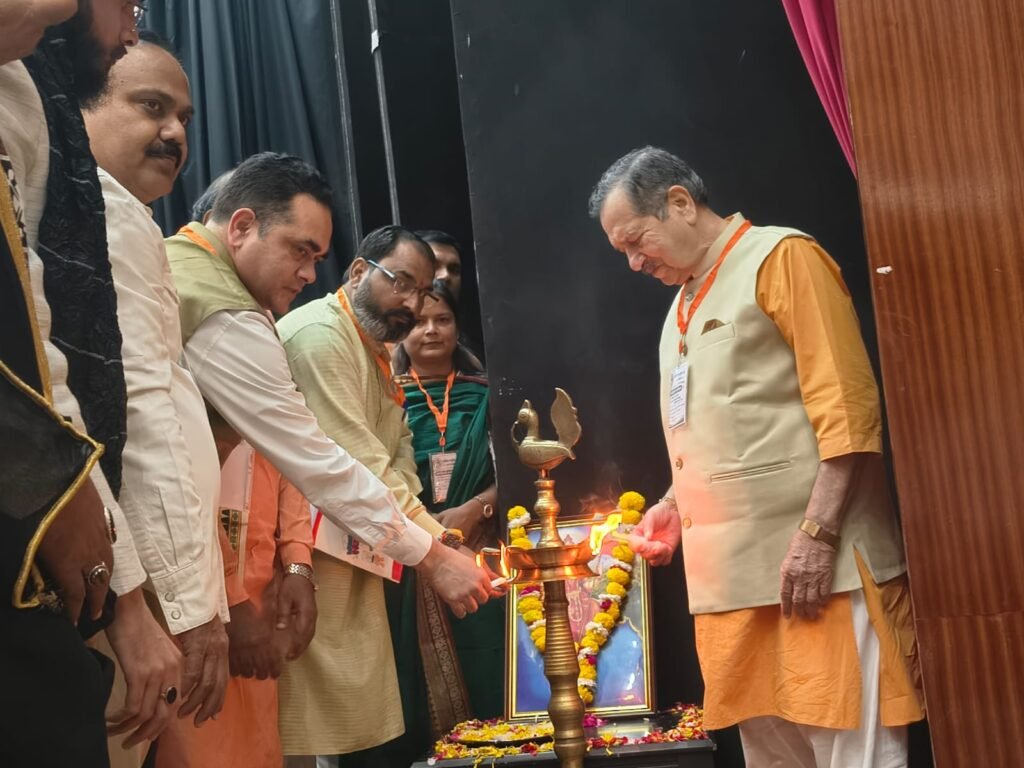
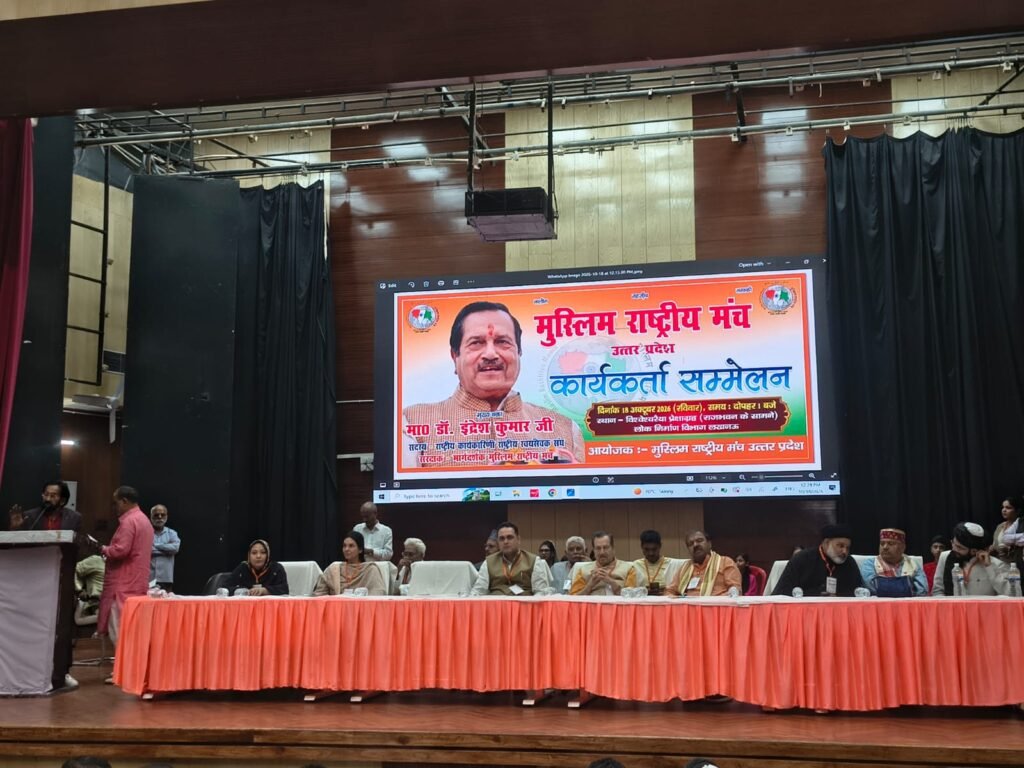
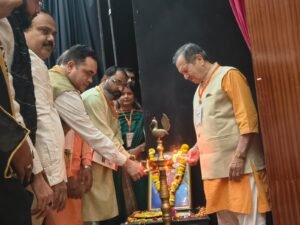
Lucknow, 18th of October, 2026 : The Uttar Pradesh unit of the Muslim Rashtriya Manch (MRM) organised a state-level workers’ conference at Vishveshvaraiya Auditorium in Lucknow on Sunday, highlighting the importance of national unity, communal harmony, education, women’s empowerment, family values and nation-building. The conference brought together MRM workers, religious scholars, community leaders, social representatives and women participants from different parts of Uttar Pradesh.
Addressing the gathering as the keynote speaker, Dr. Indresh Kumar, Member of the National Executive of the Rashtriya Swayamsevak Sangh (RSS) and Patron and Guide of the Muslim Rashtriya Manch, said that India’s true strength lies in its diversity, rich cultural heritage, mutual trust and spirit of brotherhood. He emphasised that promoting love, dialogue and humanity over hatred, violence and extremism is essential for building a peaceful and harmonious society.
He said, “A worker of the Muslim Rashtriya Manch should speak with kindness, carry radiance on their face and nurture a genuine desire to help others.”
Delivering a message of peace and compassion from Lucknow, he declared, “A message has emerged from Lucknow—love, love and love.” He expressed the hope that this message of goodwill and brotherhood would resonate beyond India’s borders, reaching Lahore and Dhaka.
Choose Peace Over War and Reconciliation Over Divorce: Dr. Indresh Kumar
Expressing concern over ongoing international conflicts, Dr. Indresh Kumar said that war and violence can never provide lasting solutions to disputes. Calling for peaceful dialogue and mutual understanding among nations, he stated, “We are neither Americans of America, nor Iranians of Iran, nor Israelis of Israel. We are Indians of India.”
He urged countries to prioritise diplomacy, peace and dialogue rather than confrontation and violence.
Highlighting the importance of family unity and respect for women, he reiterated the Manch’s message, “Not divorce, but reconciliation; not divorce, but love.”
He stressed that family disputes should be addressed through mutual respect, understanding and constructive dialogue. He also called for building families and communities free from substance abuse and domestic violence, where love, responsibility and mutual dignity form the foundation of relationships.
‘Taleem, Tehzeeb and Taraqqi’ Are Essential for an Empowered Society and a Developed India: Prof. Dr. Shahid Akhtar
Prof. Dr. Shahid Akhtar, Officiating Chairman of the National Commission for Minority Educational Institutions (NCMEI) and National Convenor of the Muslim Rashtriya Manch, emphasised the importance of education, social harmony and nation-building.
He highlighted ‘Taleem, Tehzeeb and Taraqqi’ (Education, Culture and Progress) as three essential pillars for the advancement of the Muslim community. He observed that education should not be viewed merely as a means of obtaining degrees or securing employment, but as a foundation for developing responsible citizens, strengthening moral values and building a progressive nation.
He said, “The path to the genuine progress of the Muslim community lies through Taleem, Tehzeeb and Taraqqi. Education equips us with knowledge and skills; culture and values teach us humanity, courtesy, good character and respect for others; while progress enables us to become self-reliant and contribute to the prosperity of society and the nation. We must ensure that our children receive modern education in science, technology, medicine, research and employment-oriented disciplines alongside religious education. Girls’ education and skill development among young people must also remain our foremost priorities.”
Referring to the first Quranic revelation, ‘Iqra’, meaning ‘Read’, Prof. Dr. Akhtar underscored the importance Islam places on knowledge and learning.
He also drew attention to the expression ‘Rabbul Aalameen’ (Lord of All Worlds) in Surah Al-Fatiha of the Holy Quran and the ancient Indian philosophical principle ‘Sarve Bhavantu Sukhinah, Sarve Santu Niramayah’ (May All Be Happy, May All Be Free from Illness).
He explained that both teachings reflect the universal values of compassion, dignity, mutual respect and the well-being of humanity.
He further stated, “Our religious faith and national identity are not contradictory. Being a good Muslim and being a responsible Indian citizen are complementary responsibilities. We must promote love, dialogue and brotherhood instead of hatred and extremism. The Muslim Rashtriya Manch is committed to connecting communities with education, social reform and nation-building. Our collective resolve should be to bring education to every household, cultural values to every heart and progress to every family. Only when society becomes educated, responsible and self-reliant can the dream of a harmonious, empowered and developed India be realised.”
‘Even If We Eat Half a Meal, We Must Educate Our Children’: Focus on Education and Patriotism
Girish Juyal, Organisational Convenor of the Muslim Rashtriya Manch, highlighted the organisation’s nearly 25-year journey of promoting education, ethical values, social harmony and patriotism.
Reiterating the Manch’s message, “Aadhi Roti Khayenge, Bachchon Ko Padhayenge” (Even If We Have to Eat Half a Meal, We Will Educate Our Children), he stressed that every child deserves access to education.
He said that individuals should remain committed to their respective religious beliefs while striving to become honest, responsible and compassionate Indian citizens.
Maulana Syed Kaukab Mujtaba, an Islamic scholar, said that nationalism represents love for one’s homeland and a sense of responsibility towards the nation. He emphasised that Islam promotes peace, humanity and social harmony and encourages citizens to contribute positively to the unity and development of their country.
Qari Abrar Jamal, National President of Jamiat Himayatul Islam, said that the Muslim Rashtriya Manch has provided a common platform for Muslims belonging to different schools of thought and ideological backgrounds.
He emphasised that the fundamental teachings of Islam are rooted in peace, compassion, love and humanity, and cautioned against attitudes that promote extremism, hatred or social division.
Women’s Empowerment and Interfaith Harmony Essential for Nation-Building: Dr. Shalini Ali
Dr. Shalini Ali, National Convenor of the Muslim Rashtriya Manch, described women as a powerful force for social transformation and nation-building.
Referring to Lucknow’s celebrated Ganga-Jamuni Tehzeeb, she said that the city’s shared cultural heritage symbolises mutual respect, peaceful coexistence and communal harmony.
She encouraged women to play an active role in spreading education, awareness, social unity and the values of brotherhood within their families and communities.
Expressing pride in her national identity, she recited:
“I have built my home on this earth, yet I live in paradise; I proudly proclaim that I am an Indian Muslim.”
Syed Raza Hussain Rizvi emphasised religious freedom, peaceful coexistence and the transformative power of education. Referring to the Quranic message ‘Iqra’, meaning ‘Read’, he said that the pursuit of knowledge is fundamental to individual development and social progress.
He called for strengthening mutual respect, understanding and harmony among communities.
Humanity and Service to the Nation Define the Muslim Rashtriya Manch: Mohammad Afzal
Mohammad Afzal, National Convenor of the Muslim Rashtriya Manch, said that the organisation aims to develop responsible, socially conscious and dedicated workers capable of becoming agents of positive change.
He stated, “The Muslim Rashtriya Manch is not a political party, nor does it have an election symbol. Our greatest identity is humanity, and our foremost objective is to bring people together.”
He urged MRM workers to move forward with renewed energy, commitment and determination to promote education, social harmony and nation-building.
Conference Concludes with a Renewed Commitment to ‘Be Virtuous, Be United’
The conference concluded with a collective call to strengthen education, women’s empowerment, family dialogue, interfaith harmony and national unity.
Speakers emphasised that building a developed India requires not only economic growth but also stronger ethical values, social trust, educational opportunities and a shared sense of civic responsibility.
The gathering reaffirmed the Muslim Rashtriya Manch’s guiding messages:
“Nek Bano, Ek Bano” — Be Virtuous, Be United.
“Aadhi Roti Khayenge, Bachchon Ko Padhayenge” — Even If We Eat Half a Meal, We Will Educate Our Children.
“Not Hatred, but Love; Not Confrontation, but Dialogue; Not War, but Peace.”


More Stories
Natural Diamond Brand ‘ZOORI’ Launches Its First Outlet In Hyderabad.
Lokapriya Gopinath Bardoloi International Airport (LGBI Airport) Celebrates Festivities With First-Ever Forecourt Engagement – Utsav Aarambh.
NCC Expansion, Training Academy And Higher Education Integration Discussed At Guwahati Conference.