





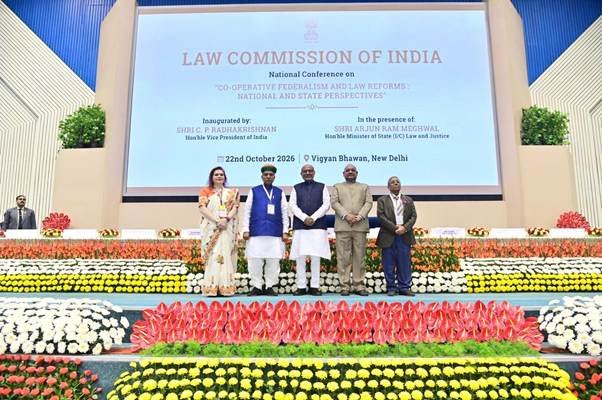
New Delhi, Delhi, 22nd of October, 2026 : The 23rd Law Commission of India today convened a National Conference on “Co-operative Federalism and Law Reforms: National and State Perspectives” at Vigyan Bhawan, New Delhi, bringing together national and State law-reform institutions, jurists, former judges, legal scholars, policymakers, law students, members of the Bar and academia to strengthen dialogue and collaboration on law reform within India’s federal framework.
Inaugurating the Conference, the Vice-President said that India’s greatest strength lies in its unity in diversity, with the Constitution providing the framework to balance the strength of the Union with the responsibilities and legitimate autonomy of the States. He emphasised that the true strength of Indian federalism lies in respecting diversity while working towards common national objectives.

Highlighting the importance of legal reforms in achieving Viksit Bharat @2047, Shri C. P. Radhakrishnan said that development must be supported by sound laws, transparent institutions, efficient administration and justice for all. Stressing that cooperative federalism in law reforms does not imply uniformity in every matter, the Vice-President said that the Union and States must work together where their constitutional responsibilities converge, while preserving the States’ legitimate space to address their specific needs. He called for stronger coordination among the Law Commission of India, State Law Commissions and State Law Departments through inter-State consultations, sharing of best practices and systematic review of outdated laws.
Addressing the gathering, Union Minister of State (Independent Charge) for Law and Justice, Shri Arjun Ram Meghwal, said that law reform must combine national constitutional objectives with the social, economic and administrative experience of the States. He identified four priorities for the way forward: continuous institutional dialogue; evidence-based and participatory law reform; technology with human oversight; and citizen-centric legal design.
Referring to Article 1 of the Constitution and Dr. B.R. Ambedkar’s exposition in the Constituent Assembly, Shri Meghwal recalled the conception of India as a Union of States. He also referred to Prime Minister Shri Narendra Modi’s emphasis on the spirit of “Team India” and said that national perspectives provide direction towards shared constitutional objectives, while States bring their social, economic and administrative experience to the reform process. He further stressed the need to bring together ease of doing business, ease of living and ease of justice, while ensuring that simplification does not compromise rights and safeguards. Summing up the way forward, he said, “Sashakt Rajya, Sashakt Bharat, Saral Kanoon, Sulabh Nyaya — Yahi Hamari Saajha Disha Ho.”
Justice (Retd.) Dinesh Maheshwari, Chairperson, Law Commission of India, called for a more structured framework of collaboration between national and State law-reform institutions, including a common law-reform docket, joint studies and post-enactment review. He proposed a “citizen friction test” to assess whether a proposed law reduces the time, cost and procedural burden on citizens, and suggested that participating Law Commissions and equivalent bodies could, within about six months, place their first joint issue papers before their respective governments for consideration.
Justice Maheshwari said, “For the citizen, justice is not divided between the Lists of the Seventh Schedule. The expectation of justice is one, and so must be our commitment to its delivery.”
Welcoming participants from across the country, Dr. Anju Rathi Rana ILS, Member Secretary, Law Commission of India, said the Commission can serve as a bridge, ensuring that valuable legal experience does not remain confined within institutional or geographical boundaries. Referring to Prime Minister Shri Narendra Modi’s emphasis on “Nagrik Devo Bhava” and more recently his description of the Jan Vishwas reforms as strengthening “a trust-based framework that empowers our citizens,” she said, “The ultimate unit of law reform is not the statute. It is the citizen.” Calling for sustained engagement between national and State law-reform institutions, she added, “The task is not to make every State think alike. It is to ensure that no State has to think alone.”

The inaugural session was followed by two technical sessions on “Reforms in Law: Needs and Methods” and “Allocated Powers, Shared Goals: Drafting the Future with Collaborative Jurisprudence”. The sessions examined approaches to responsive and evidence-based law reform, including how ideas such as Nyaya, Kartavya and Lok Kalyan may inform context-sensitive reform consistent with equality, liberty and dignity. They also considered mechanisms for greater collaboration and exchange of experience between national and State law-reform institutions, while respecting State autonomy and regional diversity.
The day-long Conference brought national and State institutions into a common conversation on making law reform more responsive and attuned to the realities of implementation across India’s diverse jurisdictions. The Conference concluded with a valedictory session.




More Stories
First Of Its Kind Initiative To Strengthen Eye Trauma Care Launched In Hyderabad.
Jai Raj Ispat Sets New Operational Benchmark With Highest Single-Day Blast Furnace Production Of 1,801 Tons.
Union Minister J.P. Nadda Inaugurates 14th India Chem 2026 In Mumbai.