





New Delhi, Delhi, 24th of March 2026 : The Council of Scientific and Industrial Research (CSIR) and Ministry of External Affairs (MEA), Government of India (GoI) jointly hosted Ambassadors and High Commissioners from countries of the Global South for a high-level “Capabilities Discovery Session” at India International Centre, New Delhi. The diplomats, representing nations from Oceania, the Gulf, West Asia and North Africa, Central America and the Caribbean, participated in the session.
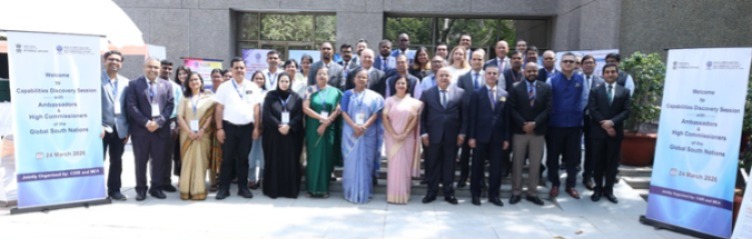
The session was jointly led by Dr Neena Malhotra, Secretary (South), Ministry of External Affairs, GoI and Dr N. Kalaiselvi, Director General, CSIR & Secretary, Department of Scientific and Industrial Research (DSIR), GoI.
The session aimed to strengthen South–South cooperation through science, technology and innovation (STI), aligned with global priorities, including sustainable development, climate action, health equity, food and water security, resilient infrastructure and inclusive technological growth. The programme was organised by the International S&T Affairs Directorate (ISTAD), CSIR.
Dr Rama Swami Bansal, Head, ISTAD, welcomed the delegation and outlined CSIR’s commitment to fostering global partnerships that translate scientific knowledge into scalable and affordable solutions.
Dr N. Kalaiselvi, Director General, CSIR and Secretary, DSIR, highlighted CSIR’s R&D ecosystem comprising 37 laboratories working across sectors such as healthcare, agriculture, environmental engineering, oceanography, infrastructure and advanced materials. She underscored CSIR’s global engagement framework based on the Connect, Collaborate, Converge and Convert approach for co-development and deployment of technologies. She emphasised that CSIR focuses on easy to adopt, relevant, affordable and globally acceptable technologies. She welcomed collaboration through joint projects, two-way mobility, technology transfer and knowledge sharing for engagements between CSIR and Global South nations.
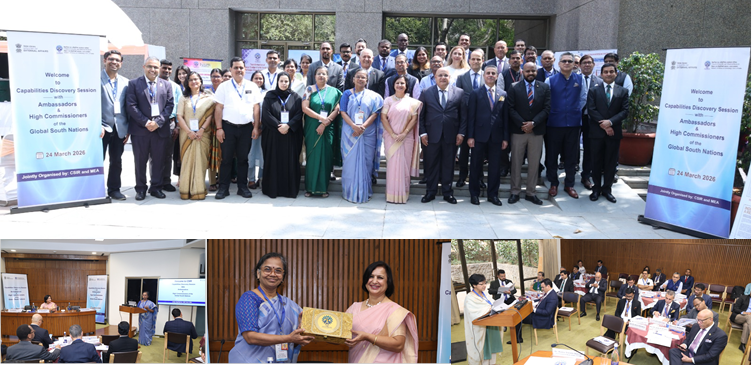
Dr Neena Malhotra, Secretary (South), Ministry of External Affairs, emphasised the role of science diplomacy in advancing shared developmental priorities across the Global South, particularly in healthcare, climate resilience and sustainable resource management. She briefed about CSIR’s role and its capabilities for strengthening S&T connect with the global south.
During thematic presentations, CSIR scientists showcased technologies addressing global challenges. Dr C. Anandharamakrishnan, Director, CSIR–NIIST presented affordable food processing and packaging solutions; Dr Ram Vishwakarma, Distinguished Scientist, CSIR highlighted pharmaceutical research and the need for global collaboration to address antimicrobial resistance; Dr Kannan Srinivasan, Outstanding Scientist, CSIR–CSMCRI presented desalination and wastewater recycling technologies; and Dr S. Venkata Mohan, Director, CSIR–NEERI spoke on biomass valorisation and circular economy approaches. Prof. Sunil Kumar Singh, Director, CSIR–NIO highlighted sustainable ocean resource utilisation and ocean–climate linkages, while Dr Chalumuri Ravi Sekhar, Director, CSIR–CRRI showcased innovations in low-carbon construction and resilient infrastructure.
In his concluding remarks, Dr. Ram Vishwakarma invited partner countries to collaborate with CSIR in strengthening STI ecosystems across the Global South and deploying technology-based solutions for societal challenges.
The programme reaffirmed CSIR’s role as a key science and technology partner for the Global South and underscored India’s leadership in leveraging STI for sustainable development.
About The Author



More Stories
Indian Railways Announces Five New Reforms Under ‘Reform Express’; Cargo, Construction, And Passenger Convenience In Focus.
Ministry Of Ayush And DBT Announce Collaborative Clinical Study On Ayurveda As Adjunct Therapy For Anti-Tuberculosis Treatment.
Raksha Mantri Reviews West Asia Situation & Its Effect On India’s Defence Preparedness.