


New Delhi, Delhi, 6th of March, 2026 : Foundations of Women Empowerment.
A nation’s economic strength is closely tied to the well-being and participation of its women and children. When girls grow up healthy, educated, and safe, they are better able to learn, work, and contribute meaningfully to society. Conversely, gaps in nutrition, healthcare, safety, and access to education limit opportunities not only for individuals but also for communities and the economy at large. Recognising this, the Government of India has prioritised a life-cycle approach to empowerment—one that begins in early childhood and continues through adolescence and adulthood.

At the centre of this approach is the Ministry of Women and Child Development, which implements a range of targeted interventions to strengthen foundational services in nutrition, care, protection, and support. Key umbrella initiatives include Saksham Anganwadi and Poshan 2.0 to improve nutritional outcomes and early childhood care, Mission Shakti to enhance women’s safety, security, and empowerment, and Mission Vatsalya to strengthen child protection systems. In addition to these are the programmes run by Ministry of Education and Ministry of Health & Family Welfare to provide for the educational and health needs of women and children. Together, these programmes aim to build enabling environments where women and children can lead healthy, informed, and secure lives—laying the groundwork for inclusive social and economic development.
Nutrition and Health as the Core Foundation
Good nutrition and strong healthcare are central to building a healthy and prosperous nation. The Government of India has prioritised maternal and child health, recognising that well-nourished citizens drive sustainable growth and social progress.
Through mission-mode, data-driven interventions, the government is tackling malnutrition among children, adolescent girls, and mothers, focusing on reducing stunting, underweight, anaemia, and low birth weight. Integrated community-based services, strengthened frontline systems, and real-time monitoring are delivering measurable improvements and building a healthier, more resilient generation.
Saksham Anganwadi and Poshan 2.0
Mission Saksham Anganwadi and Poshan 2.0 is an integrated nutrition support program to combat malnutrition among children (0-6 years), adolescent girls, pregnant women, and lactating mothers. The program delivers supplementary nutrition, early childhood care and education (ECCE), regular health check-ups, and awareness on hygiene, breastfeeding, and complementary feeding practices in an integrated manner.
The Anganwadi Centres deliver essential nutrition, besides also serving as joyful early learning spaces. They provide play-based pre-school education for children aged 3–6 to build foundational skills, social habits, and school readiness, ensuring a smoother transition to primary school and helping reduce future dropouts. Saksham Anganwadis are upgraded Anganwadis with improved infrastructure.
The Mission Poshan 2.0 component of the programme works towards malnutrition reduction and improved health, wellness and immunity. Services under this are provided through three components:

Anganwadi Services
Provides an integrated package of services to eligible beneficiaries, including Supplementary Nutrition; Pre-school non-formal education; Nutrition and Health Education; Immunisation; Health check-ups and Referral services. Of these, immunisation, health check-ups and referral services are health-related and delivered through the National Health Mission (NHM) and public health infrastructure. Poshan Vatikas or Nutri-gardens are also being developed at Anganwadi Centres across the country to provide easy and affordable access to fruits, vegetables, medicinal plants and herbs and encourage diet-diversity and consumption of wholesome local produce.
Poshan Abhiyaan
Launched on March 8, 2018, Poshan Abhiyaan is the Government of India’s flagship programme to improve nutritional outcomes for children, adolescent girls, pregnant women and lactating mothers. It aims to tackle malnutrition through a convergent, multi-sectoral approach that strengthens service delivery, promotes healthy practices, and builds an ecosystem supporting health, wellness and immunity.
Real-time monitoring is enabled through the Poshan Tracker app, which tracks beneficiary data, efficient service delivery, and Anganwadi performance.

Scheme for Adolescent Girls (SAG)
Targets girls aged 14–18 years in all districts of the Northeast and in Aspirational Districts across other states. The scheme addresses intergenerational malnutrition by improving girls’ health and nutrition. This includes both nutrition support and non-nutrition support like Iron-Folic Acid (IFA) supplementation, health check-ups, referral services, nutrition and health education, and skilling initiatives.
Poshan Bhi Padhai Bhi
Poshan Bhi Padhai Bhi is a flagship campaign of the WCD Ministry that aims to transform Anganwadi Centres into joyful early learning hubs, blending play-based education with nutrition for children aged 0–6. This is aligned with NEP 2020 recommendations on Early Childhood Care and Education. By December 2025, over 8.55 lakh Anganwadi workers and 41,645 master trainers were trained, with Aadharshila (0–3 years) and Navchetana (3–6 years) curricula rolled out nationwide in 12 regional languages—empowering little ones to grow strong, curious, and ready for school.
PM POSHAN
Nutritious school meals under PM POSHAN (formerly Mid-Day Meal Scheme)play a vital role in helping children—especially girls—stay hungry-free, attend classes regularly, concentrate better, and thrive in class. This is a centrally-sponsored scheme run by the Ministry of Education, for providing one hot cooked nutritious meal for children studying in Classes I-VIII in Government and Government-aided schools.
By easing the burden on low-income families and reducing dropout risks, this initiative fosters sustained enrolment, better learning, and healthier futures for millions of young students.

Pradhan Mantri Matru Vandana Yojana (PMMVY)
The Pradhan Mantri Matru Vandana Yojana (PMMVY), is a flagship maternity benefit scheme under Mission Shakti’s Samarthya sub-scheme. It offers cash incentives to eligible pregnant women and lactating mothers for the first living child, helping cover wage loss and promote better care. Under PMMVY 2.0, effective from April 1, 2022 under the guidelines of Mission Shakti, eligible beneficiaries receive ₹5,000 in two instalments for their first living child.
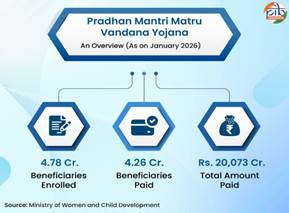
Additionally, to promote positive attitude towards the girl child, improve sex ratio at birth, and discourage female foeticide, the scheme provides ₹6,000 in a single instalment after the birth of the second living child if it is a girl.
Benefits are disbursed directly via Aadhaar-linked accounts through DBT, with provisions for fresh eligibility in cases of miscarriage/stillbirth. The scheme continues to be implemented nationwide for efficient enrolment and monitoring.
Other Health-Linked Efforts
Reproductive, Maternal, New-born, Child and Adolescent Health are an important component of India’s National Health Mission of the Ministry of Health & Family Welfare. It provides comprehensive care to women and children through five pillars of reproductive, maternal, neonatal, child, and adolescent health. Flagship schemes like Janani Suraksha Yojana and Janani Shishu Suraksha Karyakram promote safe institutional deliveries by providing cash assistance and free drugs, diagnostics, blood and diet to pregnant women and new born babies especially in low-performing states, to reduce maternal and neonatal risks. Surakshit Matritva Aashwasan (SUMAN) launched in 2019 brings together all the existing schemes for maternal and neonatal health under one umbrella to create a comprehensive and cohesive initiative that provides a service assurance.
Mission Indradhanush: A flagship immunisation drive to achieve full vaccination coverage for children and pregnant women, targeting underserved areas and boosting child survival through routine and catch-up vaccinations.
These schemes collectively contribute to significant national progress in health outcomes. Key achievements include:
- According to the Special Bulletin on Maternal Mortality in India (2019-21), published by the Sample Registration System (SRS), the country’s Maternal Mortality Ratio (MMR) has dropped by 37 points, from 130 per 100,000 live births in 2014-16 to 93 per 100,000 live births in 2019-21.
- According to the UN Inter-agency Group for Child Mortality Estimation (IGME) report released on 25th March 2025, India’s under-five mortality rate fell from 48 to 28 per 1,000 live births and neonatal mortality rate from 28 to 17 per 1,000 live births between 2015 and 2023.
These gains reflect improved access to nutrition, safe deliveries, immunisation, and community monitoring—laying a strong foundation for healthier generations.
Education and Skill for Long-Term Empowerment
Education is a powerful tool that opens doors to better opportunities, confidence, and independence, especially for girls and young women. Education plays an important role in building self-confidence among women. It also enables in building confidence to take decisions in a better way.
The government runs various schemes, programmes and initiatives for encouraging education for girls at all levels. The efforts include sustained drives aimed at encouraging gender equality, supporting health, nutrition and early childhood and adolescent learning and development for the girl child, incentivising girls’ education, providing scholarships and hostels, improving infrastructure, providing support for skilling, STEM and higher education These interventions are helping build strong foundations for lifelong growth and empowerment.
Beti Bachao Beti Padhao (BBBP)]
The Beti Bachao Beti Padhao scheme, launched by Prime Minister Narendra Modi on January 22, 2015, has evolved into a national movement for girl child empowerment, focusing on mindset change, gender equality, and multi-sectoral interventions. The scheme is implemented by the Ministry of Women and Child Development, the Ministry of Health and Family Welfare, and the Ministry of Education. It has exhibited steady progress over the years:
- Sex Ratio at Birth (SRB): Improved nationally from 918 (girls per 1,000 boys) in 2014-15 to 929 in 2024-25, according to the latest Health Management Information System (HMIS) report from the Ministry of Health & Family Welfare.
- Girls’ Gross Enrolment Ratio (GER) at the secondary level increased significantly as per the Unified District Information System for Education Plus (UDISE+) data from the Ministry of Education. This shows higher school participation and retention for girls.

Kasturba Gandhi Balika Vidyalaya (KGBV)
Kasturba Gandhi Balika Vidyalayas (KGBVs) offer safe, residential schooling to girls aged 10-18 from Socio-Economically Disadvantaged Groups (SEDGs)—such as SC, ST, OBC and others—especially in educationally backward blocks. Covering classes VI to XII, these residential schools provide a nurturing space where girls can learn, grow, and transition smoothly from elementary to higher secondary education.


The Ministry of Education under Samagra Shiksha Scheme provides Information and Communication Technology (ICT) Labs and Smart Classrooms in all KGBVs and hostels to empower girls, make them digitally savvy, and enhance their learning outcomes. Department of School Education and Literacy announced on 03.07.2024 to saturate all functional KGBVs with ICT Labs and Smart Classrooms, as per Samagra Shiksha norms. Accordingly, Rs. 28,841.96 lakhs have been allocated/UTs for establishing 3,564 ICT labs and 3,655 smart classrooms across 29 States/UTs in the FY 2024-25.
For the first time since inception 2024-25, a training program for KGBV Wardens has been designed and being delivered by DSEL in collaboration with the National Institute of Educational Planning and Administration (NIEPA). A KGBV Warden Training Handbook in English and Hindi version has been developed by NIEPA for conducting these training workshops in all official languages by the States/UTs for wardens and is also being translated.
Women in Higher Education[17]
There has been a significant increase in the female Gross Enrolment Ratio (GER) in higher education in India, reflecting improved gender parity. Recent statistics stand testament to the significant government interventions undertaken to improve access for women and girls to quality higher education.

Enrolment of Women in Ph.D. Degree
Female Ph.D. enrolment has more than doubled, with a remarkable 135.6% increase (from 2014-2015 to 2022-2023), adding 64,724 more women researchers. This highlights strong progress of women in advanced academic participation.

Scholarship Schemes for Girl Students
Scholarships and other incentives are given for education of girl students both by the central and the state governments. Some of the important central government scholarships include:
Central Sector Scheme of Scholarship for College and University Students
These scholarships are awarded by Ministry of Education, Government of India on the basis of results of Higher Secondary / Class XII Board Examination. The objective is to provide financial assistance to meritorious students from poor families for pursuing higher studies. 50% of the scholarships are earmarked for girls.
National Scholarship for Post Graduate Studies.
Launched in 2023-24, this Central Sector Scheme merges four earlier PG scholarships and offers 10,000 annual slots (30% reserved for women—3,000 selected), equally split between STEM and Humanities. Selected scholars receive ₹1,50,000 per year. Supporting this push, female postgraduate enrolment grew 61.3% from 19.86 lakh in 2014-15 to 32.03 lakh in 2022-23 (AISHE data), adding over 12 lakh more women in higher education.
AICTE PRAGATI Scholarship Scheme
Since 2014–15, the AICTE PRAGATI Scholarship has empowered meritorious girl students in technical education, awarding 10,000 scholarships yearly (5,000 each for Diploma and Degree courses) across 23 States/UTs and extending to the Northeast and J&K. In 2024–25, it reached 35,998 female students—providing crucial financial support so talented girls can focus on their studies and build rewarding careers without worry.
Supporting Women for STEM Education
Vigyan Jyoti Scheme
Run by the Department of Science & Technology (DST), Vigyan Jyoti inspires bright girls from classes IX–XII—particularly in rural areas—to chase dreams in STEM fields. It aims to address the underrepresentation of women in different fields of Science, Technology, Engineering and Mathematics (STEM) in the country. Through personalised counselling, lab visits, hands-on workshops, interactions with women role models, science camps, and extra academic support, the scheme builds confidence and opens pathways to STEM careers. Since its launch, it has touched the lives of more than 80,000 meritorious girls across 300 districts in 35 States and Union Territories, helping narrow the gender gap and show girls they belong in STEM.
Supernumerary seats for women
To encourage more women in STEM, supernumerary seats were introduced for girls in IITs and NITs, boosting female participation from under 10% to over 20%. This approach has inspired greater gender diversity in engineering and technical education across institutions nationwide. Programs like IIT Madras’s Vidya Shakti Scheme help rural and female students thrive in STEM. These efforts reflect steady strides toward inclusive, equitable higher education for girls and women.
Nurturing Aspirations through Vocational Training for Young Adolescent Girls (NAVYA)
Launched on June 24, 2025, NAVYA is a collaborative initiative by the Ministry of Women and Child Development (MWCD) and the Ministry of Skill Development and Entrepreneurship (MSDE). It seeks to impart skill training to adolescent girls aged 16–18 years with at least a Class 10 qualification under Pradhan Mantri Kaushal Vikas Yojana 4.0 (PMKVY 4.0). The programme equips these girls with practical vocational skills in emerging, non-traditional fields like digital marketing, cybersecurity, AI-enabled services, and green jobs—along with life skills, financial literacy, and digital competence. It was launched in 27 Aspirational and North-Eastern districts across 19 states, and aims to train 3,850 girls. The pilot phase will cover 9 states and 9 districts. As of December 2025, the scheme has enrolled 1,295 girls, with 671 of them already trained.
Safety and Security: Protecting Lives and Dignity
Safety and security form the bedrock of true empowerment. When women and children can live, work, and grow without fear of violence or harm, they are free to pursue their education, careers, and personal goals. The Government of India addresses this through targeted schemes that provide immediate support, emergency help, long-term protection, and community-level change. These efforts focus on prevention, response, and rehabilitation to reduce gender-based violence and ensure dignity for all.
Mission Shakti: The Umbrella Framework for Women’s Safety and Empowerment
Mission Shakti is the central umbrella scheme led by the Ministry of Women and Child Development. It integrates safety, security, and empowerment for women and girls under two clear sub-schemes:
- Sambal — focused on safety and security
- Samarthya — focused on economic and social empowerment

Sambal
The Sambal sub-scheme delivers practical, on-ground protection mechanisms to help women escape and recover from violence.
Some of the key components under Sambal include:
- One Stop Centres (OSCs)
Also known as Sakhi Centres (Friend Centres), these provide integrated, immediate support under one roof for women and girls affected by any form of violence (domestic, sexual, acid attacks, trafficking, etc.). Services include emergency medical aid, legal counselling, police assistance, psycho-social support, and temporary shelter referrals.
- Women Helpline (181)
A 24×7 toll-free emergency response service that offers counselling, information, and immediate referral to police, medical, or legal help. It acts as the first point of contact in crisis situations. The helpline handles thousands of calls monthly, providing quick support and linking women to nearby services like OSCs, shelters and legal support.
- Nari Adalat
Nari Adalats are community-based informal courts that resolve disputes related to domestic violence and harassment through mediation and awareness.
Samarthya
The Samarthya sub-scheme focuses on strengthening women’s long-term independence, resilience and participation in public life through support services, skilling and institutional care.
Key components under Samarthya include:
- Shakti Sadan: An integrated support scheme providing shelter, care, counselling, legal aid and rehabilitation for women and girls rescued from trafficking or in difficult circumstances.
- Sakhi Niwas: Safe and affordable hostel accommodation for working women, with secure living facilities to support their employment and mobility.
- National Creche Scheme (Palna): Provides daycare facilities for children (6 months to 6 years) of working mothers, enabling women’s participation in the workforce.
- SANKALP: Hub for Empowerment of Women (HEW): Acts as a coordination and facilitation mechanism at national and state levels to improve access to government schemes, skilling, capacity-building and livelihood opportunities for women.
SHe-Box Portal: Ensuring A Safe Workplace for Women
The Ministry of Women and Child Development (MoWCD) launched the Sexual Harassment electronic Box (SHe-Box) on 29th August 2024 as a single-window, centralised digital platform that creates a national repository for tracking workplace sexual harassment complaints. This, in turn, makes it convenient to monitor the implementation of the Sexual Harassment of Women at Workplace (Prevention, Prohibition and Redressal) Act, 2013 (SH Act), that was enacted on 9th December 2013.
This user-friendly portal enables women from public, private, organised, or unorganised sectors to file complaints securely, with automatic forwarding to the relevant Internal Committee (IC) or Local Committee (LC).
Featuring real-time status tracking, multi-lingual support, strong confidentiality safeguards, and a resource hub with training materials and guidance, SHe-Box promotes faster redressal, greater accountability, safer workplaces, and meaningful progress toward women’s empowerment.
Mission Vatsalya: Dedicated Protection for Children
Mission Vatsalya is the umbrella scheme focused exclusively on child welfare and safety. It supports vulnerable children—including those affected by abuse, neglect, trafficking, or loss of parental care—through institutional and non-institutional care, sponsorship, foster care, adoption, and aftercare.
- The scheme emphasises family-based care wherever possible, rehabilitation, and reintegration.
- It operates through Child Care Institutions, Child Welfare Committees, Juvenile Justice Boards, and specialised adoption agencies.
- Outcomes include thousands of children placed in safe environments annually, with strong focus on preventing child marriage, trafficking, and exploitation.
- Mission Vatsalya Portal is operational as a unified workspace for all child welfare systems. CARINGS adoption platform is integrated with MV Portal to enhance adoption processes.
- Child Helpline operational across all 36 States/UTs, integrated with ERSS-112 for emergency response. As on January 1, 2026, installation has been completed in 728 districts, enabling a unified national child response mechanism.
These initiatives—Mission Shakti (Sambal) and Mission Vatsalya—work together to create safer homes, workplaces, and communities for women and girls. They reduce gender-based violence, provide timely help in crises, and promote dignity and equality. By combining emergency response, legal support, community engagement, and child-focused protection, they build a stronger foundation for women and children to live fearlessly and participate fully in society.
Conclusion: Building a Resilient Future
India has adopted an integrated approach to advancing the health, education, safety, and security of women and girls. Flagship umbrella programmes such as Saksham Anganwadi and Poshan 2.0, and Mission Shakti, and others ensure strong convergence across Ministries, maximising reach and impact at the grassroots level. Digital platforms like the Poshan Tracker enhance transparency, accountability, and efficient service delivery.
By investing in the well-being, education, and protection of women and girls, these initiatives strengthen families, uplift communities, and build human capital. They contribute directly to inclusive growth, gender equality, and long-term national development. As India surges ahead, sustained focus on empowering women and girls remains central to achieving transformative and lasting change.
About The Author



More Stories
Vice-President Addresses The 8th Convocation Of Nagaland University At Lumami.
Team Of Charak : Fair Of Faith Visits Kolkata Ahead Of Nationwide Release On March 6.
Prime Minister Narendra Modi Addresses Post Budget Webinar On Agriculture And Rural Transformation.