





New Delhi, Delhi, 20th of February, 2026 : As artificial intelligence becomes embedded in defence systems, cyber operations, critical infrastructure and public governance, the session “Peace, Power and Perspectives: A Value-Based Approach to Trustworthy AI” at the India AI Impact Summit 2026 examined how countries are linking sovereign capability with democratic legitimacy and operational trust. The discussion moved beyond principles to the practical question of how indigenous AI capacity, secure compute, data governance and public institutions together shape national resilience and strategic autonomy.
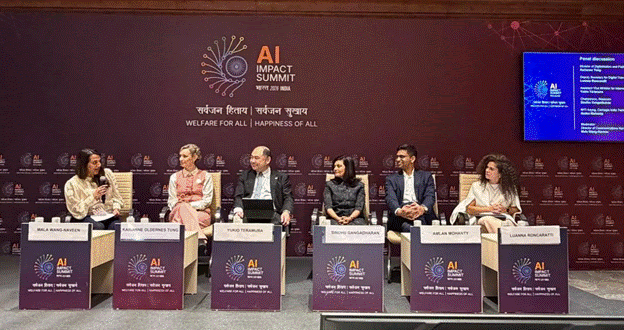
Deliberations brought together perspectives from Europe, Asia and Latin America to show how trustworthy AI is being built through real systems—ranging from crisis-response platforms and industrial optimisation to national digital governance frameworks. Across these examples, speakers stressed that trust is no longer a downstream outcome of technology, but a design requirement shaped by transparency, accountability, interoperable standards and the ability of citizens and institutions to rely on AI in high-stakes environments.
Amlan Mohanty, NITI Aayog, Government of India, underscored that India’s approach to AI governance is driven by a spirit of optimism and anchored in values of inclusivity, equality, and access. He emphasised that governance is “not about containment or regulation or risk mitigation only,” but also about driving adoption and building capacity. He noted that these principles are not new but are already embedded in India’s Constitution, and the priority is ensuring that values of fairness and equality extend to AI. He described India’s framework as a “light-touch kind of regulatory agile approach,” ensuring that constitutional values guide how AI governance is implemented across stakeholders.
Sindhu Gangadharan, Chairperson, Nasscom, MD, SAP Labs India Pvt Ltd, placed the discussion in the context of real-world public value, emphasising that technology must be measured by its societal impact. Recalling the use of digital platforms during the pandemic to track oxygen supply chains in real time, she said the experience demonstrated that “technology cannot exist for its own sake… the true purpose of technology is serving humanity.”
Karianne Oldernes Tung, Minister, Norwegian Ministry of Digitalisation and Public Governance, highlighted the need for clear national frameworks and institutional guidance to reduce uncertainty for industry and public agencies. Stressing that trust extends beyond technical accuracy, she said it must also be about “reliability, transparency, fairness and accountability,” adding that “to trust something, I need to understand how it works—and I need a real choice in the matter.”
Yukio Teramura, Assistant Vice Minister for International Affairs, MIC Japan, linked AI adoption directly to industrial competitiveness and national resilience, noting that data sharing across organisations can accelerate innovation in ageing societies. At the same time, he underlined the importance of managing risks such as bias, privacy and technical errors to ensure “a human-centric AI society where people and AI work together.”
Luanna Roncaratti, Deputy Secretary, Digital Government, Brazil, highlighted the role of democratic governance and data frameworks in shaping responsible AI adoption. She noted that for large, fast-growing democracies, AI is not only a technological shift but also “about behaviour, inclusion and social impact,” with public services, healthcare and quality of life improving when development remains aligned with human rights and sovereignty.
Heather Broomfield, Norwegian Government AI Unit, Norwegian Digitalisation Agency emphasised that trustworthy AI rests on institutional credibility, shared public values and enforceable governance. Highlighting the importance of confronting risks rather than overlooking them, she said that in the public sector AI must reflect “equality, fairness and accountability,” and that “guardrails must be in place if AI is to strengthen rather than undermine trust.”

Niels Nagelhus Schia, Research Professor, Norwegian Institute of International Affairs (NUPI), situated AI within an evolving geopolitical landscape, noting that control over compute infrastructure, semiconductors and data flows is reshaping economic competitiveness, military capability and decision-making power. He cautioned that fragmented development pathways risk weakening interoperability and legitimacy, stressing that “when technology structures power, it also stretches trust,” and that “AI cannot emerge from technological fragmentation alone.”

Morten Dæhlen, Professor, University of Oslo and Co-Director, Norwegian Centre for Trustworthy AI (TRUST), drew attention to the growing strategic importance of data governance, observing that leaders are now focusing on both data sharing and “data reduction” as the scale of data generation accelerates and sustainability considerations become central.

Hildegunn McLernon, SVP Technology Strategy and Portfolio, Kongsberg Maritime, presented an industrial deployment perspective, demonstrating how operational data and AI-driven optimisation are being used to improve maritime efficiency while reducing environmental impact. She noted that real-time performance insights enable systems that can “optimise underwater radiated noise,” directly linking advanced analytics with biodiversity outcomes.

The session emphasised that trust will be the key factor in the next phase of AI adoption. Building it will require sovereign capability, strong institutions, interoperable global frameworks and real-world applications that improve citizens’ lives, supported by international cooperation and a clear public purpose.
About The Author





More Stories
The Institute Of Cost Accountants Of India, Kicks Of Its Prestigious Convention – 2026, With The Theme ‘Reimagining The CMA Profession.
NHDC To Organise Special B2C Handloom Expo 2026 At Handloom Haat In New Delhi From February 21.
Mascots Ayo And Tina Showcase The Olympic Spirit In Milan.