





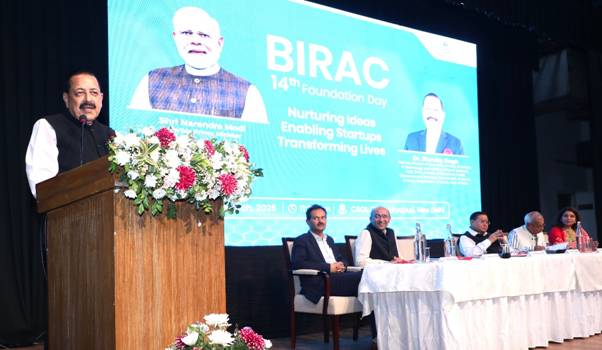
New Delhi, Delhi, 19th of March 2026 : Union Minister of State (Independent Charge) for Science & Technology, Earth Sciences, and MoS PMO, Personnel, Public Grievances, Pensions, Atomic Energy and Space, Dr Jitendra Singh today said that India’s bioeconomy has expanded from about USD 10 billion in 2014 to over USD 195 billion in 2025, reflecting a massive growth trajectory over the past decade. He said the sector has recorded an annual growth of around 17–18 percent in the last year alone, rising from approximately USD 165 billion to USD 195 billion, marking India’s emergence as a major global biotechnology hub.
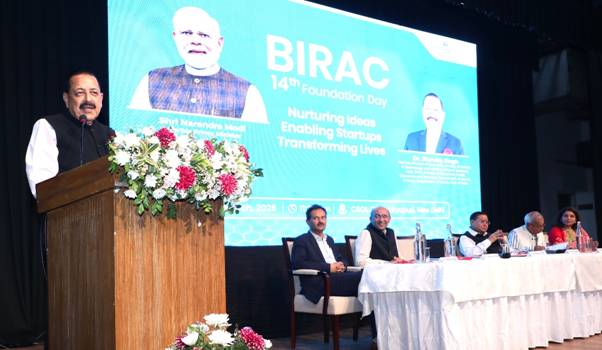
Addressing the 14th Foundation Day celebrations of Biotechnology Industry Research Assistance Council (BIRAC) at Civil Services Officers’ Institute, Chanakyapuri, New Delhi, Dr Jitendra Singh highlighted the role of BIRAC as a key enabler of India’s biotechnology innovation ecosystem. The event was attended by Dr Rajesh S. Gokhale, Secretary, Department of Biotechnology (DBT), Director General BRIC and Chairman BIRAC; Prof Ashok Jhunjhunwala from IIT Madras; Dr Jitendra Kumar, Managing Director, BIRAC; along with senior scientists, policymakers, industry representatives, and startup stakeholders.
The Union Minister said biotechnology is now central to India’s future growth story, driving advancements in healthcare, agriculture, climate solutions, and sustainable manufacturing. He said that India is steadily moving towards its target of a USD 300 billion bioeconomy by 2030, supported by a strong base of scientists, entrepreneurs, and startups. He added that BIRAC has played a crucial role in connecting research with industry and enabling the transition of ideas from laboratories into market-ready solutions.
Highlighting the government’s policy direction, Dr Jitendra Singh spoke about the BioE3 Policy, Biotechnology for Economy, Environment and Employment, as a major step towards strengthening bio-based industries and sustainable biomanufacturing. He said the policy will promote innovation in areas such as precision biotherapeutics, smart proteins, climate-resilient agriculture, bio-based chemicals, and carbon capture technologies. He added that BIRAC is facilitating this transformation by building shared infrastructure such as bio foundries, Bio-AI hubs and advanced biomanufacturing platforms.
Referring to financial support mechanisms, the Minister spoke about the Research, Development, and Innovation (RDI) Fund with an outlay of ₹1 lakh crore, under which BIRAC has been assigned a key role in supporting biotechnology ventures. He said this initiative will help channel long-term investment into projects ready for scale-up and technology translation, strengthening India’s deep-tech ecosystem.
During the event, the India Bioeconomy Report (IBER) 2026 and the BIRAC Impact Report were also released. The reports highlight that India’s bioeconomy has reached USD 195.3 billion in 2025, contributing around 4.8 percent to the national GDP, with a strong CAGR of nearly 18 percent. The sector has more than doubled in size since 2020 and is supported by over 11,800 biotech startups across the country.
The BIRAC Impact Report showcases how targeted funding, incubation and mentorship have enabled industry-academia collaboration and led to the development of affordable healthcare solutions, sustainable technologies, and job creation. It reflects measurable outcomes including commercialization of products, expansion of startups and wider societal impact.
Dr Jitendra Singh emphasized the importance of nurturing young scientific talent, especially from tier-2 and tier-3 cities, and said that initiatives supporting students, researchers and women entrepreneurs are helping build a nationwide culture of innovation.
Congratulating BIRAC on its 14th Foundation Day, he called for continued collaboration between science, industry, and policymakers to transform innovation into large-scale impact and contribute to building a self-reliant and developed India.
About The Author


More Stories
Prime Minister Meets Trustees Of Indira Gandhi National Centre For The Arts.
Ayush Partners With CISF To Boost Preventive Healthcare And Wellness For Personnel.
ECI To Facilitate Elderly, Pwd And Service Voters And Voters On Election Duty To Vote Using Postal Ballot In The Upcoming Assembly Elections.