



Deoband/Saharanpur, 7th of February, 2026 : When education transcends textbooks to become the foundation of character, responsibility, and national consciousness, it begins to shape history. A similar inspiring and thought-provoking atmosphere was witnessed at Islamia Degree College, Deoband, where a prestigious National Conference on the theme “Role of Minority Educational Institutions in National Unity, Cultural Diversity and Nation-Building: Developed India @2047” was organised jointly by the National Commission for Minority Educational Institutions (NCMEI), Government of India, and Islamia Degree College.
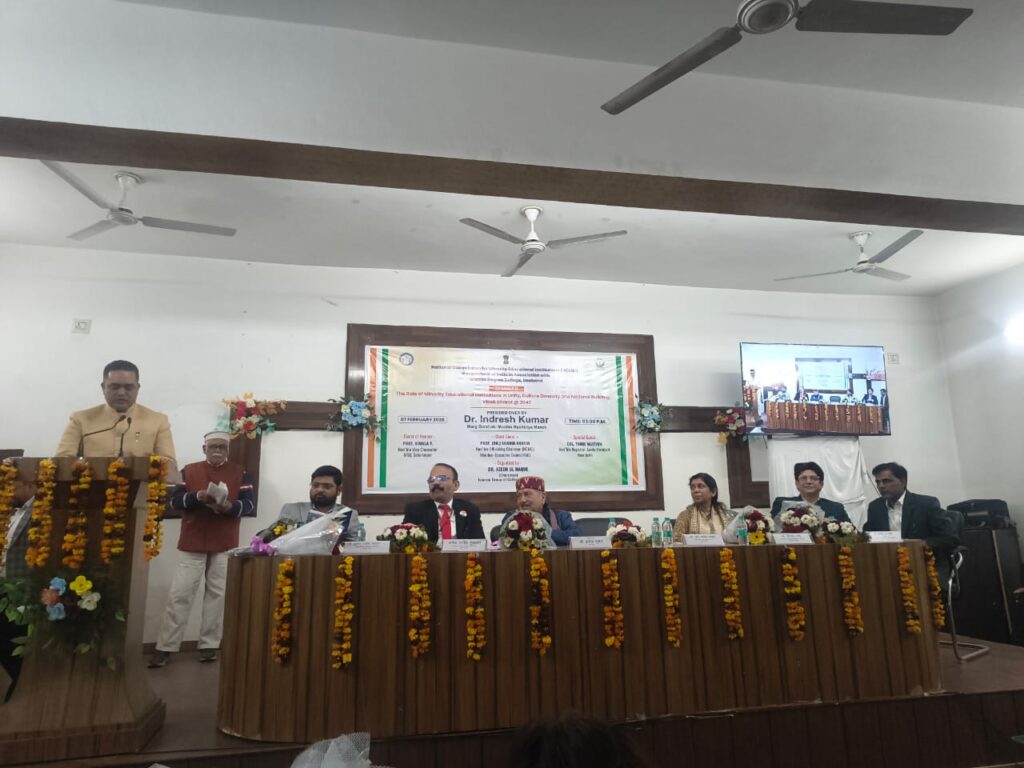
The conference was chaired by Dr. Indresh Kumar, Margdarshak, Muslim Rashtriya Manch. Prof. (Dr.) Shahid Akhtar, Officiating Chairperson, NCMEI, attended as the Chief Guest, while distinguished guests included Prof. Vimla Yadav, Vice-Chancellor, MSU Saharanpur, and Colonel Tahir Mustafa, Registrar, Jamia Hamdard (New Delhi).
At the outset, Raj Singh Tarar, Under Secretary, NCMEI, welcomed the dignitaries and stated that the Commission’s objective is to empower minority educational institutions and ensure effective implementation of rights granted under Article 30 of the Constitution. He informed that more than 14,000 institutions across the country have been granted minority status so far, including 104 institutions from Saharanpur district.
Addressing the gathering, Sumit Rajesh Mahajan said that the vision of Developed India @2047 can be realised only by linking education with a knowledge-based economy and skill development. He described India’s youth population as the country’s greatest strength.
Elevating the conference ideologically, Dr. Indresh Kumar, in his impactful address, said,
“While many parts of the world are witnessing hatred and conflict today, India’s identity is built not on confrontation, but on a culture of coexistence. We must teach the next generation not anger, but the values of living together.
Minority educational institutions have a historic opportunity to proudly carry forward their culture, language, and diversity—because diversity is not our weakness, it is our greatest strength.
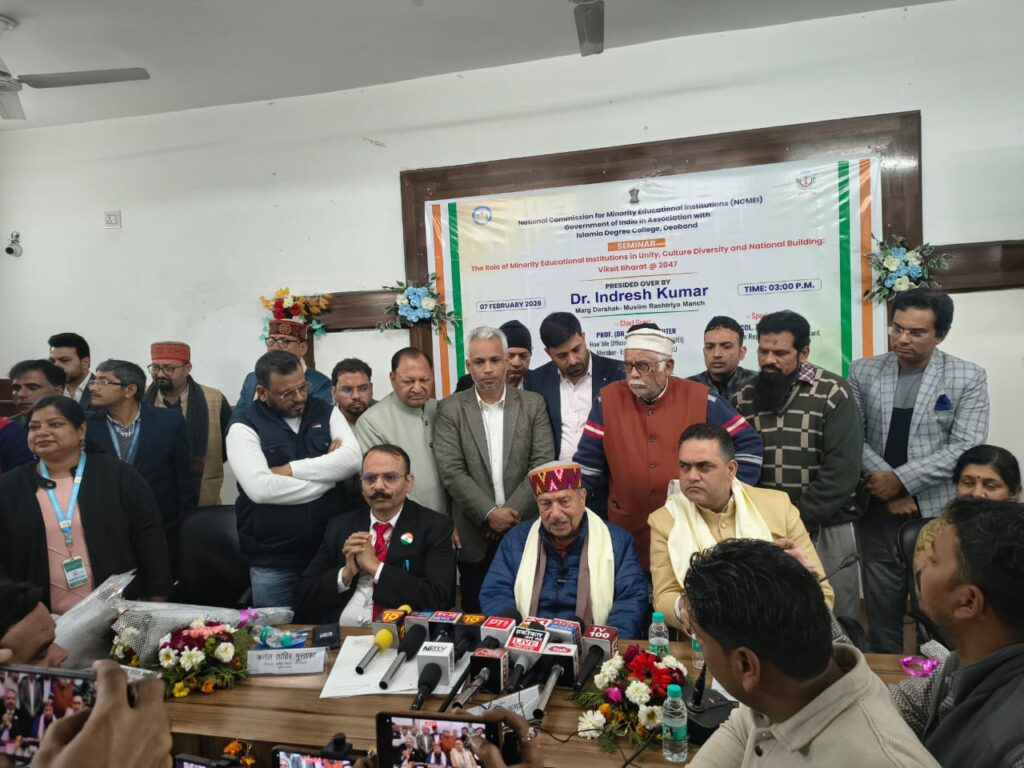
Being a minority is neither a crime nor a sign of inferiority. You are not outsiders—you were Indian, you are Indian, and you will always remain Indian. Only when we see ourselves first as citizens of the nation can the dream of a strong, harmonious, and developed India be fulfilled.”
Colonel Tahir Mustafa, Registrar, Jamia Hamdard, stated that minority educational institutions must move beyond the notion of being mere “protected spaces” and instead emerge as centres of academic excellence and national development.
Prof. Vimla Yadav highlighted diversity as India’s greatest strength and emphasised the importance of inclusive education and the relevance of the National Education Policy 2020.
Prof. (Dr.) Shahid Akhtar, Officiating Chairperson, NCMEI, said,
“Today’s programme is a joint initiative of the National Commission for Minority Educational Institutions and Islamia Degree College. Its purpose is not only to discuss rights, but also to clearly define the responsibilities of minority educational institutions.
Under the NCMEI Act, six minority communities—Muslims, Christians, Sikhs, Parsis, Buddhists, and Jains—have been officially notified. The Constitution grants them the fundamental right to establish and administer their own educational institutions. This is not a privilege, but a constitutional provision to protect diversity.
In line with Supreme Court directives, the Commission has developed a transparent and well-defined process to ensure timely and fair grant of minority status. Since reservation does not apply to minority institutions, they are permitted to earmark seats for their own community.
However, rights are accompanied by responsibilities. The role of minority educational institutions is not limited to education alone—they are a vital link in nation-building, social harmony, and in preparing capable citizens for the digital and AI-driven era.
We firmly believe that through education, unity, culture, language, and diversity can not only be preserved, but also transformed into the nation’s greatest strength.”
The conference concluded with the collective conviction and resolve that this was not merely an event, but a far-reaching and powerful initiative towards nation-building through education, contributing meaningfully to the vision of Developed India @2047.Neither Minority Normajority—First Citizens Of The Nation: Voices For Nation-Building From Deoband
About The Author


More Stories
Students Learn the Mantra to Manage Stress.
IDA Deccan Shines At National Level, Bags Eight Prestigious ‘IDA Performance Awards’.
Resonance Educational Institutions Launches Resonance – Kurnool, Bringing Its 25-Year Legacy To Rayalaseema.