
New Delhi, Delhi, 26th of March 2026 : A high-level parliamentary delegation from the Sectoral Oversight Committee on Infrastructure and Strategic Development, Parliament of Sri Lanka, led by Shri S.M. Marikkar, M.P. (Chairman), is currently on a week-long official study tour to India.
As part of this visit, the Department of Drinking Water and Sanitation (DDWS), Ministry of Jal Shakti, facilitated the visit and organized a detailed presentation on Jal Jeevan Mission (JJM) and Swachh Bharat Mission – Grameen (SBM-G) for the dignitaries this afternoon.
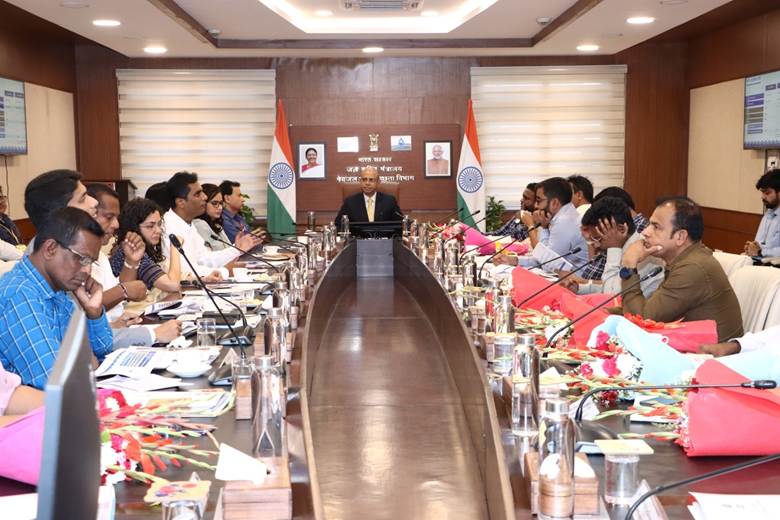
Shri Ashok K. K. Meena, Secretary, DDWS, Shri Kamal Kishore Soan, Additional Secretary & Mission Director, NJJM along with senior officials from DDWS were also present during the event.
Addressing the delegation, Shri Ashok K. K. Meena, Secretary, DDWS, highlighted India’s guiding principle that the Central and State Governments implement large national programmes for the benefit of local governments, particularly Gram Panchayats, so that they can effectively deliver essential services to the people at the grassroots level. He apprised the visiting dignitaries that India is implementing two flagship missions to address rural drinking water and sanitation under Jal Jeevan Mission (JJM), launched in 2019 and Swachh Bharat Mission – Grameen (SBM-G) launched in the year 2014.
He further shared India’s key learnings from implementing these two missions in four core points:
- Decentralisation and community-led service delivery through Gram Panchayats, making the community owners and managers of water and sanitation services.
- Convergence across various departments at the Gram Panchayat level to ensure effective delivery of services.
- Use of technology for transparency, efficiency, real-time monitoring, and grievance redressal through mobile applications.
- Sustainability in scheme design, including management of grey water, rainwater harvesting, and circular economy principles.
Continuing the session further, a detailed presentation was delivered by JJM and SBM-G officials. Shri Hari Narayanan Murugan, Director, JJM made an extensive presentation on India- Sri Lanka Cooperation in Drinking Water. He began with an outline of the journey of rural drinking water supply in India. He informed the delegation that on 15th August 2019, Prime Minister Shri Narendra Modi announced from the ramparts of the Red Fort that every rural household in the country would be provided with piped drinking water at their doorstep. This historic announcement led to the launch of Jal Jeevan Mission with a commitment to provide Functional Household Tap Connections (FHTCs) to all rural households.
The mission was designed on five key pillars for Universal Access to Drinking Water which includes strong political will, adequate public financing, partnerships, people’s participation (Jan Bhagidari), and, convergence with Gram panchayats through persuasion. He further highlighted that the mission was initially launched with an outlay of approximately $55 billion, which has now been enhanced to nearly $92 billion as a financial commitment. The rural tap water coverage has increased dramatically from 17% to 82%, with more than 15 crore households now having tap water connections in their homes.
While moving further, Shri Hari mentioned that the extended phase of the Mission which was approved by the union cabinet on 10th March 2026, shall prove to be a paradigm shift. By extending the mission till December 2028 as JJM 2.0 with an enhanced outlay, the Government is laying strong emphasis on structural reforms, continuous Jan Bhagidari, operational and financial sustainability, citizen-centric water quality governance, and digital data management through the Sujalam Bharat national asset registry. The mission aims to ensure that every rural water supply scheme remains fully functional for the next 30 years through clear role definition at every level, strengthened Gram Panchayats, District Technical Units, and a professional utility approach. He highlighted that JJM2.0 has moved from infrastructure driven approach to O&M approach which focuses on people’s participation. Through National Jal Jeevan Mission (NJJM), State Water and Sanitation Mission (SWSM), District Water and Sanitation Mission (DWSM), and Jal Arpan, it is ensured that not only assured tap water to be provided to every rural household but also to clean and safe drinking water should be availed for a transparent, and long-lasting rural water ecosystem in the country.
Smt. Kritika Kulhari, Deputy Secretary, SBM-G, gave a detailed presentation on Swachh Bharat Mission – Grameen: India’s Rural Sanitation Journey from ODF to ODF Plus (Model) before the visiting Sri Lankan Parliamentary Delegation.
The presentation highlighted that the journey of Swachh Bharat Mission-Grameen began on October, 2014 when Prime Minister Shri Narendra Modi launched the mission from the ramparts of the Red Fort, with the vision of making India Open Defecation Free (ODF). The mission gained further momentum on 2 October 2019, coinciding with the 150th birth anniversary of Mahatma Gandhi, when all districts and villages across the country declared themselves ODF. She emphasised that the Swachh Bharat Mission (Grameen) (SBM-G) has transitioned from achieving Open Defecation Free (ODF) status under Phase I to sustaining ODF outcomes and comprehensive waste management under Phase II, with an emphasis on making villages ODF Plus and “Model Villages.”
Through a massive people’s movement (Jan Andolan), the coverage reached 100% by 2019. This achievement was a significant step towards fulfilling UN SDG Target 6.2. She further highlighted the major components of SBM-G Phase-2, which includes:
- Construction of remaining and new individual household toilets (IHHLs)
- Community Sanitary Complexes (CSCs), especially for migrant population and landless households
- Solid Waste Management (biodegradable, non-biodegradable, and plastic waste)
- Liquid Waste Management (greywater and faecal sludge)
- Intensive Information, Education and Communication (IEC) and capacity building for sustained behaviour change
She further apprised that under the mission, an incentive of ₹12,000 is provided for construction of individual household toilets with priority to Below Poverty Line families, SC/ST households, persons with disabilities, landless labourers, small and marginal farmers, and women-headed households. More than 12 crore individual household toilets have been constructed since the launch of the mission. Additionally, over 2.72 lakh Community Sanitary Complexes have been built across the country.
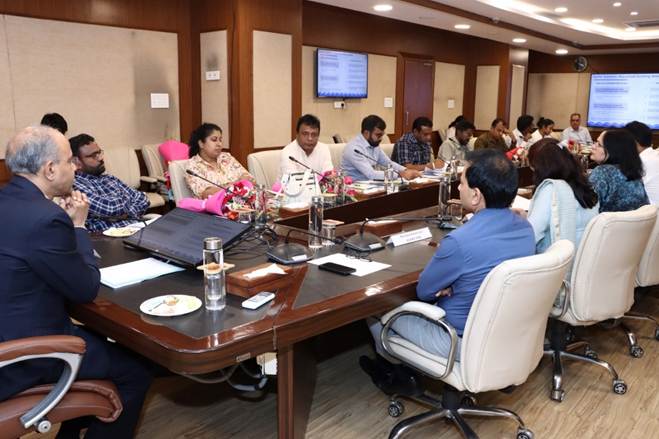
Following the two presentations, an open and interactive discussion session was held, during which the Sri Lankan delegation actively exchanged views on India’s successful approaches to sustainable rural water supply and sanitation infrastructure.
Addressing the forum, the Sri Lankan delegates outlined key challenges, noting that high levels of heavy metals, including mercury-related contaminants, persist in water bodies, posing significant risks to public health. They further noted the economic burden of water treatment and mentioned that in Sri Lanka, treated drinking water serves not only for consumption but also for washing, cleaning, and other household purposes. This multi-purpose application substantially inflates costs, as heavy investments in purification are undermined by repurposing beyond potable standards. Based on these key issues, the delegates urged collaborative innovations and cost-effective technologies for heavy metal removal, calling on DDWS partners to share affordable, comprehensive water management solutions.
Following the conclusion of the session, in her concluding remarks, Smt. Swati Meena Naik, Joint Secretary (Water), Department of Drinking Water and Sanitation, underscored India’s remarkable progress in the drinking water and sanitation sector. She emphasised that through mutual understanding, knowledge sharing, and continued bilateral engagement, India and Sri Lanka can forge a strong partnership to deliver better outcomes in the field of water management and sanitation.
About The Author

More Stories
Keralam Should Follow Tripura’s Path To Uproot Corruption: Chief Minister Of Tripura Dr. Manik Saha At Kalpetta Assembly Constituency In Keralam.
On The Sacred Occasion Of Ram Navami, We Revisit A Drape That Beautifully Embodies Devotion And Heritage.
General Elections And Bye-Elections 2026: Seizures Surpass Rs. 400 Crores.