





New Delhi, Delhi, 25th of November 2026 : The Government of India is proposing further amendments so that challenges to arbitral awards, and the execution of decrees, are resolved in a time-bound manner, Dr Rajiv Mani, Secretary, Legislative Department and Department of Legal Affairs, Ministry of Law and Justice, GOI, said on Wednesday.
Addressing the ICA – SCC Arbitration Institute Conclave on “Bridging India and the EU: Arbitration, Investment and the Future of Cross-Border Commerce” at Federation House, New Delhi, Dr Mani said negotiations on an India-EU Investment Protection Agreement were continuing, with an early conclusion in view. Government, diplomatic and institutional leaders said credible arbitration and mediation will determine how far the India-EU Free Trade Agreement translates into real trade and investment for multinationals, small businesses, exporters and start-ups.
“Besides the enactment of the Commercial Courts Act of 2015, we are also proposing to introduce further amendments so that the finality of an arbitral award, when challenged under the applicable law and the provisions of the Arbitration and Conciliation Act, 1996, is resolved within a time-bound manner, and the execution of the decree takes place, of course, in a time-bound manner,” Dr Mani said in his keynote address.
Describing the Mediation Act, 2023 as an important step that gives parties additional forums for dispute resolution, with the finality of settlements ensured by law, Dr Mani said the two mechanisms should work together. “Arbitration and mediation, in my view, should not be viewed as competing mechanisms. While arbitration provides an adjudicatory mechanism resulting in a binding determination, mediation offers parties an opportunity to resolve disputes in a consensual and amicable manner while preserving the commercial relationship,” he said. He added that carefully designed multi-tiered clauses, combining negotiation, mediation and arbitration, can play a very useful role, and that pre-institution mediation under the Commercial Courts Act offers parties a route to settlement before approaching the courts.
Welcoming the conclusion of the India-EU FTA negotiations, Dr Mani said the agreement was likely to be signed soon, “perhaps this year itself”. “Given India’s rise and its ambition of becoming a $7 trillion economy by 2030 a partnership of trust between India and the European Union would go a long way in strengthening overall international investment and cross-border commerce, benefiting everyone,” he said. He stressed that smaller enterprises in particular need accessible, affordable and predictable dispute-resolution mechanisms, and that the Government wants arbitration to reach beyond metropolitan cities to Tier-2 and Tier-3 cities.
In her special address, H.E. Petra Menander, Ambassador of Sweden to India, said that over the past decade Sweden had doubled its exports to India while India had tripled its exports to Sweden, driven mainly by services. With a Strategic Partnership and the EU Free Trade Agreement ahead, the two countries aim to double their economic exchange by 2030. “Dispute resolution enables business. Building trust and lowering the perception of risk when you have partners who are quite far away is absolutely essential,” she said. “Expectations are high, and now we need to deliver together.”
Delivering the opening address, Mr Arun Chawla, Director General, ICA, and former Director General, FICCI, said ICA and the SCC had renewed a cooperation agreement first signed in 1987, when the SCC was known as the Arbitration Institute of the Stockholm Chamber of Commerce. Citing India – EU merchandise trade of about US$136.5 billion in 2024-25, and preferential access for about 99.5% of Indian exports by trade value once the FTA enters into force, he said: “A Free Trade Agreement may reduce the cost of doing business, while an effective dispute resolution system reduces the risk of doing business. For businesses to take full advantage of market access, both are essential.”
Mr Chawla said arbitral institutions must meet three expectations: credibility, efficiency and adaptability. On artificial intelligence, he said: “Technology must strengthen human judgment, not replace the independence and fairness on which credible adjudication depends.” He proposed that ICA and the SCC explore joint training programmes, an exchange of institutional expertise and closer engagement with general counsel working between India and Europe. He also called for specialised expertise in disputes involving emerging technologies, energy transition, infrastructure and intellectual property.
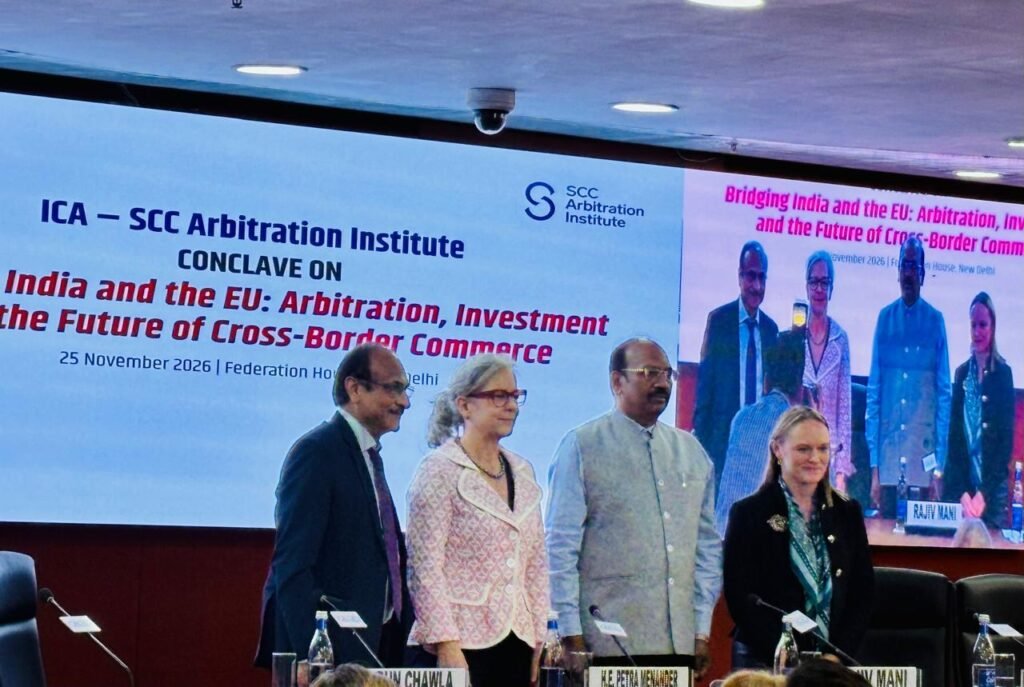
In her closing remarks, Ms Caroline Falconer, Secretary General, SCC Arbitration Institute, said parties from more than 90 countries had used the SCC in the last 10 years. Indian parties appear in its caseload almost every year, most often in disputes with European companies. She said most SCC arbitrations conclude in about a year, and that several large Swedish companies had asked her to come to India. “It is really time to get ready, because we are seeing great interest from Swedish parties, Swedish companies, and European companies in India,” Ms Falconer said.
The conclave also featured a strategic dialogue on “India-EU Dispute Resolution in a Changing World: Trade, Investment, Technology and Arbitration”, moderated by Mr Sanjeev Kapoor, Partner, Dispute Resolution, Khaitan & Co. The speakers were Ms Caroline Falconer, Secretary General, SCC Arbitration Institute; Mr Niclas Widjeskog, Partner (Dispute Resolution), CMS Wistrand, Sweden; Mr Benjamin Wells, Partner, Belgravia Law, London; and Dr Sanjeev Gemawat, Managing Director and Group General Counsel, Essar Group.
As India’s premier arbitral institution, ICA continues to promote institutional arbitration, mediation and conciliation as dependable mechanisms for domestic and cross-border commercial disputes, working with more than 50 arbitral institutions and international organisations worldwide.
About ICA
The Indian Council of Arbitration (ICA), established in 1965 under the initiatives of the Government of India and the Federation of Indian Chambers of Commerce and Industry (FICCI), is India’s premier arbitral institution. ICA is dedicated to promoting fair, efficient and cost-effective resolution of domestic and cross-border commercial disputes through arbitration, conciliation and mediation. It represents a membership of over 6,500, comprising chambers of commerce, industry associations, leading corporations and professionals. With collaborative relationships with more than 50 arbitral institutions and international organisations worldwide, ICA plays a vital role in strengthening India’s ADR ecosystem and fostering investor confidence.
About the SCC Arbitration Institute
The SCC Arbitration Institute (SCC) provides a neutral forum and an impartial process for resolving commercial disputes worldwide. Founded in 1917, it operates as a non-profit,independent entity within the Stockholm Chamber of Commerce, without commercial or political interests. Every year, parties from more than 40 countries choose the SCC to resolve their disputes through arbitration, expedited arbitration, mediation and other procedures.



More Stories
Inorbit Mall Visakhapatnam Takes Kids ‘Around The World’ This November.
Monomark Engineering IPO: A Strong Market Debut Backed By Ambitious Projects And Accelerating Growth.
Evernex Establishes India Headquarters In Hyderabad To Support Critical IT Infrastructure.