


New Delhi, Delhi, 19th of February, 2026 : The two-day international conference titled ‘Cultural Interflow between India and Mongolia’, organized by the Department of Brihattar Bharat and Area Studies of the Indira Gandhi National Centre for the Arts (IGNCA), an autonomous institution under the Ministry of Culture, Government of India, to mark 70 years of diplomatic relations between India and Mongolia, was inaugurated at the Samvet Auditorium of IGNCA.
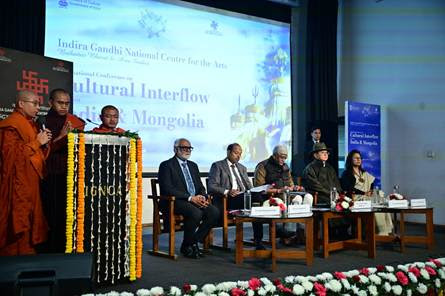
The inaugural session was graced by the Union Minister for Culture and Tourism, Shri Gajendra Singh Shekhawat, as Chief Guest. Shri Vivek Agarwal, Secretary, Ministry of Culture, attended as Guest of Honour, and His Excellency Mr. Ganbold Dambajav, Ambassador of Mongolia to India, was the Special Guest. The welcome address was delivered by Dr. Sachchidanand Joshi, Member Secretary, IGNCA. Conference Convener and Trustee of IGNCA, Professor Nirmala Sharma, and Professor Dharm Chand Chaubey, Head of the Department of Brihattar Bharat and Area Studies, also addressed the gathering.
A special exhibition showcasing visual representations of Mongolian culture was inaugurated on the occasion and is open to the public at IGNCA’s Darshanam Gallery until 25 February. The conference brings together 31 scholars from India, Mongolia, the United States of America, France, and other countries, with 75 research papers being presented over two days.
Shri Gajendra Singh Shekhawat stated that the conference reflects the shared spiritual and cultural traditions between India and Mongolia. He observed that exchanges between the two nations have extended beyond religion to fields such as astronomy, calendrical sciences, medicine, literature, and philosophy. Referring to the Mongolian Kangyur, he described it as a significant record of linguistic and philosophical scholarship and emphasized that its preservation and digitization strengthen civilizational dialogue and cultural diplomacy. He recalled the Prime Minister’s reference to India as a ‘spiritual neighbor’ during his 2015 visit to Mongolia and highlighted the importance of manuscript preservation through the integration of conservation science and digital technology. He underlined that the conference marks seventy years of diplomatic relations and centuries of civilizational bonds.

Shri Vivek Agarwal said that India and Mongolia are shaping a partnership grounded in shared civilizational memory and cultural kinship. He noted cooperation in strategic sectors, including the oil refinery project, defense, education, and manuscript preservation initiatives such as the dissemination of the Mongolian Kangyur. Under Project Mausam and Project Brihattar Bharat, efforts are being made to document and preserve shared intangible heritage for multinational recognition at UNESCO. He emphasized the need for scholarly dialogue to translate into concrete outcomes, including collaboration in creative and cultural sectors.

Ambassador Ganbold Dambajav recalled the establishment of the Embassy of Mongolia in New Delhi in 1957 and described India as Mongolia’s spiritual neighbor and a key regional partner. He highlighted Buddhism as a central shared value and referred to the preservation and translation of classical Buddhist texts, including the Kangyur and Tengyur. He expressed appreciation for India’s support in their dissemination and noted the expanding strategic partnership between the two countries.
Introducing the conference, Prof. Nirmala Sharma outlined the long history of India–Mongolia cultural interflow spanning over two millennia, citing historical references to early exchanges, travels of monks, and shared symbols.
In his welcome address, Dr. Sachchidanand Joshi stated that while diplomatic relations between the two nations are seventy years old, cultural relations date back thousands of years. He noted India’s efforts in tracing, republishing, and presenting 108 volumes of the Mongolian Kangyur to monasteries and institutions in Mongolia, and highlighted linguistic and cultural links reflected in shared symbols and traditions.
At the conclusion of the inaugural session, Prof. (Dr.) Dharm Chand Chaubey expressed gratitude to the guests and participants and noted that the conference would further strengthen cultural ties between India and Mongolia.
The conference provides a platform for scholars to examine the historical, cultural, and spiritual ties between India and Mongolia, including archaeological links, religious and literary traditions, Sanskrit manuscripts in Mongolia, artistic exchanges, and shared material heritage.

More Stories
“A Vision For Advanced Packaging: Delivering Maximum Value With Minimum Investment” : – Prof. Rao R. Tummala, Father of Advanced Packaging Emeritus Professor, Georgia Tech, Advisor, ISM.
Union Minister For Education, Shri Pralhad Joshi Launches The Six-Month Certificate (Bridge) Course In Primary Teacher Education.
Pratap University, Jaipur Marks Prime Minister Narendra Modi’s Birthday With Vedic Hawan.