





New Delhi, Delhi, 10th of May, 2026 : The essence carried by this shloka from Srimad Bhagvad Gita and from the civilisational wisdom enclosed in the Indian scriptures and traditions, is reflected in the essence of Somnatha Temple located at Somanatha-Pattan on the southern shore of Kathiawad (historic region in southwestern region of present-day state of Gujarat). Regarded as the first among the twelve Jyotirlingas, many a times its walls have borne the brunt of battle at the hands of barbarian invaders only to rise again and resume the drums and bells of worship.
Across more than a thousand years of Indian history, Sanātana Dharma – understood as a diverse, decentralised constellation of religious practices, philosophies, rituals, and institutions – has experienced repeated moments of disruption arising from political conquest, regime change, and shifting structures of power. These disruptions included the destruction or repurposing of temples, monasteries, and centres of learning, as well as the displacement of patronage networks that had sustained religious institutions. Yet, despite these ruptures, the broader religious tradition endured, adapted, and reasserted itself across time. The historical significance of this endurance lies not in claims of uninterrupted dominance, but in the capacity of religious life to survive institutional loss and political vulnerability.
From the early medieval period, temples functioned not only as places of worship but also as economic, cultural, and political centres. Their close association with ruling elites made them vulnerable during periods of military conflict. The raid on the Somnath Temple by Mahmud of Ghazniis among the most discussed examples. Persian chronicles celebrated the event as a victory, while later Indian traditions emphasised loss, resistance, and eventual restoration. What is historically verifiable is that the temple did not disappear from religious life; it was rebuilt under regional rulers such as the Chaulukyas and continued to attract devotion. Similar patterns are visible elsewhere.
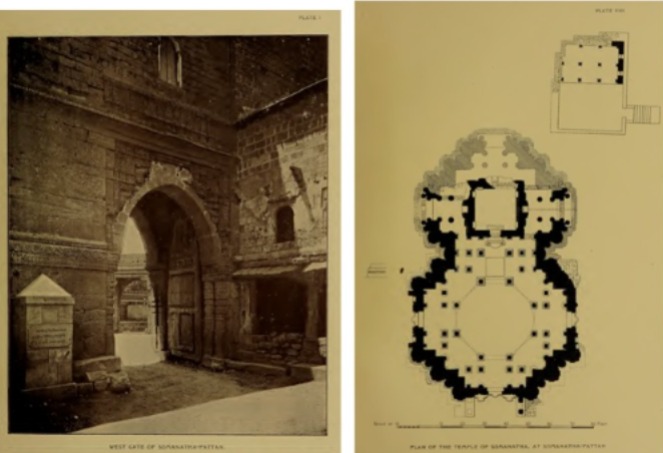
Credit: Somanatha and Other Medieval Temples in Kathiawad. 1931. Archaeological Survey of India, Vol. XLV, Imperial Series. Calcutta: Government of India.
The history of Somnath must never be reduced to a single episode. From ancient times, Prabhasa Patan has been a sacred geography. Patan, known by different names in different sources including Prabhas-Pattan, Shiva-Pattan and Prabhas-Tirtha, is an ancient town on the east of which three beautiful rivers merge at a Triveni – held sacred marking the cremation of the body of Lord Krishna. In the neighbourhood lies the Vairagya Kshetra and Gopi Tulow (from where people procure the Gopi Chandan). Sacred pilgrimage to this region is considered incomplete without visiting this sacred land. One can find details of the ruins found in this region in the Report on the Antiquities of Kathiawad and Kachh, and The Antiquities of the town of Dabhoi in Gujarat.
Somnath represents a rare confluence of Shaiva and Vaishnava traditions, repeatedly remining us that the Indian heritage has always been plural and inclusive.
The modern chapter in the history of Somnath in independent India began on Kartak Sud 1, Diwali – 12 November 1947, barely months amid the unfortunate Partition that our first Deputy Prime Minister and Home Minister visited this sacred land of Somnath. Accompanied by senior leaders and great personalities, Sardar Patel took a decisiove pledge of free Indian undertaking the reconstruction of this historic temple. What resulted next was the institutional framework that carried the national consciousness. Somnath was reconstructed, conceived as more than rebuilding of a shrine, as a cultural and intellectual centre.
The consecration ceremony performed early morning on 11 May 1951 in the august presence of Hon’ble President of India Shri Rajendra Prasad reaffirmed the shared cultural memory of the nation.
As India advances towards India@2047, these civilizational values assume renewed relevance. In an era marked by technological acceleration and geopolitical uncertainty, India’s gift to humanity lies in demonstrating that progress need not abandon compassion, and power need not forsake restraint. The endurance of Somnath reminds us that true leadership — national and global — is sustained not only by strength, but by wisdom, memory, and an unwavering commitment to shared human dignity.
Somnath Swabhiman Parv 2026-27 is envisaged as a year-long national commemoration anchored in the civilisational legacy, spiritual resilience, and cultural continuity symbolised by Shri Somnath Jyotirlinga at Prabhas Patan, Gujarat. Somnath occupies a unique place in India’s civilisational history. Despite repeated destruction across centuries, the temple was rebuilt time and again through the collective resolve of the people, emerging as a living testament to cultural continuity, spiritual resilience, and national self-belief.
Somnath Swabhiman Parv (that began from 8-11 January 2026) marks two significant milestones in India’s civilizational journey: one thousand years since the first recorded attack on the Somnath Temple in 1026, and seventy-five years since the reopening of the reconstructed temple in 1951 following Independence.
Thereby, positioning Somnath as a unifying national symbol of endurance, collective memory, and cultural self-respect. The commemoration shall culminate in a major national event on 11 May 2026, supported by a structured sequence of yatras, cultural productions, dialogues, educational initiatives, and coordinated programmes across Jyotirlingas, States, Union Territories, districts, and shivalayas nationwide.
Under the leadership of Hon’ble Prime Minister, Shri Narendra Modi, who also serves as Chairperson of the Shri Somnath Trust, Somnath has entered a renewed phase of holistic revival. Governance reforms, infrastructure enhancement, heritage conservation, and cultural initiatives have strengthened the temple’s role as a living spiritual centre. Sustainability measures and women-led service initiatives further reflect how civilizational values are being expressed through contemporary responsibility and inclusion.
The Somnath Swabhiman Parv creates a connection between modern society and the deeper essence of its culture through cultural, spiritual, and educational activities. It is a reminder to every generation that the temple of Somnath is not just about its physical existence; its true essence lies in the values and the responsibility that are consciously transferred from one generation to another. In this spirit, Somnath stands today not only as a restored shrine, but as a living tirtha.
As Bharat continues its journey in the twenty-first century, the spirit of Somnath offers a guiding principle: that a civilisation remains strong when it is rooted, remains relevant when it is adaptable, and remains unified when it is inclusive.
May the legacy of Somnath continue to inspire us – to build with purpose, to act with balance, and to move forward with a deep awareness of who we are.
(The author is the Union Minister for Culture and Tourism, Government of India.)




More Stories
PRAMAAN A Vital Instrument To Meet Emerging Global Requirements For Responsible Deforestation-Free Timber Sourcing And Livelihood Generation: Shri Bhupender Yadav.
ICMAI Conducts ‘Advanced Skill Training Programme’ To Bridge Academia-Industry Gap.
Ministry Of MSME And Ministry Of Statistics And Programme Implementation Sign Memorandum Of Understanding (MoU) For Development And Strengthening Of The Statistical Business Register.