





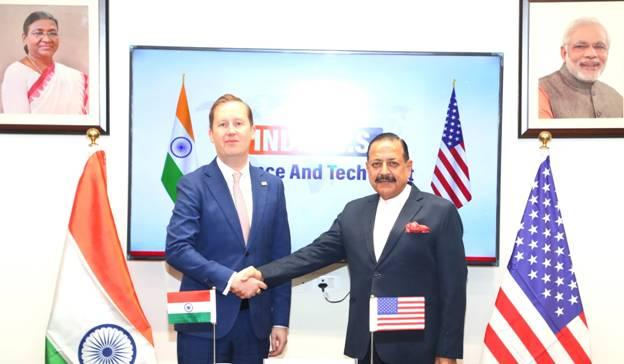
New Delhi, Delhi, 20th of May, 2026 : U.S. Ambassador to India, Sergio Gor called on Union Minister Dr Jitendra Singh today and discussed expanding bilateral collaborations in skilling, investment, knowledge exchange and industry-led partnerships across domains in biotechnology, quantum technologies, space, atomic energy and nuclear medicine.
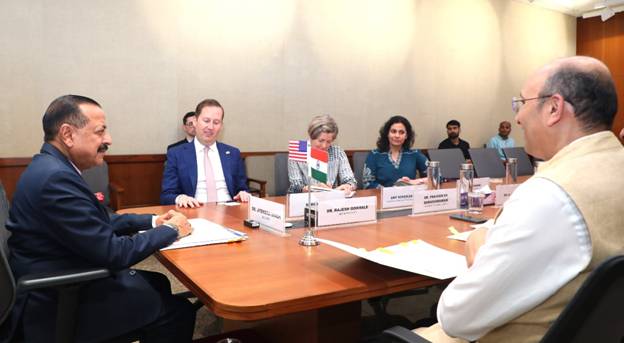
The Minister said, nuclear research had been opened up to the private sector for the first time in India, paving the way for new investment opportunities, private sector participation and international collaboration in advanced cancer care, diagnostics, oncology research and genetic medicine.
Dr. Jitendra Singh said India’s major advantage lies in its large and heterogeneous genetic data pool, with diverse population groups coexisting within the country. This, he noted, could be of significant value for global research in biotechnology, precision medicine, AI-enabled diagnostics and future healthcare solutions. He also underlined that emerging tool such as AI-enabled diagnosis, sequencing technologies and faster testing methods could significantly reduce time in healthcare delivery, including processes that otherwise take nearly 48 hours through conventional culture-based methods.
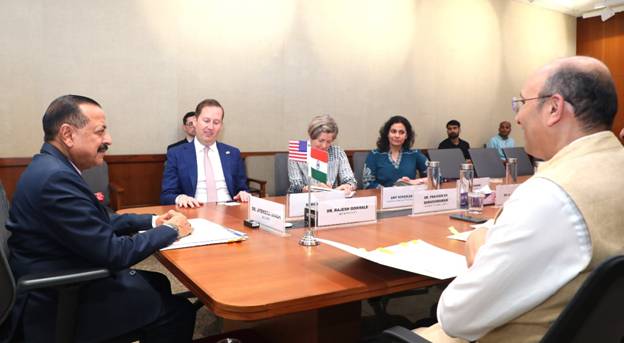
The Minister noted several measurable markers of cooperation and opportunity: four thematic hubs have been established under the National Quantum Mission in quantum computing, communication, sensing and metrology, and quantum materials and devices; India has achieved more than half of the Mission’s targets in three years against an eight-year framework, he said.
The discussions were anchored in the U.S.-India TRUST initiative as a framework for cooperation among governments, academia, industry and startups in artificial intelligence, semiconductors, quantum technologies, biotechnology, energy, advanced materials, critical minerals and space technologies. Dr. Jitendra Singh said the initiative’s emphasis on trusted technology partnerships, resilient supply chains, innovation ecosystems and protection of sensitive technologies was central to the next phase of India-U.S. scientific cooperation. Existing platforms such as IUSSTF, USISTEF and cooperation with the U.S. National Science Foundation were identified as institutional mechanisms to support implementation.
Highlighting a key policy shift, Dr. Jitendra Singh said India had opened up the nuclear sector and nuclear medicine-related research and investment to private participation, while retaining safeguards and security considerations. He said the move would enable private sector investment in areas that were earlier largely confined to the public sector, and indicated that final rules could be rolled out in the coming weeks.
The two sides also discussed biotechnology, vaccine cooperation, regulatory harmonisation, oncology trials, CAR-T therapy, AI-enabled diagnostics and the use of India’s diverse genetic data pool for global research. BIRAC was cited as an interface for industry collaboration in biotechnology, with the possibility of creating a similar facilitation mechanism for nuclear medicine.
On investment, Dr. Jitendra Singh referred to the Research, Development and Innovation Fund as a major government initiative to bring the private sector into R&D investment. The fund, aimed primarily at private sector participation, provides long-term unsecured financial support at about 2–3% interest, enabling industry to become an equal partner in research and innovation.
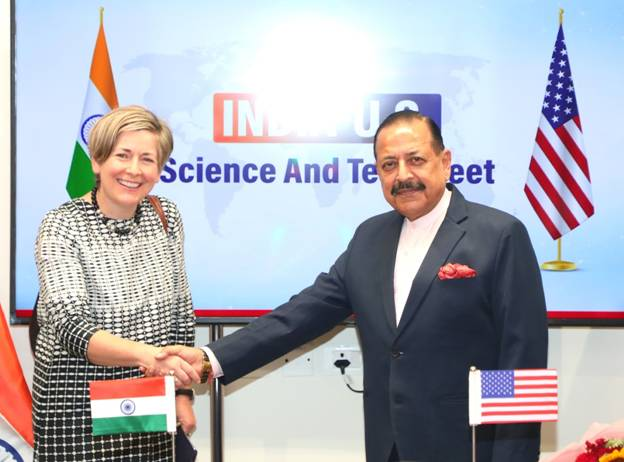
Union Minister also proposed a regular working group, possibly meeting once a month, to take forward investment, skilling, knowledge exchange and institutional collaboration with U.S. investors, companies and research institutions. He said such engagement would help bring not only capital but also technical expertise, private-sector experience and collaborative capacity into India’s emerging science and technology sectors.
Space cooperation, Starlink, quantum infrastructure in the country, technology transfer for thorium-based nuclear possibilities, and upcoming space engagements in Bengaluru also figured in the talks. Dr. Jitendra Singh said India’s opening up of the space sector to private participation over the last five to six years had led to a major leap, creating new scope for collaboration with trusted partners.



More Stories
Knauf India Strengthens Sustainability Efforts With Tree Plantation Drive In Gurugram.
BHASHINI, Current AI And Kalpa Impact Conclude VYOMA Innovation Challenge, Showcase Open-Source AI Solutions For India.
New Zealand University Connects With Students Across India.