




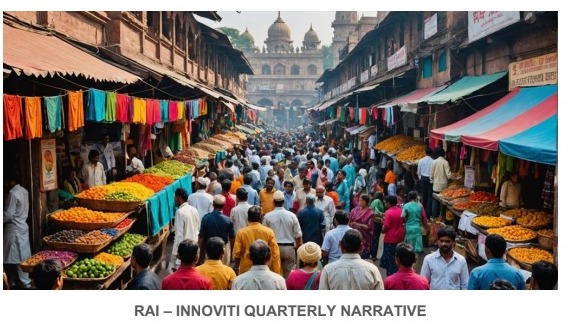
Mumbai, Maharashtra, 14th of August, 2026 : The RAI-Innoviti SANKET report shows like-for-like business growth data across India’s retail sector, tracking how consumers spend, category by category, and city by city. The Retailers Association of India (RAI) has tied up with Innoviti Technologies (Innoviti) to produce this report. The latest edition shows retail growth softened through April, May and June — from 9.4% to 7.8% to 4.7% — before recovering to 6.8% in July, the first month-on-month improvement since the quarter began.
The report is built on same-store data: current-month sales compared to the same month a year earlier, at the same stores, stripping out the effect of new store openings. That gives RAI and Innoviti a like-for-like read on genuine demand strength, city by city and category by category, rather than growth numbers inflated by opening of more stores.
Category: Jewellery had the widest swings — up 14.2% in April around Akshaya Tritiya, easing to 4.6% in May, then settling into the mid-single digits at 6.6% in June and 6.4% in July. Grocery ran steady at ~7% for two months, softened to 4.3% in June as food inflation hit a 16-month high, then rebounded sharply to 7.5% in July as monsoon rains eased the supply squeeze. Consumer electronics and fashion stayed positive throughout and both improved into July.
Geography: All four zones softened through Q1 and all four recovered in July. The South held up strongest across all four months. The West saw the widest swing of any zone — the sharpest Q1 deceleration, then the sharpest July rebound. Smaller cities pulled ahead of metros through the quarter, with the Tier 3 lead over Tier 1 widening from 0.7 percentage points in April to 2.4 points in June. That gap narrowed to 1.9 points in July as metro demand recovered faster than small-city demand advanced — a sign, per the report, that Q1’s metro weakness may have been more event-driven than structural.
Payments: UPI transactions grew far faster than card transactions throughout — 22% in April against 4.6% for cards, easing to 12% against 0.7% by June, then both re-accelerating in July to 14% and 3.2% respectively. Card growth stayed concentrated in jewellery, where larger ticket sizes still favour cards; in grocery, UPI now dominates payment volumes almost entirely.
Kumar Rajagopalan, CEO, Retailers Association of India, said: “The RAI-Innoviti SANKET report shows like-for-like business growth data — real, per-store demand, not growth that’s just new stores opening. That distinction matters, because it’s the only way to tell if Indian retail is actually gaining strength or just gaining square footage. This quarter, the data showed a sector that dipped through the summer and then bounced back — but unevenly across categories, cities and payment methods. Jewellery moves on its own calendar. Payments are shifting structurally toward UPI. And whether smaller cities keep outpacing metros, or whether July’s recovery closes that gap for good, is exactly the kind of question this data will keep answering month by month. That’s why this partnership matters.”
Rajeev Agrawal, CEO, Innoviti Technologies, said: “The RAI-Innoviti SANKET report shows what categories consumers are buying, where, and how they are paying for it. The inferences are from a compilation of 50million+ data points from 2800+ cities gathered from consenting businesses, publicly reported data, and primary data acquired through surveys. The report then uses AI to correlate trends with events happening in the economy to provide insights. It focusses on like-for-like growth across category, geography, and payment instruments. The key findings are a) discretionary buying (lifestyle and consumer electronics) has stayed robust throughout this period, b) economic growth is deepening into smaller cities, both in essentials and discretionary buying, and c) payments are shifting towards UPI for good, not just small ticket, but also higher values. We are excited to be partnering with RAI on unravelling these insights using advanced technologies and AI applied to real data, to build a roadmap that can help businesses plan better, market better, and grow better.”
About Retailers Association of India RAI:
The Retailers Association of India is the national body representing India’s retail industry across all channels and formats, from large format and specialty retail to e-commerce, quick commerce, and connected commerce businesses. RAI works with governments, regulators, and industry stakeholders to enable a competitive, innovation-friendly retail ecosystem. Through policy advocacy, industry events, research, and learning programmes, RAI builds the conditions for retail to grow, invest, and create employment at scale. India’s retail future is connected. RAI is building for it. Visit: www.rai.net.in |



More Stories
From Classroom To AI: Jiopc Brings A Computer Within Reach Of Students, Schools, Colleges And Skilling Centres.
City Express By Marriott Debuts In India With The Opening Of City Express By Marriott Udaipur Nathdwara Highway.
Short-Term Investment Plans Vs. Long-Term Investments: Which Fits A 3-Year Goal?