




Guwahati, Assam, 24th of August, 2026 : Cashew (Anacardium occidentale L.) is one of the most promising commercial plantation crops for the Northeastern Region of India. While states such as Kerala, Karnataka, Goa, Maharashtra, Andhra Pradesh and Odisha dominate India’s cashew sector, the Northeast possesses significant untapped potential because of its favourable climate, availability of wastelands and undulating terrain, increasing entrepreneurial interest, and expanding food processing infrastructure. Among the eight states of the
North East, Meghalaya, Tripura and parts of Assam can emerge as important centres for premium cashew production and value-added processing over the next decade if supported by a comprehensive strategy integrating production, processing, branding and market development.
Cashew is an Ideal Crop for Northeast India as it requires relatively low maintenance afterestablishment,performs well on degraded and marginal lands, prevents soil erosion, generates long-term income, supports inter cropping during the initial years, has a long productive lifeand has a strong
domestic and international demand.
Unlike many seasonal crops, cashew offers a stable source of annual income while also contributing to ecological restoration. The biggest opportunity lies not merely in producing raw cashew but in processing it locally in the northeast. Every component of the cashew tree has commercial value. Thus, a zero-waste processing model is achievable.
A large proportion of raw cashew nuts (RCN) produced in the region continues to be transported to processing centers outside the Northeast, resulting in loss of value addition, employment and revenue. Cashew processing is labour-intensive and particularly benefits rural women. Any small or medium-sized processing unit can create substantial direct as well as indirect employment, especially for Self Help Groups and rural youths. Developing a processing ecosystem for Cashew is therefore very essential to unlock the full economic potential of the cashew sector.
Status of Cashew Production & Processing in North East India:
In the North East, Meghalaya, Tripura and few districts of Assam possess substantial but largely untapped potential for developing a modern cashew processing industry. While cultivation is expanding in these three states of north east, processing remains fragmented and dominated by small-scale
primary operations. Investment in mechanized processing, value addition, branding, and organized marketing is yet to make a commercial beginning.
(i) Meghalaya has the most advanced cashew cultivation base, especially in the Garo Hills region (West Garo Hills, South Garo Hills, South West Garo Hills, East & North Garo Hills). It has over 18,000 MT level of encouraging production. However, processing capacity remains limited and is largely confined to small-scale and cottage-level primary processing units for years. Consequently, the state captures only a fraction of the potential value from its cashew production. Emerging local units include plants at Phulbari, Babadam (All Garo Hills Co-operative Society), and small homestead processing units. Research has shown that much of the state’s production is still sold as raw nuts outside Meghalaya, indicating significant scope for local value addition. There are a few mechanised processing facilities capable of producing export-quality kernels, one such is in AEZ – Byrnihat, marketing Cashew.
(ii) In Tripura, South Tripura, Gomati, and West Tripura districts produce Cashews. State possesses favourable climatic conditions for expanding cashew cultivation, particularly in upland and hilly areas. However, commercial processing infrastructure is still at an early stage. Presently, thestate has:small household-based processing, local roasting and packaging for domestic consumption, limited primary processing undertaken by entrepreneurs and farmer groups, minimal secondary processing facilities.
The absence of organized collection centers and medium-sized processing plants restricts commercial growth. One State Govt processing Unit and one NERAMAC processing facility has also outlived its capacity. State Government’s focus has been on micro-processing units and cooperative clusters to process raw cashew locally rather than selling raw nuts outside.
(iii) Assam is not traditionally known as a cashew producing state. However, enormous opportunities exist in the districts of Goalpara, Dhubri, South Salmara-Mankachar, Karbi Anglong, Dima Hasao, Cachar, Hailakandi etc. Assam Horticulture Vision specifically recommends expansion into non-traditional districts, wastelands and hill regions along with private processing units and market linkages.
Commercial processing remains largely absent. Mankachar and Goalpara in Assam act as the primary industrial processing belt in NE India, sourcing raw cashews from both Assam and the neighbouring Garo Hills of Meghalaya. Harvested raw cashew nuts are transported to processing industries in West Bengal, Odisha, Andhra Pradesh, Karnataka, Kerala and even Goa. Although Assam possesses stronger industrial infrastructure than many neighbouring states, dedicated cashew processing facilities have yet to be developed. Existing food parks and Agro-processing Clusters could be leveraged for future investment in cashew value addition.
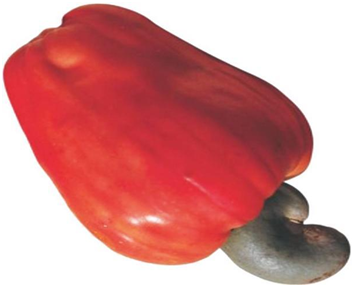
Cashew Apple with Nut
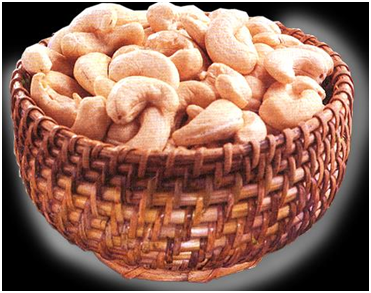
Finished Cashew
Core Challenges in the Value Chain:
· Processing Bottlenecks: Significant portion of raw cashewsproduced in these states are transported outside the region for hulling, grading, & packaging, causing loss of local economic value.
· Low Yielding Varieties: Legacy plantations rely heavily on oldseedling-based trees rather than high yielding softwood grafted clones.
· Wasted By-products: Cashew apple juice is rich in Vitamin C (4 to 5times more than orange juice), anti-oxidants, and fermentable sugars, making it an ideal raw material for non-alcoholic beverages and distilled spirits like Feni and Cashew Nut Shell Liquid (CNSL) are largely discarded due to lack of local extraction/distillation facilities.
· Inadequate Mechanization: Existing local facilities rely heavily onmanual roasting and peeling, limiting throughput and quality control.
Future Possibilities & Strategic Roadmap
· Establishment of Primary Processing Hubs: Setting up mini-processing units near cultivation clusters in Garo Hills (Meghalaya) and South Tripura to handle shelling, peeling, and grading at source.
By-Product Industrialization:
· Cashew Nut Shell Liquid (CNSL): Extracting CNSL for industrial usage(friction linings, paints, resins).
· Cashew Apple Utilization: Processing fruit pulp into juices, jams, orfermented beverages (similar to Goa’s Feni industry) can create a secondary revenue stream for farmers. Micro-distillation and local fruit brewing align well with the cultural acceptance of traditional fermented beverages in North Eastern states.
· Organic Certification & Premium Branding: North Eastern cashew isnaturally grown with minimal chemical inputs. Branding Garo Hills and Tripura cashews as organic, single-origin produce commands higher margins in domestic and international markets.
· Farmer Producer Organizations (FPOs): Empowering FPOs to operatecollective drying, storage, and primary processing units to bypass intermediaries and improve farmers’ profit margins.
· Re-plantation with High-Yielding Softwood Grafts: Leveraging ICARand KVK networks across NE India to replace aging plantations with high-density, early-bearing grafted varieties.
Setting up Mini Processing Unit of 500 Kg – 1 ton / day:
Setting up a mini cashew processing unit in North East India—typically rated at a capacity of 500 kg to 1 Ton per day (Raw Cashew Nuts/RCN) requires a streamlined line of machinery to handle cleaning, conditioning, shelling, drying, peeling, grading, and packaging.
Budgetory Estimate: INR 50 Lacs
(A) Total Capital Investment Estimate (500 kg/day Unit): INR 34 – 50 Lacs
(B) Essential Plant & Equipment are: INR 12 – 18 LacsShed & Civil
Infrastructures: INR 4-6 Lacs
(C) Utilities & Electrical Setup: INR 2-3 Lacs
(D) Licenses & Certifications; INR 1 Lacs
(E) Total Fixed Capital: INR 19 – 28 Lacs
(F) Initial Working Capital (RCN For 1/2 months initially): INR 10 – 15 Lacs
(G) Miscelleneous: INR 5-7 Lacs
Subsidy Support to set up Cashew Processing Unit in NE Region:
Setting up a mini cashew processing unit in North East India qualifies for significant government financial assistance, capital subsidies, and collateralfree bank loans under both Central and State industrial promotion schemes.
- PMFME Scheme Details (Pradhan Mantri Formalisation of Micro foodprocessing Enterprises): PMFME Scheme (under the Ministry of Food Processing Industries/MoFPI) is the primary vehicle for microprocessing setups:
· Capital Subsidy Amount: 35% of the total eligible project cost, cappedat a maximum of ₹10 Lakhs per unit.
· Funding Pattern: For North Eastern states (Meghalaya, Assam,Tripura, etc.), the financial ratio between the Centre & State is 90:10.
· Beneficiary Contribution: The entrepreneur must contribute a minimumof 10% of the project cost from their own sources. The remaining cost is covered via a credit-linked bank loan.
· ODOP Alignment: Cashew processing aligns with the One District OneProduct (ODOP) focus for primary cashew belts like West Garo Hills (Meghalaya) and South Tripura.
- Other Key Government Subsidies & Schemes
Beyond PMFME, cashew units in North East India can leverage stateand sectoral programs:
· MIDH / HMNEH (Mission for Integrated Development of Horticulture):Provides financial assistance up to 40%–50% credit-linked capital subsidy for post-harvest management and processing infrastructure (including primary processing sheds, sorting/grading units, and cold storage).
· State Specific Industrial Policies also supports such units set up inrespective states.
· Bank Loan Facilities & Credit Guarantee Support
· Agri Infrastructure Fund (AIF)
· NEDFi Direct Funding: North Eastern Development Finance Corporationoffers term loans tailored specifically for agro-processing entrepreneurs in NE states at competitive interest rates.
Utilization of Cashew Apples:
Cashew apple beverages and feni production in Meghalaya and North East India can uplift the cashew business: Meghalaya (Garo Hills), Tripura, and parts of Assam produces thousands of metric tons of cashew apples annually. However, nearly 80–90% of the cashew apple crop is currently discarded as agricultural waste because farmers only harvest the nut.
Market Potential of Cashew beverages and feni production like Goa in North East India can bring more viability returns in the cashew projects.
(i) High Raw Material Availability: For every 1 Ton of cashew nuts, approximately 8 to 10 Tons of cashew apples are produced. Meghalaya alone yields over 1,00,000+ MT of unutilized cashew apples annually.
(ii) Secondary Revenue Source: Processing cashew apples creates an immediate secondary revenue stream for traditional cashew farmers without requiring extra land or cultivation costs.
(iii) Geographical & Tribal Heritage Synergy: Micro-distillation and local fruit brewing align well with the cultural acceptance of traditional fermented beverages in North Eastern states.
Conclusion
Cashew offers a significant and largely untapped opportunity for economic development in Northeast India. Meghalaya, Tripura and suitable districts of Assam can emerge as major hubs for cashew cultivation and processing. Focus should shift from selling raw cashew nuts to establishing integrated local value chains and processing facilities. Mini & medium-scale processing units can generate substantial employment, particularly for rural women, SHGs, FPOs and youth. Modern processing, high-yielding planting material, improved post-harvest management & organized marketing are essential for competitiveness. By-products such as cashew apples and CNSL can create additional revenue streams and support a zero-waste processing model. Premium branding, geographical identity and organic positioning can help Northeast cashew command better prices in domestic & export markets. Government schemes, subsidies, credit facilities and state incentives can significantly reduce the initial investment burden for entrepreneurs.Co-ordinated approach involvingfarmers,FPOs, governments, financial institutions, research organizations & private investors can build theecosystem. With the right strategy, cashew processing can become a sustainable engine of rural income,employment, entrepreneurship and value addition in the Northeast over the next decade.




More Stories
INS Trishul Arrives At Plymouth, Uk For Exercise Konkan 2026.
Uttarakhand Delegation Interacts With Governor Of West Bengal, Shri R. N. Ravi, During Yuva Sangam Phase VII Visit.
DRI Cracks Down On Gold Smuggling From Bangladesh In Eastern Region; Seizes Over 7.8 Kg Foreign-Origin Gold; Six Arrested.