



Agartala, Tripura, 25th of August, 2026 : Natural farming is built on the idea that a farm can feed itself biologically through mulch, compost, green manure, and locally prepared inputs such as Jeevamrit and Beejamrit without relying on purchased chemical fertilisers. What is less often discussed is that this entire model depends on a steady, year-round supply of biomass: leaves, green twigs, fodder, and organic matter. In a hill state like Arunachal Pradesh, the fastest and most reliable source of this biomass is not the crop itself, but the trees standing around it. This is why fast-growing tree species deserve a far more central place in natural farming plans than they currently receive.
Why Speed Matters
Slow-growing timber species certainly have their place in a farm landscape, but they cannot supply the quick, repeated flushes of leaf litter, green manure, and fodder that natural farming inputs require. A tree that takes fifteen or twenty years to yield a usable canopy is of little help to a farmer trying to prepare Jeevamrit or mulch a field this season. Fast-growing species close that gap. They establish canopy cover within two to four years, produce cuttable biomass annually or biennially, stabilise slopes quickly on jhum land prone to erosion, and, in the case of nitrogen-fixing species, begin improving soil fertility almost as soon as they are planted.
Species Worth Prioritising
Several fast-growing species already familiar to farmers across Arunachal Pradesh and the wider North-East are well suited to natural farming integration:
- Alder (Alnus nepalensis) -the classic jhum-fallow tree of the Eastern Himalaya. Its root nodules fix nitrogen, and its leaf fall rapidly rebuilds fertility on cleared slopes, shortening the fallow period farmers must otherwise wait out.
- Gamari (Gmelina arborea) – among the fastest-growing hardwoods usable for boundary planting and alley cropping; its broad leaves make for abundant mulch and its lopped branches regrow readily, allowing repeated harvest without replanting.
- Dhaincha and other Sesbania species -short-duration, nitrogen-fixing shrubs that can be grown as a green-manure crop within a single season, ideal for quickly building soil organic matter on newly opened natural-farming plots.
- Coral tree (Erythrina) -a fast-growing, nitrogen-fixing species traditionally used as a living support for betel vine and pepper, doubling as a shade and fodder tree.
- Mulberry (Morus) – grows back vigorously after cutting, supplies high-quality leaf fodder for livestock, and its manure in turn feeds back into Jeevamrit preparation, closing the nutrient loop.
- Bamboon- arguably the fastest-growing woody plant available to North-Eastern farmers, reaching harvestable size within three to five years and regenerating from the same clump indefinitely; its leaf litter, culm sheaths, and thinnings all serve as ready mulch and construction material for farm bunds and fencing.
- Tree bean (Parkia timoriana) – comparatively quicker to bear pods than most timber legumes, and useful both as an income-generating crop and as a nitrogen-contributing component of a mixed natural-farming plot.
- Subabul (Leucaena leucocephala) – a widely planted, fast-growing nitrogen fixer valued for its leaf fodder and repeated coppicing ability; useful on boundary lines and alley rows, though it should be managed carefully where it has shown weedy tendencies.
- Malabar neem (Melia dubia), also called forest neem or Malai Vembu – discussed in detail below as one of the clearest agroforestry success stories in the country, and a strong candidate for wider trial in Arunachal Pradesh.
Melia dubia: A Proven Success Story Worth Replicating
If any single species demonstrates what fast-growing trees can do for a farm, it is Melia dubia. Known locally in different states as Malabar neem, forest neem, or Malai Vembu, this indigenous tree has, over roughly the past decade and a half, become one of the most widely adopted agroforestry species in India and for reasons that make it just as relevant to natural farming as to commercial timber growers.
Melia dubiareaches harvestable size in as little as six to eight years, far faster than most other timber species, which typically need fifteen to twenty years or more. Its straight, cylindrical bole and light, spreading crown mean it casts comparatively little shade, so farmers routinely intercrop it with turmeric, ginger, pulses, and other annual or short-duration crops without a major yield penalty underneath. This makes it especially well suited to natural farming’s preference for diversified, multi-layered plots rather than single-species blocks.
Its rapid uptake among farmers in Tamil Nadu, Karnataka, Andhra Pradesh, Maharashtra, Punjab, and Haryana has been driven by strong, assured demand from the plywood, veneer, matchstick, pulp-and-paper, and pencil industries, which has translated into genuinely attractive returns per acre compared with many alternative land uses. Beyond its timber value, the tree also offers direct natural-farming benefits: its leaves are valued as livestock fodder, and farmers traditionally use the leaf litter as a natural pest deterrent in the field, since the wood and foliage carry compounds that discourage termites and certain insect pests a useful complement to natural farming’s reliance on biological rather than chemical pest control.
Melia dubiatolerates a fairly wide climatic range, growing well from near sea level up to about 1,800 metres elevation, in areas receiving anywhere from moderate to fairly high rainfall. This tolerance range overlaps comfortably with much of the mid-elevation, high-rainfall terrain found across Arunachal Pradesh, suggesting the species could be trialled on farm boundaries and in alley-cropping blocks in the state much as it already has been in southern and central India. Given its short rotation, ready market, light canopy, and fodder and pest-management value, Melia dubiaoffers CHF Pasighat a concrete, already-proven model to adapt rather than an unproven experiment when demonstrating to farmers how fast-growing trees and natural farming can reinforce each other.
Local Evidence: The East Siang Plus-Tree Study
This is not a purely hypothetical case for Arunachal Pradesh. An MSc study carried out in the College of Horticulture & Forestry, Pasighat’s own Department of Forest Biology & Tree Improvement, surveyed 65 Melia dubiatrees across eleven villages of East Siang district and selected 34 genetically distinct “plus trees” each tagged with a CHF/CAU/MD identity, GPS-located, and measured for height, girth, and stem form (Daryal, 2020). Selected trees ranged from about 8 to 15 metres in height, and fruit and seed traits from these individuals showed statistically significant, strongly heritable variation, confirming the population is a genuinely suitable base for future seed-orchard and nursery work.
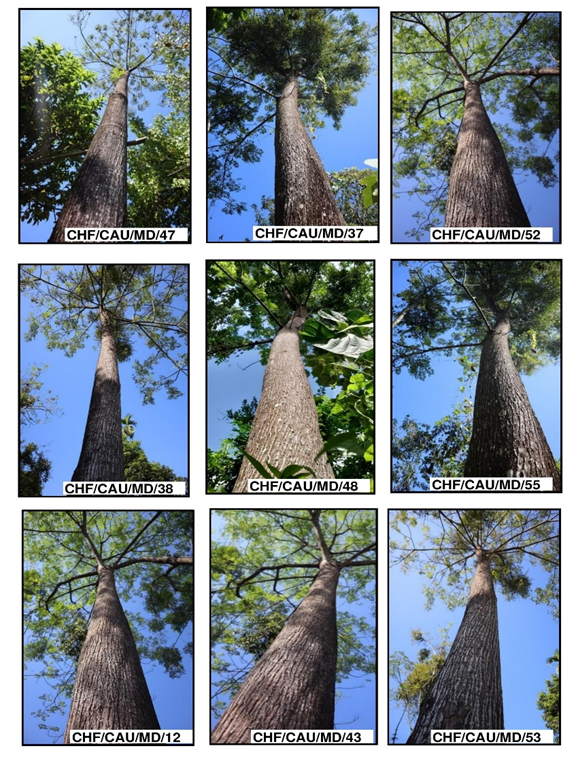
Melia dubia plus trees selected across villages of East Siang district, Arunachal Pradesh. (Source: Daryal, U. (2020). MSc thesis, CHF Pasighat,)
The value of this study is that it turns a general recommendation “plant more Melia dubia” into something farmers and nurseries can act on directly: a named, mapped, and measured set of locally proven trees to propagate from, rather than an unfamiliar import.
Recommended Planting Models
None of this requires abandoning existing cropping patterns. Fast-growing species can be integrated through a handful of straightforward configurations:
- Boundary and bund planting – fast-growing species such as gamari, alder, or bamboo planted at roughly 2–3 metre spacing along field edges double as living fences and windbreaks while continuously shedding biomass onto the plot below.
- Alley cropping– rows of a fast-growing, nitrogen-fixing species (subabul, coral tree, or dhaincha) spaced 4–6 metres apart, interplanted with annual crops and periodically pruned, with the cut branches laid directly as mulch between the crop rows.
- Jhum-fallow enrichment– deliberately seeding or retaining alder, or triallingMelia dubiaat wider spacing (roughly 3.5 × 3.5 metres, as used in established Melia plantations elsewhere in India), on fallow land can shorten the fallow period farmers must observe before the land is productive again, turning a passive waiting period into an active, biomass-generating one.
Why This Belongs in the Natural Farming Conversation
Natural farming’s promise of near-zero input cost only holds if farmers have a genuinely local, renewable source of biomass. Without fast-growing trees on or around the farm, that biomass has to be bought, carted in, or foraged from increasingly distant forest patches – undermining the very premise of the approach. By contrast, a farm boundary lined with alder, gamari, Melia dubia, or bamboo turns biomass production into something the land does automatically, year after year, with minimal labour. For a forestry and horticulture college such as CHF Pasighat, encouraging farmers to treat fast-growing tree planting withMelia dubiaas a well-tested, locally validated starting point – as a first step in adopting natural farming, rather than an afterthought, could meaningfully improve how quickly and how affordably the practice takes root across the state.
Conclusion
Fast-growing trees are not a peripheral detail in natural farming – they are the infrastructure that makes the whole model work. Species already familiar across Arunachal Pradesh, from alder to bamboo to Melia dubia, can supply the mulch, green manure, and fodder that natural farming depends on, without competing for cropland or requiring farmers to learn an unfamiliar system. With locally validated evidence already sitting in CHF Pasighat’s own research -the East Siang plus-tree selections being one clear example -the college is well placed to move this from a general principle into a concrete, farmer-ready extension programme.


More Stories
Chief Minister Of Tripura Dr. Manik Saha Inaugurates, Laid Foundation Stones Of 21 Development Projects In Unakoti.
TRESP Livelihood Success Draws Appreciation From Sepahijala DM During Field Visit To Jampuijala.
Tripura Moving Rapidly Towards Development On PM Modi’s Path: Chief Minister Of Tripura Dr. Manik Saha.