






New Delhi, Delhi, 19th of November, 2026 : As cybercrime becomes increasingly accessible and commercially driven, the cost of launching sophisticated cyberattacks is emerging as a major concern for global cybersecurity. Highlighting this growing challenge, Major Vineet Kumar, Founder of CyberPeace Foundation, called for stronger cyber laws, enhanced investigative capabilities and greater international cooperation during the 3rd Edition of the National Conference on Cyber Security, Digital Forensics & Intelligence (NCCDFI 2026), held on 16–17 November at the Dr. Ambedkar International Centre, New Delhi.
Organised by the National Institute of Electronics and Information Technology (NIELIT), under the Ministry of Electronics and Information Technology (MeitY), Government of India, the two-day conference brought together senior government officials, law enforcement agencies, policymakers, defence representatives, judicial professionals, cybersecurity experts, technology providers and industry leaders to deliberate on India’s evolving cyber threat landscape.
As a knowledge partner, CyberPeace Foundation contributed to discussions on emerging cyber threats, digital forensics, artificial intelligence and the need to strengthen India’s cyber resilience. Addressing Technical Session 2, titled ‘Digital Evidence and Frontier Technologies’, Major Vineet Kumar spoke about the increasing accessibility of cybercrime tools and services, particularly as technology lowers the financial and technical barriers to launching cyberattacks.
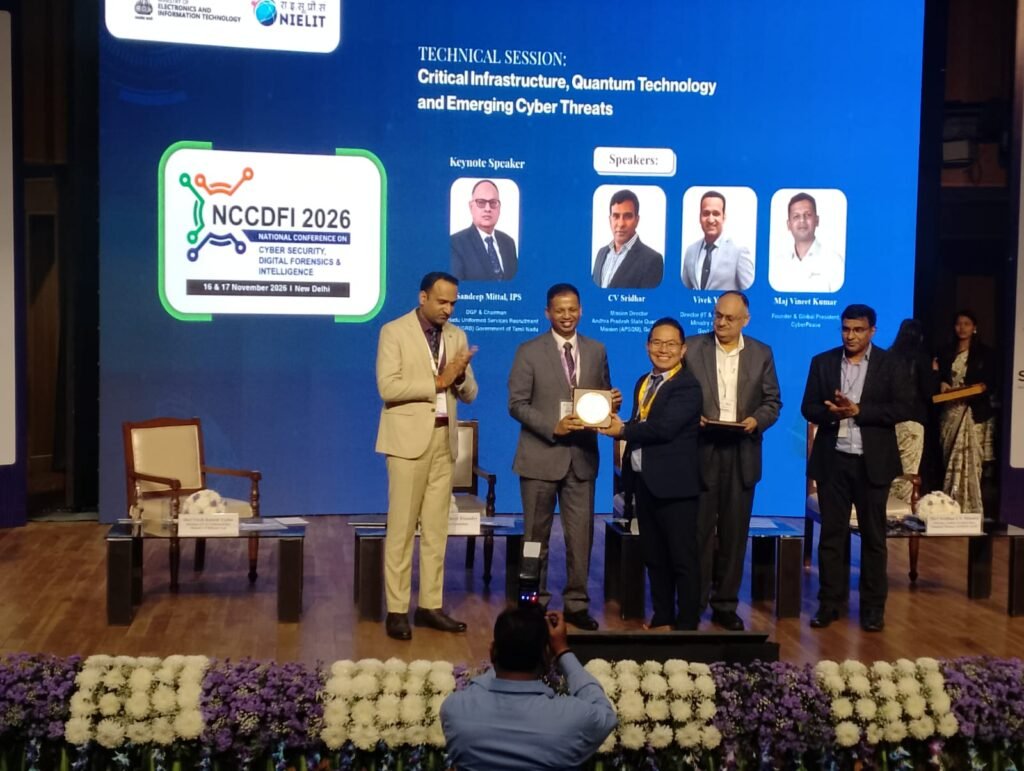
Emphasising the changing economics of cybercrime, Major Vineet Kumar, Founder and Global President, CyberPeace Foundation, said, “The economics of cybercrime have changed dramatically. Today, the cost of launching a cyberattack has reduced significantly, with some malicious tools and services reportedly available for as little as $50. This means that the resources once required to target sophisticated systems are increasingly accessible to individuals with limited technical expertise. Almost everything, from hacking tools to stolen credentials and cybercrime-as-a-service, is finding a marketplace in the digital underground. While technology continues to evolve at an unprecedented pace, our legal frameworks, investigative capabilities and institutional responses must evolve just as rapidly. We need stronger cyber laws, proactive enforcement and greater international cooperation to ensure that the accessibility of technology does not translate into greater opportunities for cybercriminals.”
Major Vineet Kumar also participated in a panel discussion titled ‘The Future of Digital Evidence: Can Law, Forensics and Innovation Keep Pace with Emerging Technologies?’ The discussion brought together experts from cybersecurity, digital forensics, law enforcement and technology to examine the challenges of maintaining investigative effectiveness and evidentiary integrity in an increasingly AI-driven digital environment.
The conference featured seven technical sessions addressing critical areas including national cybersecurity and critical infrastructure, digital evidence, law enforcement readiness, international cooperation, advanced device and drone forensics, cyber intelligence, OSINT, financial cybercrime, artificial intelligence and automated digital investigations.
Another key component was Cyber Kusti 2026, a cybersecurity and AI hackathon conducted alongside the technical sessions. Designed around three levels of competition — Review, Attack and Defend — the initiative provided a platform for participants to demonstrate their cybersecurity skills and problem-solving capabilities through practical challenges.
The conference also featured an exhibition showcasing innovations in digital forensics, cybersecurity, drone technology, surveillance systems and AI-driven security solutions, facilitating interactions between technology providers and institutional stakeholders.
CyberPeace Foundation’s participation at NCCDFI 2026 reinforces its commitment to strengthening India’s cybersecurity ecosystem through awareness, capacity building, policy advocacy and multi-stakeholder collaboration. As emerging technologies continue to reshape the nature and scale of cyber threats, platforms that bring together government, law enforcement, industry and academia will play an increasingly important role in building a secure, resilient and trusted digital environment.
About CyberPeace Foundation:
CyberPeace is an India-headquartered, award-winning organization and think tank composed of cybersecurity and policy experts with a global footprint. Established in 1997, CyberPeace has been at the forefront of shaping policy, conducting research, and delivering training, with a central objective of combating Cyber Warfare, Cyber Weapons, Cyber Crime, and Cyber Terrorism. CyberPeace is dedicated to enhancing the internet's security, stability, trustworthiness, and inclusivity for netizens worldwide. Operating as a non-partisan collective, it brings together expertise, experience, and intent across diverse institutions, disciplines, and cultures to combat the common threat of cybercrime — collaborating regularly with citizens, government organizations, law enforcement agencies, private companies, NGOs, universities, cybersecurity experts, and bug bounty hunters to build a safer, more resilient digital environment for all.




More Stories
Council Of Scientific And Industrial Research Transfers Indigenous Technologies To Industry To Accelerate Commercialisation And Promote Sustainable Development.
Indian AgriTech Strength To Reach From America To Africa, SC Agrotech Makes A Major Global Push.
Spotify’s Project Echo Partners With The Shillong Chamber Choir To Take Meghalaya’s Music To The World.