




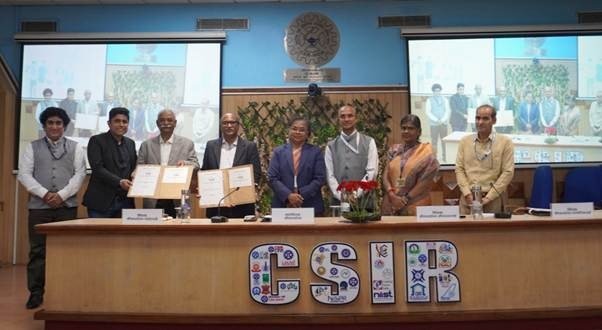
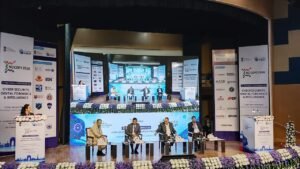
New Delhi, Delhi, 19th of November, 2026 : The Council of Scientific and Industrial Research (CSIR) organised a Technology Transfer (ToT) and MoU signing event at CSIR Headquarters, New Delhi, bringing together CSIR laboratories and industry partners to accelerate the commercialisation and deployment of indigenous technologies. The event, organised as part of CSIR’s monthly technology transfer initiative, featured technologies developed by CSIR-Structural Engineering Research Centre (CSIR-SERC), Chennai; CSIR-Central Road Research Institute (CSIR-CRRI), New Delhi; CSIR-Advanced Materials and Processes Research Institute (CSIR-AMPRI), Bhopal; and CSIR-Indian Institute of Petroleum (CSIR-IIP), Dehradun.
Dr N. Kalaiselvi, Secretary, Department of Scientific and Industrial Research (DSIR), and Director General, CSIR, chaired the event.
Delivering the welcome address, Dr N. Anandavalli, Director, CSIR-SERC, highlighted the laboratory’s longstanding contributions to structural engineering, infrastructure safety and resilience. She emphasised the importance of translating research outcomes into practical solutions through partnerships with industry. Dr Anandavalli also presented an overview of the technologies developed by CSIR-SERC that were being transferred to industry partners.
CSIR-SERC showcased three important technologies addressing critical infrastructure requirements, sustainable construction and the circular economy.
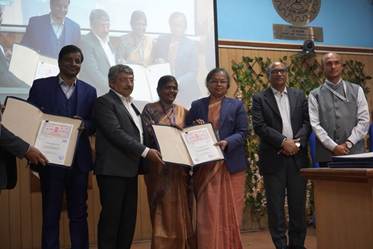
The Emergency Retrieval System (ERS) for Power Lines, developed by CSIR-SERC, is an indigenous, lightweight and modular structural system designed for rapid restoration of electricity transmission lines following failures or disruptions. The technology was transferred to M/s IFAB Global, further expanding its potential for industrial deployment.
CSIR-SERC also transferred its Recycled Aggregate-based Eco-friendly bricks, Hollow Blocks and Paver Blockstechnologies to the National Automotive Test Tracks (NATRAX). These technologies utilise 100% recycled aggregates and industrial waste to manufacture sustainable construction products, reducing dependence on natural aggregates and promoting large-scale utilisation of construction and demolition waste.
Another significant technology transferred to NATRAX for pilot-scale field implementation was Ultra-High-Performance Concrete (UHPC) Pavement Technology. The technology offers high strength, durability, superior resistance to heavy axle loads and reduced maintenance requirements, making it suitable for developing longer-lasting road infrastructure.
Dr Ch. Ravi Sekhar, Director, CSIR-CRRI, presented an overview of the technologies being transferred to industry, highlighting the collaborative research efforts of CSIR-CRRI with CSIR-AMPRI and CSIR-IIP in developing sustainable road construction materials and technologies.
The MicroReAct-RAP™ technology, a sustainable cold micro-surfacing solution incorporating up to 40% reclaimed asphalt pavement (RAP), was transferred to three industry partners: Innovative Roadztech Private Limited, Delhi; AVK BlackGold Infra Private Limited, Surat; and Hindustan Colas Private Limited (HINCOL), Mumbai. The technology reduces the requirement for virgin aggregates and bitumen emulsion while promoting circular utilisation of road construction materials.
Another significant technology transferred was Bio-Bitumen, developed through collaborative research involving CSIR-CRRI and CSIR-IIP. The technology converts agricultural residues, including rice straw (parali), into a biomass-derived material capable of partially replacing conventional petroleum-based bitumen. The Bio-Bitumen technology was transferred to RAACS Solutions Private Limited, Bihar (BioBhoomi), and SAR Parivahan Private Limited, Kolkata.
MoUs to Strengthen Research and Industry Collaboration
CSIR-CRRI also signed two Memoranda of Understanding to strengthen research, technical cooperation and industry engagement.
The first MoU was signed with the Global Automotive Research Centre (GARC), Tamil Nadu, under the National Automotive Board, Ministry of Heavy Industries, for collaboration in joint R&D, shared testing facilities, technical projects, seminars and academic exchanges. Dr A. S. Ramadhas, Director, GARC, signed the MoU on behalf of GARC.
The second MoU was signed with Pārakhi Skill Systems Private Limited, Patna, for collaborative research in driver risk assessment, cognitive and psychomotor evaluation, field trials, research publications and related technology deployment.
Addressing the gathering, Dr N. Kalaiselvi emphasised that it is imperative for CSIR to transfer more and more technologies to industry, ensuring that scientific research undertaken in its laboratories translates into tangible economic, industrial and societal benefits.
She stressed that technology development must be accompanied by effective mechanisms for industrial adoption, commercialisation and scale-up. The monthly technology transfer initiative, she noted, provides an important platform for strengthening the interface between CSIR laboratories and industry and accelerating the journey of innovations from laboratory to market. The DG, CSIR emphasised that the true measure of scientific research lies in its successful translation into products, processes and technologies that benefit industry and society.
The programme concluded with a vote of thanks by Dr Thallada Bhaskar, Director, CSIR-AMPRI, who expressed gratitude to the Director General, CSIR, participating laboratories, industry partners and other stakeholders.


More Stories
When Cybercrime Costs Just $50: Major Vineet Kumar Calls For Stronger Cyber Laws And Global Cooperation At NCCDFI 2026.
Indian AgriTech Strength To Reach From America To Africa, SC Agrotech Makes A Major Global Push.
Spotify’s Project Echo Partners With The Shillong Chamber Choir To Take Meghalaya’s Music To The World.