




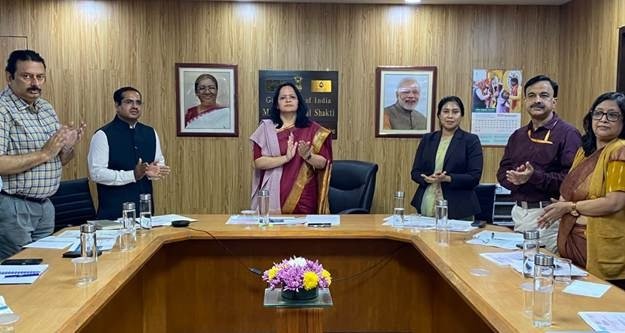
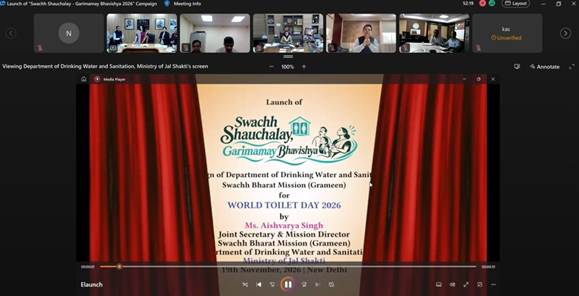
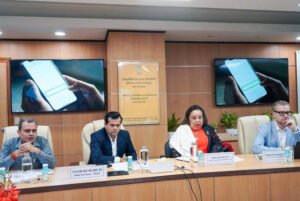
New Delhi, Delhi, 20th of November, 2026 : The Department of Drinking Water and Sanitation (DDWS), Ministry of Jal Shakti, launched the ‘Swachh Shauchalay – Garimamay Bhavishya’ (SSGB) campaign under Swachh Bharat Mission (Grameen) [SBM(G)] yesterday on World Toilet Day, 2026. The campaign and its reporting module were e-launched by Ms. Aishvarya Singh, Joint Secretary & National Mission Director, SBM(G), DDWS.
The event commenced with welcome remarks and context setting for the campaign by the Deputy Secretary, DDWS. This was followed by a brief presentation on the progress of SBM(G) by Director, DDWS which highlighted the achievement of ODF Plus (Model) status in around 89.9% villages and achievements under other components of SBM(G).
Thereafter the ‘Swachh Shauchalay – Garimamay Bhavishya’ campaign was e-launched by Joint Secretary & National Mission Director. She also launched the reporting module designed by DDWS for States/UTs to report progress of the campaign.
The United Nations theme for World Toilet Day 2026, ‘Safe toilets. Equal futures.’, links sanitation to gender equality. Aligned with the same, the Swachh Shauchalay – Garimamay Bhavishya campaign focuses on improving rural sanitation facilities, with particular attention to the needs of women, girl students and Divyangjan.
The objectives of Swachh Shauchalay – Garimamay Bhavishya campaign include: –
- Assessment of the status of CSCs and institutional toilets (Schools, Anganwadi centres and Panchayat Ghar etc) and undertake repairs/maintenance/restoration, as required. For institutional toilets this may be done through concerned authorities (SMC/AWC/GPK/GPB etc). Motivating individual households to also undertake repair/maintenance of their IHHLs, where warranted.
- Assessment of toilet typology for the village and retrofitting of identified single-pit toilets to twin-pit toilets and septic tank without soak pits to septic tank with soak pits, wherever feasible, against targets set by States/UTs.
- Assessment and planning of mechanized desludging wherever operational or required for FSM compliance.
- Assessment and strengthening of O&M arrangements for the upkeep and maintenance of CSCs and institutional toilets.
- Encourage communities to transform CSCs and institutional toilets into welcoming, clean and well-maintained spaces with local wall art, signage and improvement of surroundings. Individual households may also be motivated to do the same for their IHHLs.
- Assessment of the ODF sustainability in the village; promote continued use of toilets through intensive Behaviour Change Communication (BCC) and awareness drives to sustain ODF status.
- Assess the status of Swachh Seva Aankalan (SSA) for the village(s)/Gram Panchayat and ensure SSA completion by 30th November 2026, if not done already; Where SSA has been submitted, way forward for resolution of identified gaps to be discussed.
- Awareness generation on various aspects including, importance of sanitation with particular attention to the needs of women, girl students and Divyangjan/PwDs, maintenance of personal and community hygiene, hand washing with soap, importance of FSM compliance, compliance of Solid Waste Management Rules, 2026, 4-way segregation of waste and Swachh Seva Aankalan.
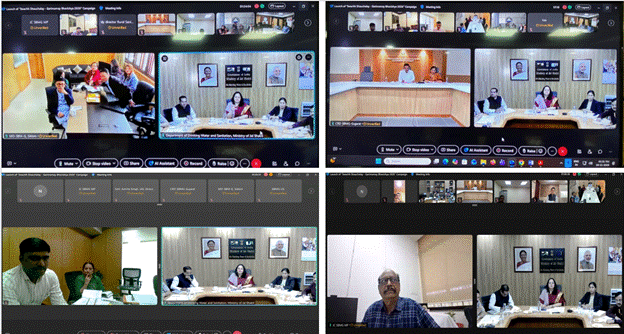
Following this, States/UTs participated in an interaction and apprised regarding their proposed action plans for campaign implementation. SBM(G) teams from Gujarat, Madhya Pradesh, Sikkim and Karnataka shared their planned activities for the campaign.
Speaking at the e-launch, Ms. Aishvarya Singh, Joint Secretary & National Mission Director, SBM(G), emphasised that the Swachh Shauchalay – Garimamay Bhavishya campaign has been designed around dignity for all and sanitation for all. She highlighted that the SSGB campaign also focuses on school children as future custodians of Swachhata, sensitizing them onSwachhata, importance of sanitation & hygiene and community participation for keeping toilets clean and accessible to all.
Joint Secretary & National Mission Director, SBM(G) called on the State/UT SBM(G) teams to coordinate with School Management Committees and the concerned Departments to facilitate participation of school children in the campaign including for school sanitation audits. She further highlighted the importance of clean and functional CSCs at places with high public footfall areas including in tourist places in the country, recognizing their contribution directly to overall visitor experience and indirectly to the local economy.
The e- launch concluded with an appeal to all States/UTs for ensuring engagement with different stakeholders, making it a successful campaign driven by Jan Bhagidari for Sampoorna Swachhata.


More Stories
IIT Mandi Researchers Develop AI-Based Mathematical Model To Predict Changes In Wildlife Populations.
MeitY Engages with UN Special Rapporteur on Digital Accessibility and Inclusion of Persons with Disabilities.
V-Guard Launches Cool Wires, Powered By ICE 300 Engineering, Bringing A New Dimension To Wire Performance.