




New Delhi, Delhi, 16th of January, 2026 : The Hon’ble Deputy Chairman, Rajya Sabha today addressed the Lightning Round Session of the 28th Conference of Speakers and Presiding Officers of the Commonwealth (CSPOC), held in New Delhi, on the theme “Women’s Contribution to India’s Three-Tier System of Governance”.
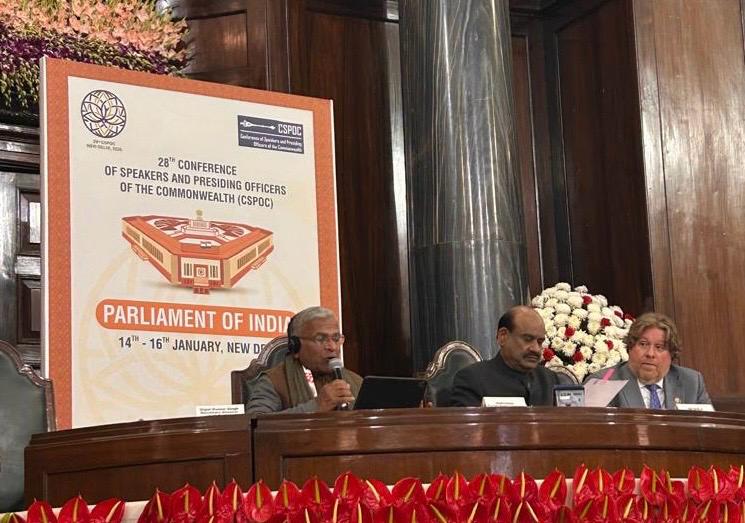
Addressing the distinguished delegates, the Hon’ble Deputy Chairman shared India’s lived experience of women’s participation in governance across its three-tier democratic framework comprising Parliament at the Union level, State Legislatures and Local Self-Government institutions. He noted that this framework is based on vertical power-sharing among the Centre, States and grassroots institutions and has acquired global significance due to the constitutional and institutional inclusion of women, particularly at the local level.
The Hon’ble Deputy Chairman observed that India’s experience demonstrates how women’s participation strengthens democratic legitimacy and improves governance outcomes. He stated that India’s journey of women’s political participation is deeply rooted in its civilisational ethos, where deliberative assemblies and collective decision-making have historically witnessed meaningful participation by women.
Referring to India’s constitutional evolution, the Hon’ble Deputy Chairman noted that women were enfranchised in several provinces as early as the 1920s, much before Independence. With the adoption of universal adult franchise in 1950, India took a bold and progressive step by ensuring political equality from the very inception of the Republic.
The Hon’ble Deputy Chairman further stated that the commitment to gender equality was deepened through the 73rd and 74th Constitutional Amendments in the early 1990s, which mandated one-third reservation for women in rural and urban local bodies. He observed that this provision has since been enhanced to 50 per cent reservation in rural local bodies by over two-thirds of States, and by nearly half the States in urban local bodies.
Highlighting the scale of women’s participation, the Hon’ble Deputy Chairman referred to the observations made by the Hon’ble Prime Minister of India, Shri Narendra Modi, and noted that nearly 1.5 million women currently serve as elected representatives in local self-governing bodies. He described this as the largest experiment in women’s political representation anywhere in the world.
The Hon’ble Deputy Chairman observed that for many women, particularly from rural and marginalised sections of society, local bodies serve as the first point of entry into public life. This unprecedented scale of participation, he noted, has begun translating into tangible improvements in the quality of local governance.
The Hon’ble Deputy Chairman highlighted that studies and field experience indicate that women-led local bodies demonstrate higher levels of transparency, closer monitoring and stronger accountability. He noted that due to their close engagement with communities, leakages are often reduced and the benefits of government programmes and schemes reach intended beneficiaries more effectively.
Referring to governance priorities, the Hon’ble Deputy Chairman stated that women leaders have consistently focused on issues such as safe drinking water, sanitation, primary healthcare, education, nutrition and social welfare delivery. He observed that with increasing participation of women across all three tiers of governance, the emphasis has gradually shifted from women’s development to women-led development.
The Hon’ble Deputy Chairman further noted that women’s participation in local governance has challenged traditional gender roles and created a large pool of experienced women leaders who move on to State Legislatures and the national Parliament. He observed that many such leaders have gone on to serve as Ministers, Speakers, Chief Ministers and Presiding Officers, including in the highest constitutional offices of the country.
Referring to recent constitutional reforms, the Hon’ble Deputy Chairman stated that the passage of the 106th Constitutional Amendment, the ‘Nari Shakti Vandan Adhiniyam’, marks a significant milestone by providing 33 per cent reservation for women in the Lok Sabha and State Legislative Assemblies. He described this as a reaffirmation of India’s long-term commitment to gender balance in parliamentary representation.
Summarising key lessons from India’s experience, the Hon’ble Deputy Chairman observed that local governance provides a sustainable entry point for women’s leadership; that diversity and scale are not barriers to inclusion; and that women’s leadership improves governance outcomes, rather than merely improving representation statistics.
For the Commonwealth, the Hon’ble Deputy Chairman stated, India’s experience reinforces the shared conviction that inclusive parliaments are stronger parliaments, and that democracies flourish when women participate as equal partners in governance.


More Stories
Beyond Property Management: Stakeholders Discuss Need For Stronger Charitable Institutions In Assam.
IAF Commences Operational Phase At Jodhpur.
Vice-President Shri C. P. Radhakrishnan Graces The 15th Graduation Day Ceremony Of Sree Uthradom Thirunal (SUT) Academy Of Medical Sciences In Thiruvananthapuram.