





New Delhi, Delhi, 12th of December, 2025 :
- World’s first inter-continental translocation of a large carnivore successfully completed with 20 cheetahs from Namibia and South Africa (2022-23) coming to India.
- Prime Minister Shri Narendra Modi personally released the first eight cheetahs on 17 September 2022
- As of December 2025, India has a total of 30 cheetahs – 12 adults, 9 sub-adults, and 9 cubs – comprising 11 founder animals and 19 India-born individuals.
- Mukhi, the first cheetah cub born on Indian soil, has herself become a mother to five healthy cubs.
- Over 450 Cheetah Mitras, 380 direct jobs, and 5% eco-tourism revenue share created for local communities around Kuno.
- India is on track to establish a self-sustaining metapopulation of 60–70 cheetahs across 17,000 km² by 2032, with Gandhi Sagar Wildlife Sanctuary ready for the next phase.
Introduction
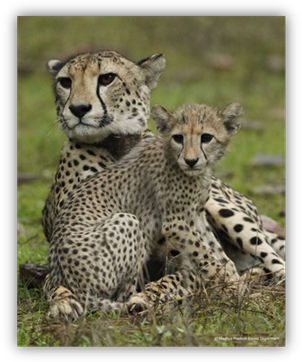
In the golden hues of a September dawn in 2022, eight majestic cheetahs from the Namibian savannas touched down on Indian soil, their paws marking the first steps of a species long absent from the subcontinent. This historic moment, presided over by Prime Minister Shri Narendra Modi at Kuno National Park in Madhya Pradesh, heralded Project Cheetah, the world’s first inter-continental translocation of a large carnivore. Fast-forward to November 2025: Mukhi, the first cheetah cub born on Indian soil, has herself become a mother to five healthy cubs, symbolizing not just biological resurgence but a profound testament to human stewardship over nature’s delicate balance. Launched on September 17, 2022, under the aegis of the Ministry of Environment, Forest and Climate Change (MoEFCC) and spearheaded by the National Tiger Conservation Authority (NTCA), Project Cheetah embodies India’s unwavering commitment to biodiversity restoration. Drawing from the 2013 Action Plan and Supreme Court directives, it seeks to reintroduce the Asiatic cheetah (Acinonyx jubatus, declared extinct in India in 1952) as a flagship species, fostering ecosystem health across vast landscapes.
As of December 2025, Kuno supports a population of 30 cheetahs. With a further eight cheetahs arriving in India from Botswana, the project continues to stand as a beacon of hope, earning international recognition for its scientific rigour and diplomatic finesse.
What began as a conservation experiment has grown into a statement of ecological optimism and national commitment: a chance to restore a broken ecological link, honour our natural heritage, and lead a global effort in large-carnivore rewilding.
Historical Context: From Extinction to Renaissance
The cheetah’s tale in India is woven into the fabric of ancient lore, with the animal being a favoured hunting companion. The Asiatic cheetah, once roaming from the Arabian Peninsula to the Indian subcontinent, vanished from independent India, leaving a void in the grassland-savanna biome. Historically, the Asiatic cheetah ranged widely across India, from Punjab in the north to Tirunelveli in Tamil Nadu, and from Gujarat and Rajasthan in the west to Bengal in the east, occupying diverse open habitats, including scrub forests, dry grasslands, savannas, and other arid to semi-arid landscapes.
The final confirmed sighting of wild cheetahs in India occurred in 1947, when three animals were shot in the Sal (Shorea robusta) forests of Koriya district in present-day Chhattisgarh. Five years later, in 1952, the species was officially declared extinct in India, marking the end of its native presence on the subcontinent.
India’s native Asiatic cheetah vanished due to a combination of excessive hunting, poaching, and the use of cheetahs for coursing. Large-scale habitat loss from agriculture, decline of prey, climate pressures, and the species’ low reproductive rate and narrow genetic base further accelerated their extinction.
Endorsed by an expert committee, Kuno NP was selected as the optimal reintroduction site after the relocation of 24 villages (1,545 families), creating nearly 6,258 hectares, post- incentivized voluntary relocation, of inviolate grassland for the cheetahs.
By 2022, fortified by Convention on Biological Diversity (CBD)-aligned strategies for species recovery, India transformed this plan into action. The project’s ethos resonates with UN Sustainable Development Goal 15 (Life on Land), positioning India as a leader in reversing biodiversity loss through transboundary conservation.
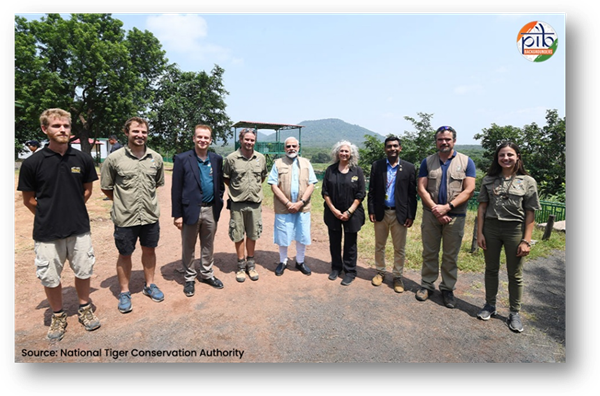
Prime Minister Shri Narendra Modi’s personal vision and sustained intervention have been the driving force behind Project Cheetah, transforming a decades-old dream into a living reality. From directing the formulation of the 2022 Action Plan and pushing for the world’s first inter-continental cheetah translocation, to personally releasing the first eight Namibian cheetahs into Kuno National Park on 17 September 2022, he has remained deeply invested at every stage. He facilitated high-level MoUs with Namibia (July 2022) and South Africa (January 2023), engaged the nation by inviting citizens through Mann Ki Baat to name the cheetahs, and consistently highlighted milestones such as the birth of the first Indian cubs in 2023 and the historic second-generation litter litter in November 2025. As of December 2025, India has a total of 30 cheetahs – 12 adults, 9 sub-adults, and 9 cubs – comprising 11 founder stock and 19 India-born cheetahs.
By linking the project to Mission LiFE and India’s G20 “One Earth, One Family, One Future” ethos, PM Modi has elevated Project Cheetah into a global symbol of science-driven, community-inclusive rewilding, personally overseeing its progress and ensuring that the roar of the cheetah, silent in India for over seven decades, echoes once again across its ancient grasslands.
| Date | Event / Milestone |
| 17 Sep 2022 | First batch of 8 African cheetahs (5 females, 3 males) flown from Namibia to India, released into quarantine enclosures in Kuno National Park (KNP), Madhya Pradesh. |
| Feb 2023 | Second batch: 12 cheetahs flown from South Africa under MoU between India and South Africa. |
| 2023 (first 6 months) | First births on Indian soil: cubs born to imported cheetahs, first cheetah births in India in over 70 years. |
| 2024 onwards | Phase-wise releases from acclimatization bomas into open wilderness begin; soft-release protocols followed internationally. |
| 2024-25 | Expansion of the programme plans to bring new cheetahs (e.g. from Botswana), and to extend to additional habitats beyond Kuno. In November 2025, Botswana gifted eight cheetahs to India. |
Objectives and Strategic Framework
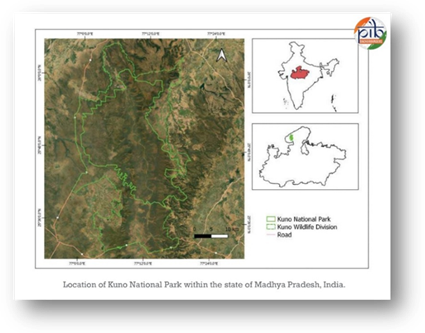
Project Cheetah’s mandate is multifaceted with establishment of a viable metapopulation of 60-70 cheetahs across 17,000 km² in the Kuno-Gandhi Sagar landscape, and restore open forests and grasslands, along with mitigating climate impacts via enhanced carbon sinks. Under Project Cheetah, the cheetah has been designated as a flagship/umbrella species. The official plan aims to use its reintroduction to restore neglected grassland and semi-arid ecosystems, thereby benefiting prey species and other grassland‑dependent biodiversity.
Phased implementation ensures ecological prudence through:
- Founder stock introduction into Kuno National park’s 748 km² core area, expanding to 3,200 km² landscape. About 12–14 wild cheetahs of reproductive age, genetically diverse, disease-free, predator-wary, capable hunters, and socially compatible, sourced from South Africa, Namibia, or other African countries as founder stock for the first five years, with additional imports as needed.
- Metapopulation linkage with Gandhi Sagar Wildlife Sanctuary (368 km² sanctuary, 2,500 km² potential habitat) located about 300 km from Kuno. The long-term goal is to establish a metapopulation of 60-70 Cheetahs in the Kuno-Gandhisagar landscape after ensuring restorative measures, prey availability and ensuring scientific management.
- Self-sustaining growth: If a net annual growth rate of about 5% is maintained, accounting for natural mortality, births, and periodic supplementation, the released population is expected to reach its carrying capacity in roughly 15 years.
Budgetary support underscores resolve: INR 39 crore (USD 5 million) for Phase 1, integrated into the Centrally Sponsored Scheme-Project Tiger,with additional allocations for prey translocation and infrastructure. Monitoring adheres to IUCN Guidelines (2013) employing GPS collars,camera traps and distance sampling (734-816 km transects for monitoring prey & habitat).
Milestones and Achievements: A Data-Driven Triumph
Project Cheetah’s ledger brims with quantifiable successes, blending innovation with resilience. By February 2023, 20 cheetahs (8 from Namibia: 5 females, 3 males; 12 from South Africa: 5 females, 7 males) were translocated via Indian Air Force C-17 Globemasters, a logistical marvel spanning more than 7900 kms without morbidity.
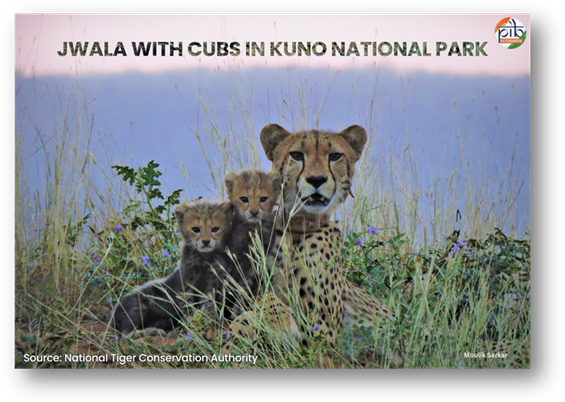
Early breeding is one of the strongest biological signals that a species has adjusted well to its new environment. The successful reproduction of cheetahs in Kuno so soon after their translocation indicates that the landscape is meeting their essential ecological needs, adequate prey, suitable habitat, and low stress levels. This early reproductive success is a powerful marker of habitat suitability and ecological stability, affirming that the reintroduction strategy is working as intended. It suggests that Kuno is not just supporting cheetahs in the short term but has the potential to sustain a healthy, viable population over the long run.
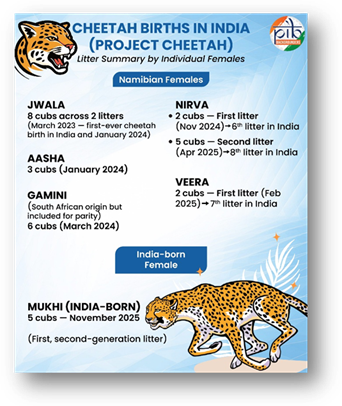
litters include:
- Jwala (Namibian female): 8 cubs across two litters (March 2023 – First born litter in India and January 2024)
- Aasha (Namibian): 3 cubs (January 2024)
- Gamini (South African): 6 cubs (March 2024)
- Nirva (Namibian female): 2 cubs in her first litter, 6th litter in India(November 2024); 5 cubs in her second litter, 8th litter in India (April 2025)
- Veera (Namibian female): 2 cubs in her first litter, 7th litter in India (February 2025)
- Mukhi (Indian-born): 5 cubs (November 2025), a genetic milestone for second-generation viability
Female Aasha ranges across 121 km², while her three sub-adult male cubs use a much larger 1,508 km² area. The male coalition Agni–Vayu holds a home range of 1,819 km². Female Gamini and her four sub-adult cubs occupy an extensive 6,160 km² range, and female Jwala with her four sub-adult cubs uses a home range of 3,139 km².
| Did You Know?Kuno National Park in Madhya Pradesh was selected as India’s first cheetah reintroduction site because it offers ideal habitat, abundant prey, and minimal human disturbance, thanks to earlier village relocations. The Wildlife Institute of India (WII) and NTCA’s Action Plan identifies Kuno as ready for cheetahs, making it the perfect home for these big cats after more than 70 years. |
Community and Livelihood Empowerment: Partners in Preservation
At Project Cheetah’s heart lies inclusive conservation. Over 450 “Cheetah Mitras” in 80 villages serve as vigilant ambassadors, conducting 150 awareness sammelans and 16 Anubhuti camps for 2,200 students.
Employment surges: 80 locals as cheetah trackers, 200 as “Surksha Sramik” for patrols, and local youth trained as safari guides.
Eco-development: roads, check dams, sanitation, spans 100+ villages in the Cheetah zone, fostering coexistence. This model, echoed in UNEP-CBD frameworks exemplifies community-led biodiversity gains.
International Collaboration: A Symphony of Shared Stewardship
Project Cheetah stands as a landmark in global wildlife diplomacy, built on deep, formalised cooperation between India and African range countries. Under the inter-governmental MoU between India and South Africa (signed January 2023) , both nations committed to a long-term partnership in cheetah translocation, custodianship, training, and technology transfer, an arrangement reviewed every five years to ensure continuity and relevance. This followed India’s historic first-ever intercontinental wild-to-wild cheetah translocation from Namibia in 2022, making Project Cheetah the world’s first large carnivore reintroduction across continents. Expert teams from Namibia and South Africa jointly carried out capture, quarantine, airlift, and release operations, while Indian wildlife managers received extensive hands-on training in carnivore handling, monitoring, radio-collaring, and post-release management. Sourcing cheetahs from genetically diverse southern African populations further strengthens India’s founding population and aligns with global conservation responsibility. India has also documented Project Cheetah as a model for rewilding and species recovery across its national submissions to global biodiversity forums, reinforcing the initiative’s multilateral character. This collaborative framework, anchored in formal agreements, joint field operations, and iterative training exchangepositions Project Cheetah not merely as India’s conservation endeavour but as a global restoration mission that exemplifies how threatened species can be revived through science-led,
| International Big Cat AllianceIndia has elevated its global conservation leadership through the establishment of the International Big Cat Alliance (IBCA), a flagship initiative of the Prime Minister Narendra Modi, dedicated to safeguarding the future of the world’s seven big cat species, including the cheetah. Headquartered in India with ₹150 crore budgetary support for five years till 2027–28, it was formally launched by the Prime Minister on 9 April 2023 during the commemoration of 50 years of Project Tiger. Designed to strengthen transnational cooperation, shared research, capacity building and technology transfer among range countries, the Alliance positions India as a global hub for big cat conservation and collaborative ecological stewardship. By embedding Project Cheetah within this broader international framework, India underscores its commitment to collaborative ecological stewardship and presents a unified global strategy for species revival, demonstrating how threatened predators can be restored through science-led, transnational partnerships. |
transnational cooperation.
Conclusion: An Invitation to Global Acclaim
Project Cheetah is more than reintroduction; it is India’s ode to ecological harmony, where science, diplomacy, and community converge to heal a fractured wild. With cheetahs thriving in India, it invites the world to celebrate this renaissance, a model for CBD nations, where extinct echoes race back to life. Let this story inspire: In India’s grasslands, hope sprints eternal.
About The Author




More Stories
Dona Ganguly’s Artistic Brilliance Illuminates Vasanta Utsav At Indian Museum.
Janaushadhi Saptah 2026 kicks off with Health Camps across the Country including Assam.
Vantara Foundation Day: One Year After Inauguration By Prime Minister Narendra Modi, Many Animals Restored To Health And Returned To The Wild.