





Chennai Tamilnadu 25th of November 2026 : AI agents now book, pay, write code and move goods across companies, often acting first and explaining later. Two filed Metainventions set out to restore the right sequence. The 0→1 Doctrine checks each consequential act against the rules people set before it runs, then seals the result: Authorized Intelligence by design. Band-Based Archive Triage (BBAT) turns dormant data behind the data wall into governed AI signals, without exposing records.
| WHY ONE SCALE MATTERS Science never agreed on one way to count. A hospital measures in millimetres of mercury, a port in tonnes, a bank in basis points and AI in odds. The 0→1 Doctrine gives each measure its own range from zero to one, with its meaning attached, so needs, abilities and rules from different fields can be compared on equal terms. This article covers one thin slice: the moment before AI acts. |
THE ORDER HAS FLIPPED
Not long ago, AI suggested and people decided. Today, AI agents place orders, release payments, merge code and dispatch vehicles on their own, across company lines. The usual pattern is act now, log it, review later. A log explains damage; it seldom prevents it. Researchers found that a harmful goal, split into small steps across several agents, slips past monitors that watch each agent alone. Security testers showed that one planted line could talk a risk check below its own threshold. Both point to the same gap: the check arrives too late.
CHECKS THAT SIT BESIDE THE ACT
Training shapes how a model behaves. Filters screen its words. Permission settings fence its tools inside one company. Yet each guards its own corner, keeps its own rules and writes its own log. The moment that matters most, when one company’s AI acts on another company’s goods, money or data, rarely meets a single gate both sides can trust.
ONE GATE, IN A FIXED ORDER
Inventor Vatsal Soin’s filings turn that moment into a sequence. In the 0→1 Doctrine, each need takes the form of User System Parameters (USP), carried as ranges inside a User Compliance Code (UCC), while the raw details stay where they began. The required product or service is written as a Product Design Token (PDT), and each supplier’s real capacity as an Asset Capability Token (ACT). The Service-Product Fit Score (SFS) measures how well the two meet. Only then does the Manufacturing Authorization Token (MAT) open or stay shut, after testing safety, law, certification and feasibility. A high fit never outweighs a broken rule, and when rules collide, the strictest governs unless a recorded override applies. Once the act is under way, the Orchestration and Compliance Token (OCT) keeps watch and can halt or redirect it. Finally, the Actuation Compliance Receipt (ACR) seals a record of every check, with no raw data inside. Either side may be an AI agent.
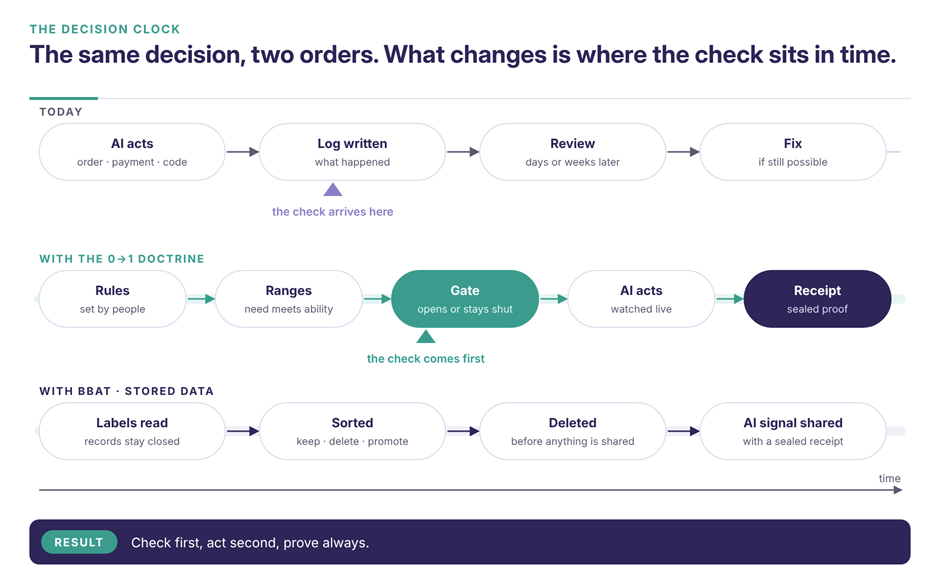
Figure 1. Where the check sits in time.
A DECISION, START TO FINISH
Illustrative example: a utility’s AI agent tries to buy power from a solar trader’s AI in a neighbouring market. On price and timing the match is strong, about 0.91. But the trader’s grid-certification range sits between 0.70 and 0.80, while the required range runs from 0.85 to 1. The gate refuses before any trade is placed. The sealed receipt records the refusal, and why, without a single customer meter reading.
THE SAME ORDER FOR STORED DATA
BBAT looks at nothing but the labels attached to a record: how old it is, what consent covers it, its purpose and any legal hold. From those alone it keeps, deletes or promotes the record without opening it. A promoted record is handled solely in a Trusted Execution Environment (TEE), a sealed zone inside the chip. Under Delete-Before-Share, the records used there are deleted inside a declared scope; a Hardware Attestation Certificate (HAC) then attests that deletion before anything is released. What leaves is Band-Derived Training Signals (BDTS): patterns for AI training, each tested against attempts to rebuild individual records before release, and held back if it fails. This is Dark Data Monetisation Without Exposure (DDME): dormant data behind the data wall, put to use without being exposed. Promotion is not permission: every use needs its own approval.
LESSONS FROM GREAT INVENTIONS
Railway signalling locked out a dangerous route before a train entered. Card networks approved each payment before money moved, then recorded it. The barcode let a shop read a label without opening the box. Email and internet protocols gave strangers’ computers a common format. PageRank ranked pages by their links. The two filings join these patterns into one sequence for AI: patterns compared, not places in history.
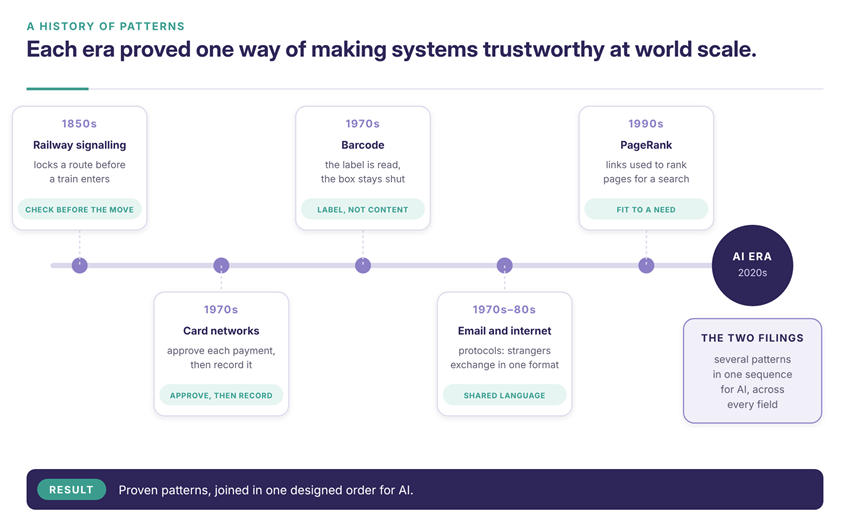
Figure 2. Proven patterns, one sequence for AI.
WHY AI LEADERS AND INVESTORS SHOULD CARE
Neither invention asks a company to rip out what it has built; each works as a layer over existing systems. AI firms can let agents trade across company lines with proof attached to every step, and give auditors records they can verify without seeing model weights or customer files. A sealed receipt shows which checks ran. For investors, it is governance that grows with the rules.
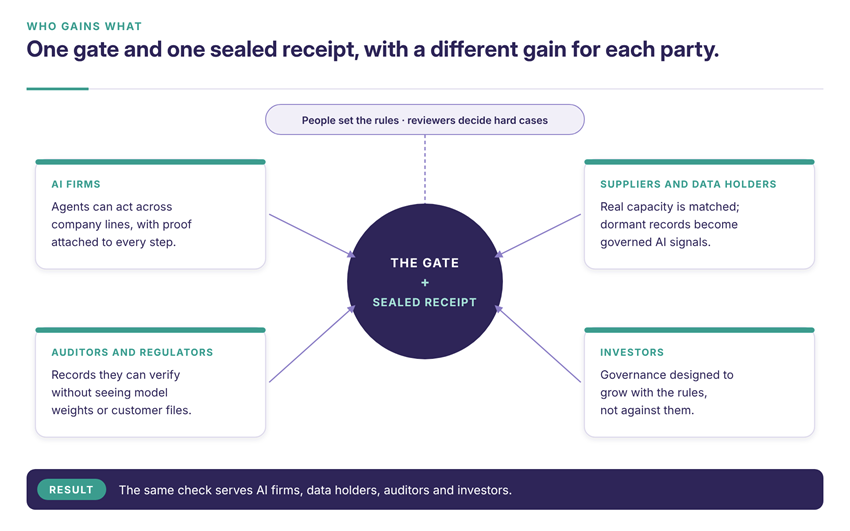
Figure 3. Who gains what from one gate.
PEOPLE REMAIN IN CHARGE
People write the rules; the gate applies them. Any doubtful case is sent to a qualified reviewer, and operators can approve, change or stop a decision at every stage.
A SMALL PART OF A LARGER DESIGN
The moment before AI acts is one narrow use of two domain-agnostic inventions, built for products, services, assets and archives of every kind. The gate tests decisions against rules people declare; it does not judge whether those rules are wise. A receipt proves which checks ran on the data supplied. The two inventions are filed separately; each can run alone or alongside the other.
QUICK ANSWERS
| 01 Will this slow our agents? It adds one check before the act, working on ranges, not raw files. | 02 Can a strong match override a rule? A failed must-pass rule stops the act, however strong the match. |
| 03 What crosses company lines? Ranges, decisions and sealed receipts. Raw records remain where they are held. | 04 Who checks the receipts? Anyone permitted: the firms involved, auditors and regulators. |
LOOKING AHEAD: AGI AND BEYOND
Agentic AI is working today. Superintelligence, and the artificial general intelligence (AGI) expected before it, still lie ahead, and no one can date a singularity. Tomorrow’s science may hand AI the lab bench, the power grid and the trading floor. The filed sequence does not change with the power of the system asking to act: rules first, action only when cleared, proof every time.
CLOSING NOTE
Every great system learned one lesson: check before the move. AI, and one day superintelligence, must learn it too: ask first, act after.
This can be tested, live, via API, governed against ungoverned, side by side.
THE INVENTOR
Systems theorist, inventor, and serial entrepreneur Vatsal Soin holds grants in the US, Japan, India and more; filings span six continents; latest grant, AI footwear, August 2026. Inventions: footwear, apparel fit, Sharable Size Cards, digital twins, robotics, global governed data, archive triage, quantum-resilient cryptography, AI governance. SIM–RMIT and NTU alumnus. Every prior invention was a step; 0→1 is the destination.
SELECTED REFERENCES
Granted: US Patent 12,446,652 B2 · Japan Patent 7560909 · India Patents 454081 and 599317. Filed: PCT/IN2025/051943 · US 19/489,595 · India 202511115781 · Australia AU2022450649 · India 202611113867 (23 September 2026) · PCT/IN2026/052042 (1 October 2026).
DISCLAIMER
Informational only. Not certified. No endorsement implied. Not investment advice. Examples are illustrative, not field results. Vatsal Soin · © 2026 All Rights Reserved.




More Stories
Apollo Women’s Hospitals Launches Centre Of Excellence For Fibroids, Builds On Experience Of 20,000+ Cases.
The Union Health Ministry Observes Constitution Day With Collective Reading Of The Preamble, Reaffirms Allegiance And Commitment To The Constitution.
Kyrgyz Drama ‘Skylark’ Brings Stories Of Displacement, Memory And Resilience To IFFI.