





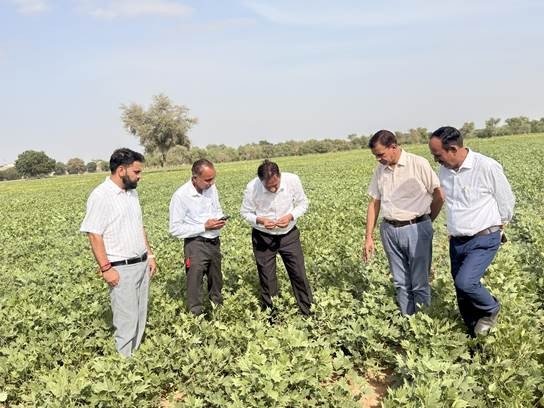
New Delhi, Delhi, 13th of September, 2026 : Moth bean, one of the most important pulse crops of the hot arid regions of western Rajasthan, is cultivated over nearly 10 lakh hectares. However, its productivity remains low at around 350 kg per hectare, primarily due to low, erratic and uncertain rainfall of 150–250 mm, prolonged dry spells of 20–30 days and limited availability of soil moisture. Under such challenging conditions, the ability of a variety to withstand moisture stress, maintain growth and continue reproductive development is critical for sustaining crop production.
Addressing these challenges, the ICAR–Central Arid Zone Research Institute (CAZRI), Jodhpur, has undertaken long-term moth bean breeding and genetic improvement programmes aimed at developing varieties with developmental plasticity, enhanced stress resilience and high yield potential suited to the harsh and unpredictable conditions of the arid region. In the last three years, four varieties—CAZRI Moth-4, CAZRI Moth-5, CAZRI Moth-6 and CAZRI Moth-7—have been released. Their performance during the current El Niño year (Kharif 2026) has demonstrated remarkable field-level resilience, particularly under a prolonged moisture stress period of around 35 days.
During the crop growth period from 10 July to 2 September 2026, cumulative pan evaporation was around 317 mm. Rainfall ceased after the rainfall event of 3 August 2026, resulting in a prolonged rainless period during the subsequent crop growth and reproductive stages. During the 35-day dry spell from 3 August to 7 September 2026, cumulative pan evaporation was around 180 mm. The crop received rainfall mainly during the early stages of establishment and growth. Early canopy development, soil binding and moisture retention in the rhizosphere supported crop establishment and helped the plants withstand the prolonged dry spell. Surface soil moisture at 0–10 cm depth was around 15–16 per cent (v/v) until 2 August 2026, when the last significant rainfall of 86 mm was received. Thereafter, a dry spell of more than one month, accompanied by three to four scattered rainfall events of less than 2.5 mm each, reduced surface soil moisture to around 5–6 per cent. At the 10–40 cm subsurface layer, soil moisture declined from around 23 per cent to 16 per cent, which continued to contribute to meeting the crop’s water requirement.
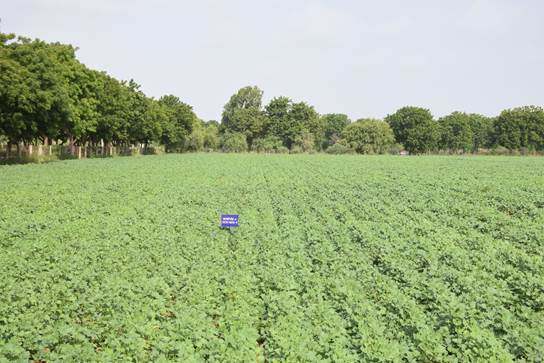
The field performance of the CAZRI varieties was supported by appropriate crop management practices, including timely sowing with the onset of the monsoon in July, optimum plant geometry of 45 × 10 cm, mechanical interculture operations at 20 days after sowing for moisture conservation, mechanical weed management along with manual spot weeding and effective canopy development for efficient utilisation of available soil moisture. The experimental fields had poor fertility conditions, with organic carbon content of 0.13–0.18 per cent, soil pH of 7.9–8.1, available nitrogen of 90–100 kg per hectare, available phosphorus of 10–15 kg per hectare and available potassium of 250–260 kg per hectare.
The four recently developed CAZRI moth bean varieties are also being multiplied for seed production. Seed production is currently being undertaken over seven hectares at the CAZRI Research Farm to meet the Saathi Portal-indented seed requirement of 23.32 quintals for 2026. In 2025, the seed indented through the Saathi Portal for all four varieties was 63.2 quintals. One quintal of breeder seed can produce around 1,000–1,400 quintals of certified seed and, when properly multiplied and marketed as certified seed, can facilitate cultivation over around 10,000 hectares. Even at 50 per cent of this potential, wider adoption of these varieties in Rajasthan could cover around 25 per cent of the total moth bean area. The seed is being multiplied by Rajasthan State Seeds Corporation, National Seeds Corporation and selected private players.
The performance of these varieties was particularly significant as the prolonged moisture deficit coincided with flowering, pod formation and reproductive development. Despite the extended period without substantial rainfall, the varieties maintained a green appearance, good growth and profuse pod development at around 55 days after sowing. Developed through more than a decade of systematic moth bean breeding and genetic improvement at CAZRI, these varieties have been selected with emphasis on adaptation to the harsh and unpredictable arid environment of western Rajasthan. Their ability to maintain active vegetative growth and reproductive development during the prolonged rainless period provides an important field-level indication of their genetic potential and adaptability to moisture-stress conditions.
An important adaptation characteristic of these varieties is developmental plasticity. The varieties begin flowering at approximately 30 days after sowing and possess the ability to adjust their growth and maturity according to the availability of soil moisture. Such flexibility is particularly valuable in western Rajasthan, where rainfall varies considerably in amount, timing and distribution. The ability to progress rapidly towards reproductive development while efficiently utilising available soil moisture, combined with appropriate crop management, provides an important adaptation advantage for moth bean cultivation under rainfed arid conditions.
Dr M. L. Jat, Secretary, Department of Agricultural Research and Education (DARE) and Director General, ICAR, said that moth bean is a unique crop of the Thar Desert wherein these highly climate-resilient moth bean varieties of CAZRI could play an important role in making the Thar Desert more prosperous and creating new income opportunities for farmers and contributing to achieving self-reliance on pulses. He said that the ability of these varieties to maintain growth and pod development during a prolonged period without rainfall demonstrates the potential of genetic improvement as an important component of climate-resilient agriculture. At the same time, he emphasised that a package of best management practices such as optimum plant population, timely sowing, weed management and moisture-conservation practices are essential for enabling varieties to realise their genetic potential under stress conditions.



More Stories
BRICS Backs Expert Group On Traditional Medicine, Calls For Evidence-Based Global Cooperation.
Anup Jalota Launches ‘Bhaktidwar’ Anup Jalota Becomes The ‘Saarthi’ Of ‘Bhaktidwar’.
INS Kulish Arrives At Ream Naval Base, Cambodia As Part Of Eastern Fleet Operational Deployment.