




Lembucherra, Agartala, Tripura, 31st of October, 2026 : Citrus Decline And Its Management In Northeast India : Mahesh B Tengli, Prashant Kisan Nimbolkar, Dwipendra Thakuria And Anupam Mishra.
Citrus began in these hills, yet our orange trees are dying young. What has gone wrong, and what can still be put right?
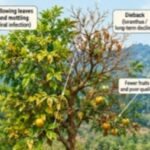
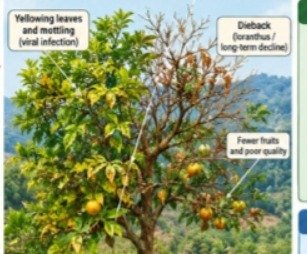
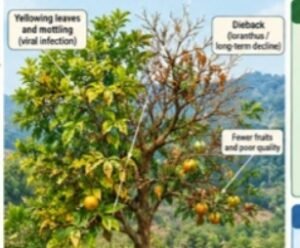
Anyone who has spent a winter in the orange belts of the Northeast knows this sight. It is December, when a Khasi mandarin tree should be bending under its fruit. Instead, it stands half bare. The branch tips have dried out, the leaves are small and patchy yellow, and the few oranges hanging there are undersized and sour. Ask the owner and he will say the tree is “old” or “tired”. Some just shrug. We call it citrus decline, and it is hardly news. Back in 1974, workers at the Citrus Research Station in Assam had already tied viruses to the dying orchards of this region. Fifty years later we are still discussing it, which says a good deal about how slowly knowledge travels from the laboratory to the hillside.
Rich in genes, poor in yield
The North Eastern Hill (NEH) Region is one of the richest reservoir of genetic variability and one of the major centres for citrus diversity in India. Natural and undisturbed populations of Citrus genepool are observed in these regions with the special status as “treasure house” of Citrus germplasm in India. This region is the natural home for various endangered species of Citrus viz. Citrus indica, C. medica, C. latipes, C. hystrix and C. cavaleriei, grow in our forests, along with a long list of local landraces. Citrus macroptera has significant culinary importance in Northeast India. Its fruit peel and juice are traditionally used in curries, meat dishes, pickles and refreshing beverages by communities in Manipur, Meghalaya, Assam and Mizoram. and the fruit even has a place in the Wangala dance. But when it comes to growing citrus for the market, the region falls well behind.
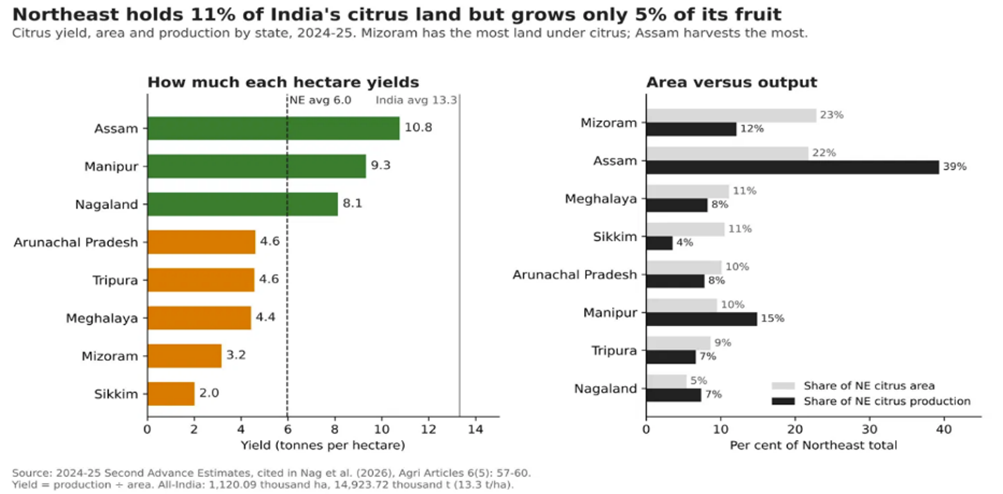
Source: Horticulture statistics, 2024-25 second advanced estimate, Department of agriculture & farmers welfare, Government of India.
The latest figures make this plain. As per the 2024-25 second advance estimates, India grows citrus on about 11.2 lakh hectares and harvests roughly 149 lakh tonnes. The eight northeastern states cover 1.26 lakh hectare and produce 7.53 lakh tonnes of citrus which holds around 11.27 per cent of total area but give only 5.04 per cent of the output. A hectare of citrus here yields about 6 tonnes. The national figure is over 13. Mizoram has the largest citrus area in the region, close to 0.288 lakh hectare, yet its trees average a little over 3.16 tonnes a hectare. Assam, with about the same area, harvests three times as much. Sikkim’s well-known mandarin gardens manage only about 2 tonnes. Meanwhile the market keeps sending signals. Khasi mandarin and Arunachal orange got its GI tag in 2014 and 2015 respectively while Assam’s Kaji Nemu (Jatiya Phal) made the state fruit in 2024.
Why the trees give up:
Citrus decline in Northeast India is a multifactorial problem involving viral diseases, bacterial infections, soil-borne pathogens, nutritional deficiencies and poor orchard management. Major contributing factors include Citrus tristeza virus (CTV), Huanglongbing (citrus greening), Phytophthora-induced root rot, deficiencies of essential nutrients (Ca, Mg, Zn, N, P and B), waterlogging and parasitic infestation by Loranthus. Inadequate orchard maintenance and infected planting material further aggravate the problem.
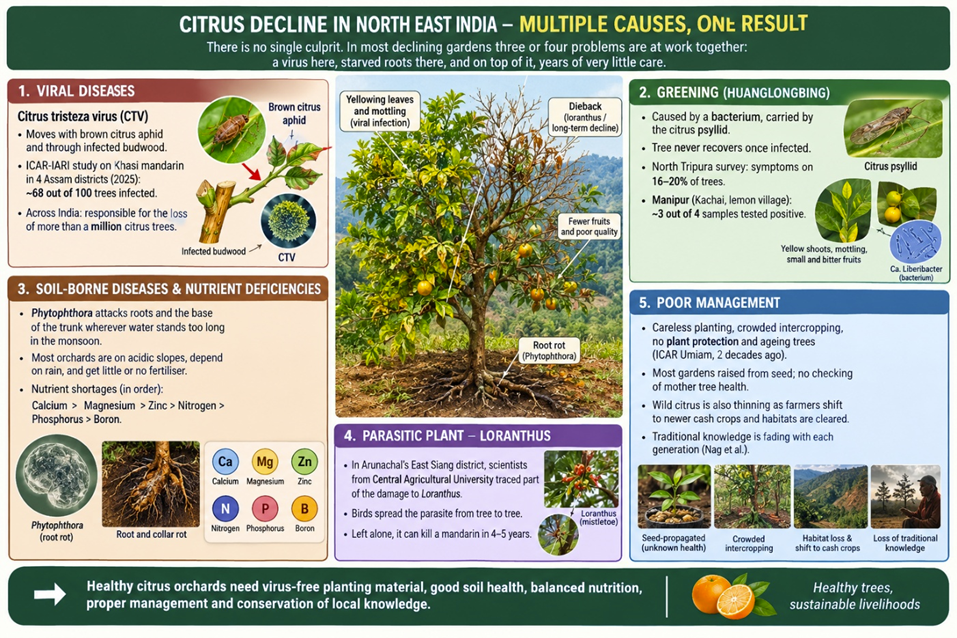
Fig. Diagrammatic representation of cumulative causes of citrus decline in northeast India
Last comes management, or rather the lack of it. Researchers at ICAR Umiam noted two decades ago that careless planting, crowded intercropping, no plant protection and ageing trees were all feeding decline. Most gardens were raised from seed, and nobody checked whether the mother tree was healthy. Out in the forests, wild citrus is also thinning as farmers move to newer cash crops and habitats are cleared. Nag and co-workers warn that the traditional knowledge about these plants is fading with each generation.
What can be done
Decline can be slowed, and many tired orchards can be brought back. But the whole garden has to be treated, not one symptom at a time. It all begins with the plant that goes into the pit. The following recommendations can be adopted for effective management of citrus decline in northeastern India.
Use of quality planting material: Certified nurseries should be established by adopting ICAR-Umiam’s containerized nursery technology. Rough lemon and Rangpur lime rootstocks should be raised in sterilized growing media and maintained above ground. Mother plants must be screened for five graft-transmissible diseases, including citrus greening and tristeza. Wedge grafting should be practised during July-August alongside conventional budding during January-February to ensure a continuous supply of healthy, disease-free planting material.
Rejuvenation of declining orchard: The rejuvenation package developed by Assam Agricultural University’s Tinsukia station, involving removal of dead and diseased branches, sealing of pruning cuts with Bordeaux paste, removal of Loranthus along with affected branches and balanced nutrient application can be done. In addition, the month wise operations developed by the ICAR Research Complex for NEH Region, Basar, Arunachal Pradesh also need to be adopted.
Soil and nutrient management: Conduct regular soil testing and correct acidity by applying dolomite (2-3 kg/tree) every alternate year, as recommended by soil-test results. Ensure balanced macro- and micronutrient nutrition through recommended NPK fertilizers (300:250:300 g N:P₂O₅:K₂O/tree, as recommended by ICAR-Umiam for Khasi mandarin rejuvenation) and micronutrient sprays (ZnSO₄ 60 g, MgSO₄ 40 g, borax 20 g, MnSO₄ 40 g and lime 180 g / 20 L water) on new flushes (ICAR, NEH, Basar, Arunachal Pradesh). Supplement with 5-10 kg well-decomposed FYM or compost per tree and use half-moon trenches around tree basins to conserve moisture and improve nutrient availability.
Moisture conservation strategies: Adoption of moisture conservation strategies like mulching, rainwater harvesting, construction of half-moon terrace, mircocatchments surrounding tree basing area, bamboo drip irrigation and proper drainage to conserve soil moisture, reduce nutrient losses and prevent waterlogging-related root diseases.
Integrated pest and disease management: Adopt regular orchard monitoring and integrated management of trunk borers, leaf miner, citrus psylla, thrips, mites, aphids, white flies, and other insect pests. For insect management 5% neem oil or imidacloprid @ 1ml/L should be spray 2-3 times. Root rot, greening, canker gummosis etc. diseases are also a contributor for decline. AAU trials reported effective root rot management using Pseudomonas fluorescens at 100 g/plant followed by fosetyl-Al spray at 0.2%. Application of Bordeaux mixture (1%) or COC @ 5 ml/L at 15-20 days interval is safe for disease management. Remove trees confirmed to be infected with citrus greening and tristeza, as these diseases have no curative field treatment, and manage their insect vectors, particularly psyllids and aphids, during new vegetative flushes.
Seasonal orchard management: Follow a year-round schedule covering postharvest pruning and sanitation (January-February), nutrient management (March-April), pest management (May-June), drainage and weed management (July-August), orchard sanitation and fruit fly management (September-October), and timely harvesting and postharvest handling (November-December).
Working together
None of this helps much if one grower cleans up his garden while the trees next door keeps breeding aphids and psyllids. Decline does not respect fences. It has to be tackled village by village, with KVKs, state horticulture departments, ICAR institutes, CAU, Imphal, and agencies such as NHB, APEDA and NABARD pulling in the same direction. Citrus started in these hills, and it would be a sad thing to watch it fade here. Most of what is needed is already known. Getting it into farmers’ hands, garden by garden, is the work that remains.



More Stories
State Election Commission Announces Municipalities -2026 Election On 27th November & Counting On 2nd December, 2026.
Present Government Committed To Accelerating Socio-Economic Development: Chief Minister Of Tripura Dr. Manik Saha.
Tripura Railway Police Seizes 17.155 Kg Of Cannabis Worth ₹8,00,000 With 1 Drug Peddler In Agartala Railway Station.