





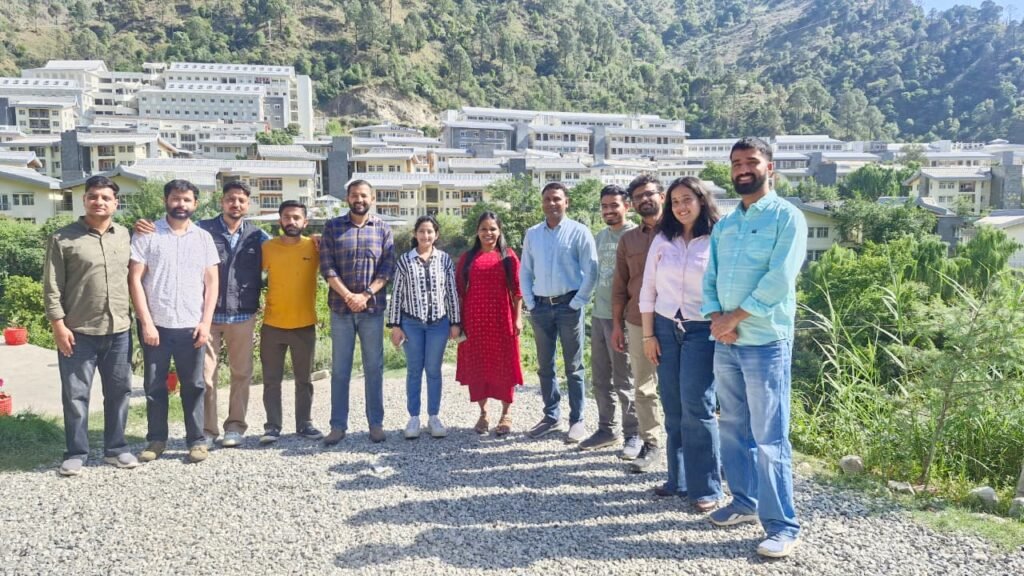
Mandi, Himachal Pradesh,17th of November, 2026 : What if imperfections in a material could become its greatest strength? Researchers at the Indian Institute of Technology (IIT) Mandi have demonstrated how tiny structural defects in an ultra-thin material can be strategically harnessed to enhance electronic functionality, opening new possibilities for next-generation memory devices and brain-inspired computing.
The research, titled “Crack- defect landscapes enable multi modal memristive switching in WS2 mono-bilayers,” explores tungsten disulfide (WS₂), an atomically thin material, for applications in neuromorphic computing – a technology that seeks to replicate the brain’s ability to process and store information efficiently.
Led by Prof. Viswanath Balakrishnan, along with Anjali Sharma, Yadu Chandran and Bhumit Luhar, the research team studied WS₂-based devices fabricated using chemical vapour deposition (CVD). The researchers investigated how sulphur vacancies (missing atoms) and microscopic cracks influence the movement of electrical charges.
Multiple Switching Mechanisms in a Single Device
A significant finding is that defects traditionally considered manufacturing flaws can be converted into functional features. The interplay between vacancy migration along cracks, resulting in counter-clockwise filamentary switching, and charge trapping and Schottky barrier modulation at the WS₂-metal interface, producing clockwise switching, enables a single planar device to demonstrate multiple switching behaviours.
The devices can transition between gradual analog-type conductance changes, abrupt digital switching and low-current, trap-dominated states. This multimodal switching capability could enable a single device architecture to perform functions associated with both artificial synapses and neurons.
Potential Applications and Benefits for Society
Biological synapses gradually strengthen or weaken connections, while neurons generate signals when specific thresholds are reached. By emulating these functions, the technology could contribute to future neuromorphic circuits capable of performing computing tasks more efficiently.
Potential applications include energy-efficient artificial intelligence, smart sensors, wearable and portable electronics, autonomous systems and edge computing. For example, intelligent sensors could process information locally without constantly relying on distant cloud servers, potentially reducing power consumption, response times and data-transfer requirements. Such technologies could eventually benefit healthcare monitoring, smart devices, robotics and industrial automation.
The devices also demonstrated promising endurance and data-retention characteristics under experimental conditions. However, oxidation of WS₂ in ambient conditions remains a challenge requiring suitable protective techniques.
Published in Advanced Functional Materials, the research highlights how deliberately engineered material defects could help create compact, multifunctional and energy-efficient electronic systems. While further work is needed to improve stability, consistency and semiconductor compatibility, the findings represent a promising step towards computing technologies inspired by the human brain.
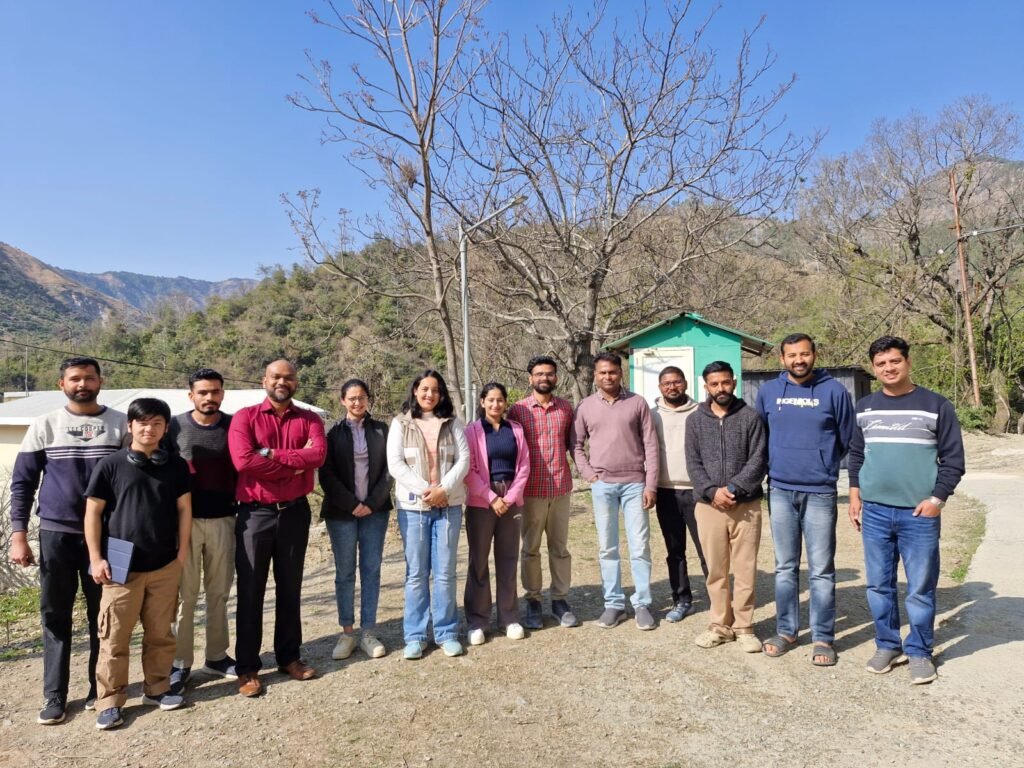
By turning manufacturing flaws into functional features, IIT Mandi researchers are exploring a future in which even microscopic imperfections can help make electronic devices smarter and more efficient.
About IIT Mandi:
Indian Institutes of Technology Mandi is one of the top second-generation IITs located in Kamand Valley, Mandi district of Himachal Pradesh, India. It is one of eight new Indian Institutes of Technology (IITs) established by the Ministry of Human Resource Development, Government of India, and recognized as one of Institutes of National Importance. IIT Mandi’s permanent campus about 14 km (8.7 mi) from Mandi consists of the South and North campuses connected by a narrow neck. The South campus is on the left bank of the Uhl River below Kamand village. The North campus is along the Kataula Khad opposite Salgi village. A transit campus at Government Post graduate College, Mandi was handed over by the Himachal Pradesh Government on 16 November 2009. The Kamand campus ground-breaking ceremony, to mark the start of construction, was held on 13 April 2012. On 25 April 2015, IIT Mandi became the first of all the new IITs to completely shift B. Tech students to its permanent campus in Kamand. Since its inception the institute has been involved with more than 275 Research and Development (R&D) projects worth more than ₹120 crore. In the past 10 years, the institute has signed Memorandum of Understanding (MoU) with as many as 11 international and 12 national universities.



More Stories
Indian Naval Ship Sahyadri Participates In Bilateral Naval Exercise Jaimex 2026 With Japan Maritime Self-Defence Force.
India And Sweden Launch Leadit 3.0 At COP31 To Accelerate Low-Carbon Industrial Transition; Brazil Joins Leadit As Its Newest Country Member.
Prime Minister Condoles The Loss Of Lives In Mishap In Tehri Garhwal, Uttarakhand.