




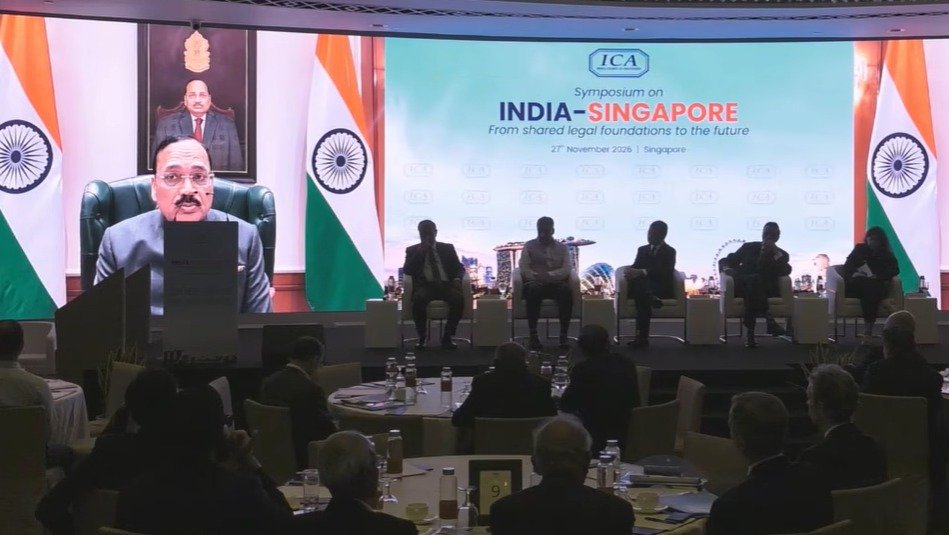
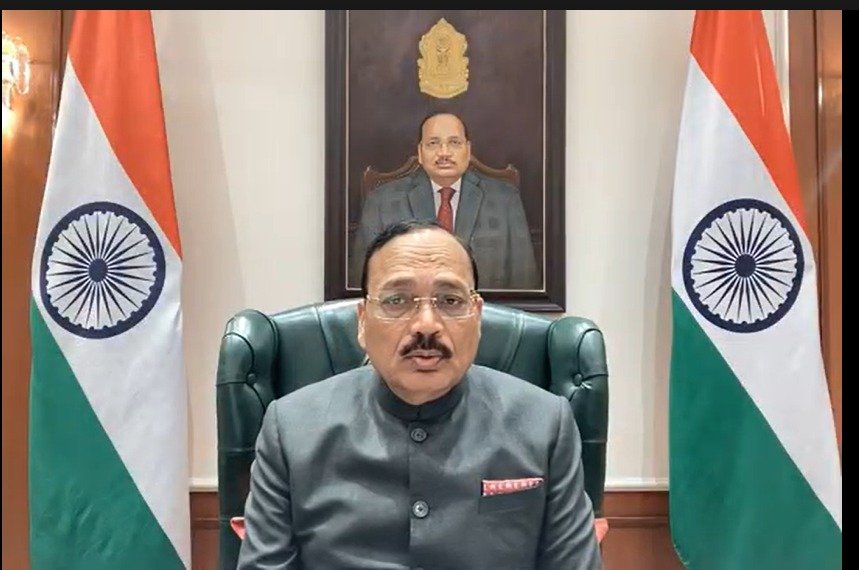
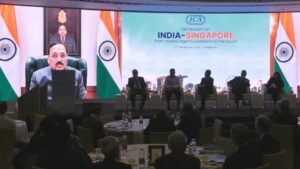
Singapore, 27th of November 2026 : India and Singapore can exchange experience in institutional design, professional standards, training and technology, and encourage the early use of mediation, Hon’ble Mr Justice Surya Kant, Chief Justice of India, said on Friday. In his video message to the Indian Council of Arbitration’s (ICA) Symposium on “India–Singapore: From shared legal foundations to the future” at The Fullerton Hotel, Singapore, the Chief Justice said predictable dispute resolution is central to the confidence that drives trade and investment between the two countries.
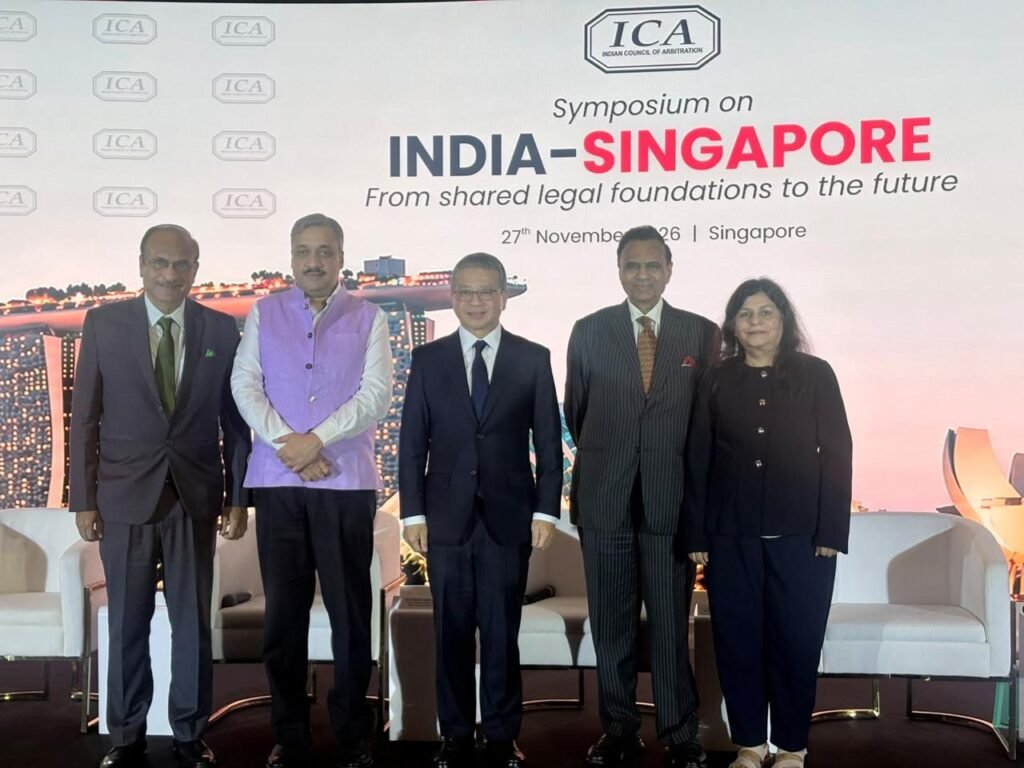
The symposium was held on the 200th anniversary of Singapore’s Second Charter of Justice of 1826, which extended the Court of Judicature to Singapore. It brought together Singapore’s Minister for Law, India’s High Commissioner to Singapore, the ICA leadership, and members of the legal and business communities of both countries.
“Predictability in dispute resolution is not an afterthought to commerce, it is part of the confidence that enables it,” Justice Surya Kant said. Noting that Singapore is India’s largest trading partner within ASEAN, he said bilateral trade had grown from about US$6.7 billion in 2004-05 to US$34.3 billion in 2024-25. Singapore is also a leading source of foreign investment into India, with cumulative FDI inflows of about US$174.88 billion between April 2000 and March 2025, around 24% of India’s total inflows.
The Chief Justice said India’s growing engagement with mediation, including the establishment of the Mediation Council of India, creates further avenues for cooperation, including through multi-tiered dispute resolution clauses. “Sometimes the best outcome is not a victory for one side, but an agreement that enables both sides to move forward,” he said.
Recalling the 2024 Memorandum of Understanding on Cooperation in Law and Dispute Resolution between the two countries, the first meeting of the India-Singapore Joint Consultative Committee in 2025, and the India-Singapore ADR Conclave convened by ICA in New Delhi on 10 September 2026, Justice Surya Kant said the relationship must rest on reciprocity. “Neither needs to replicate the other’s institutional model. The opportunity is to learn from each other. The corridor must be a two-way channel for expertise, professional opportunities and institutional knowledge, measured by the confidence it creates on both sides,” he said.
Delivering a special address, Mr Edwin Tong SC, Minister for Law and Second Minister for Home Affairs, Government of Singapore, said investors need to know that any dispute over their investment will be resolved fairly, transparently and predictably. India has long been one of the Singapore International Arbitration Centre’s most important foreign users, he said, with 178 Indian parties involved in its arbitrations last year, making India its third-largest foreign user jurisdiction. Indian counsel and arbitrators also take part in many cases that involve no Indian party.
Mr Tong said complex, multi-contract transactions can push linked disputes into separate forums with inconsistent outcomes. “Arbitration is built on party consent. So how do we preserve that principle whilst ensuring that interconnected parties and their disputes can be resolved effectively?” he asked, calling for innovation by institutions, practitioners and courts. “India and Singapore should aspire not merely to succeed in international arbitration, but to make international arbitration better,” he said.
Dr Shilpak Ambule, High Commissioner of India to Singapore, outlined the breadth of the bilateral partnership, from skilling, digital payments and connectivity to aircraft maintenance, semiconductors, energy and health. He said there had been more than 12 visits by Indian Chief Ministers to Singapore in the last two years, and that Singaporean companies are increasingly investing beyond traditional hubs such as Bengaluru and Hyderabad.
Dr N.G. Khaitan, President, ICA, and Senior Advocate, said a shared legal future depends on strong economies and trade ties. He credited Singapore’s success to
factors including predictable regulation, the resolution of commercial disputes and strong enforcement of law, and noted that Singapore accounts for about 24% of equity FDI into India. “It is a win-win situation for all of us,” he said.
Mr Arun Chawla, Director General, ICA, said the symposium fell exactly 200 years after the Second Charter of Justice was granted on 27 November 1826. “Commerce needs confidence, investment needs certainty, and both need assurance of justice,” he said. He set out four pillars of the partnership: economy and enterprise; emerging technology; energy and environment; and exchanges and engagement, all connected by trust. “The future of arbitration cannot be only about resolving yesterday’s disputes, it must also be about enabling tomorrow’s partnerships,” Mr Chawla said. “Our shared legal foundations are part of history. Our shared legal future is for us to build.”
The symposium also featured a panel discussion on “Beyond Litigation: From Commercial Justice to Commercial Continuity”, moderated by Mr Francis Xavier SC, Regional Head of Disputes Group, Rajah & Tann Singapore LLP, and a conversation on “The Future of the Legal Profession: Perspectives from India and Singapore”, moderated by Mr Avinash Pradhan, Head, International Arbitration, and Co-Head, South Asia Desk, Rajah & Tann Asia.
About ICA
The Indian Council of Arbitration (ICA), established in 1965 under the initiatives of the Government of India and the Federation of Indian Chambers of Commerce and Industry (FICCI), is India’s premier arbitral institution. ICA is dedicated to promoting fair, efficient and cost-effective resolution of domestic and cross-border commercial disputes through arbitration, conciliation and mediation. It represents a membership of over 6,500, comprising chambers of commerce, industry associations, leading corporations and professionals. With collaborative relationships with more than 50 arbitral institutions and international organisations worldwide, ICA plays a vital role in strengthening India’s ADR ecosystem and fostering investor confidence.


More Stories
Go Spiritual & Approach Entertainment Launch 2026 Blanket Donation Campaign With A Message: No One Should Freeze To Death.
IIT Mandi Design Practicum Showcases 75 Student-Built Prototypes With Over 1,200 School Students Witness Innovation In Action.
Synopsys Launches EPIC HPC Scale-Up Program In India With AWS And Syncious To Accelerate Access To Cloud-Based High-Performance Computing.