





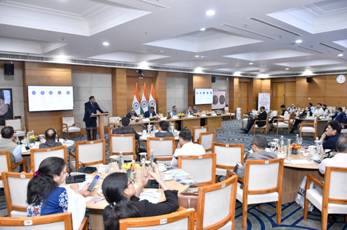
Bengaluru, Karnataka, 30th of January, 2026 : As India’s microfinance sector stands at a critical inflection point, Karnataka has emerged as a beacon of resilience with research reports from Equifax India and India Ratings validating the state’s Rs 23,743 crore portfolio strength. This comes as Budget 2025’s doubling of credit guarantee limits to Rs 10 crore and evolving Q3 FY26 results signal a decisive shift from crisis to cautious optimism. The research organizations presented the Microfinance insights of Karnataka and outlook of Microfinance institutions FY27.

THE TURNAROUND STORY: FROM STRESS TO STABILITY
India Ratings’ landmark upgrade of the microfinance sector outlook from ‘deteriorating’ to ‘neutral’ marks a watershed moment. The agency projects credit costs plummeting from 9.5% (FY25) to 4.0% (FY27), while profitability (PAT-to-AUM) is expected to surge from negative 0.4% to positive 2.7%a remarkable 310 basis point swing. Karnataka’s performance validates this optimism. Equifax data shows the state’s 30+ delinquency improving to 5.60% in November 2025. Belagavi leads with Rs 1,788 crores, followed by Mysuru (Rs 1,707 cr) and Bengaluru Urban (Rs 1,536 cr).
Mr. N. Venkatesh, Chairman of Association of Karnataka Microfinance Institutions (AKMI), during the presentation stated: “While the intent of the new February 2025 regulations was clear and necessary, our member institutions rose to the occasion with decisive action and firm commitment to inclusive finance. We responded swiftly, calibrating loan book growth, provisioning prudently, and realigning field operations. At every step, we stayed committed to the millions who depend on us for their first and often only opportunity for financial empowerment. Our collective actions helped counter misinformation and re-establish the strong foundation of our microfinance sector, and we look forward to a vibrant 2026.”
DRAMATIC DELEVERAGING AND BUDGET CATALYST
The most striking recovery indicator is dramatic deleveraging. Borrowers with four or more lenders plummeted from 19.2% in June 2024 to just 8.8% in September 2025a 54% reduction. Stage 2 loans eased to 2.7% in Q2 FY26 from a 3.7% peak.
Union Budget 2025-26’s MSME focus provides critical tailwinds. Doubling credit guarantee limits unlocks Rs 1.5 lakh crore in additional credit over five years. Sa-Dhan’s recommendationsincluding a Special Fund for small MFIsgained traction during meetings with Department of Financial Services Secretary M Nagaraju.
BEYOND CREDIT: EMPOWERMENT THROUGH FINANCIAL LITERACY
The industry has maintained sharp focus on credit-plus activities beyond mere lending. Financial literacy initiatives have been strengthened with emphasis on customer protection and responsible borrowing. AKMI has pioneered innovative approaches including street plays for awareness, upskilling programs, and comprehensive grievance redressal mechanisms in partnership with M-Fin and Sa-Dhan.
Ganesh Narayanan, MD & CEO, Credit Access Grameen Limited (CAGL)emphasized: “A hybrid model using IT as well as personal contact both before and after loans is called for. The quality of an MFI should be assessed on the inherent dynamics of its model to ensure repayments and effective loan utilization.” This approach delivers resultsthe sector’s 83% graduation success rate to retail credit validates microfinance’s gateway role to mainstream finance.
WOMEN ENTREPRENEURSHIP DRIVING INCLUSIVE GROWTH
With women comprising 99% of 8.67 crore active borrowers, the sector continues as a powerful tool for supporting women entrepreneurs in backward and rural areas. Industry partnerships aimed at credit linkages, market access, and capacity building demonstrate potential for 30% increase in average incomes.
Mr. Jiji Mammen, Executive Director & CEO of Sa-Dhan, presented compelling evidence of how microfinance has expanded employment opportunities through increased disbursals, enabling entrepreneurship across rural and semi-urban areas. This job creation impact underscores the sector’s 2-3% contribution to India’s GVA.
Q3 FY26 TRENDS AND DIGITAL TRANSFORMATION
Recent quarterly results paint a nuanced stabilization picture. IndusInd Bank’s measured stancereducing MFI exposure from 13-14% to 9% while maintaining 95.5% collection efficiencyreflects cautious optimism. Industry-wide credit costs peaked at 13.5% in Q3 FY25 but are moderating as stricter guardrailsthe Rs 2 lakh debt limit and three-lender capimprove asset quality.
Digital adoption is enhancing efficiency. The Reserve Bank of India’s decision lowering the qualifying asset threshold to 60% enables portfolio diversification toward secured products, creating sustainable quality-focused growth.
FY27 PROJECTIONS: KARNATAKA LEADS THE CHARGE WITH NEW POLICY SUPPORT
India Ratings projects sector AUM growth rebounding to 12% in FY27, with pre-provisioning operating profit improving 190 basis points year-on-year. For Karnataka, this translates to potential portfolio expansion to Rs 26,600-27,000 crores by FY27-end.
This optimistic outlook is now powerfully reinforced by a decisive government move to ensure sustained credit flow. In a latest update, as of Jan 29, the Government of India approved a fresh ₹8,000 crore credit guarantee facility for microfinance institutions (MFIs). This targeted intervention is designed to ease funding pressures, particularly for smaller and medium MFIs, and acts as a direct national catalyst to support the growth projected for states like Karnataka.
With microfinance penetration at 30% of the addressable market and a national portfolio of Rs 3 lakh crore, significant growth potential remains. The combination of Karnataka’s demonstrated resilience, broader regulatory prudence, deleveraging progress, and this new budgetary support positions the microfinance sector to fully reclaim its vital role as an engine of inclusive economic growth—with Karnataka leading the charge.
Celebrating the visionaries who built the sector, the Association of Karnataka Microfinance Institutions honored three pioneering figures for their lifetime of service: Shri Samit Ghosh, whose Ujjivan redefined urban microfinance; Shri Uday Kumar Hebbar, the strategic force behind Credit Access Grameen; and Padmashri Aloysius Prakash Fernandes, the grassroots architect of MYRADA and Sangamithra.
About The Author




More Stories
Keel Laying Of Two Next Generation Offshore Patrol Vessels For ICG.
Indian Navy Continues Ios Sagar Initiative To Strengthen Maritime Partnership With Indian Ocean Nations.
NICDC Organises Stakeholder Consultation On Revitalising Export-Oriented Industrial Clusters.