





Chennai Tamilnadu, 30th of September, 2026 : As nations race to out-build one another in frontier compute, inventor Vatsal Soin filed a fresh patent on 23 September 2026 targeting a resource the world has not prioritized: the zettabytes of dormant, unmonitored data sitting untouched inside the world’s clouds and archives, potentially valuing trillions in storage and gigawatts in power.
Live: www.0to1doctrine.com
A COMPUTE RACE, AND A DATA PROBLEM NO ONE IS SOLVING
National AI strategies are being measured in chips, gigawatts, and model parameters. Sovereign compute budgets are reaching enormous values, with announcements in the hundreds of billions. Almost none of that spending touches the older liability sitting inside every large institution: decades of archived records nobody reads, deletes, or governs — a resource the world has not made part of its stated AI strategy.
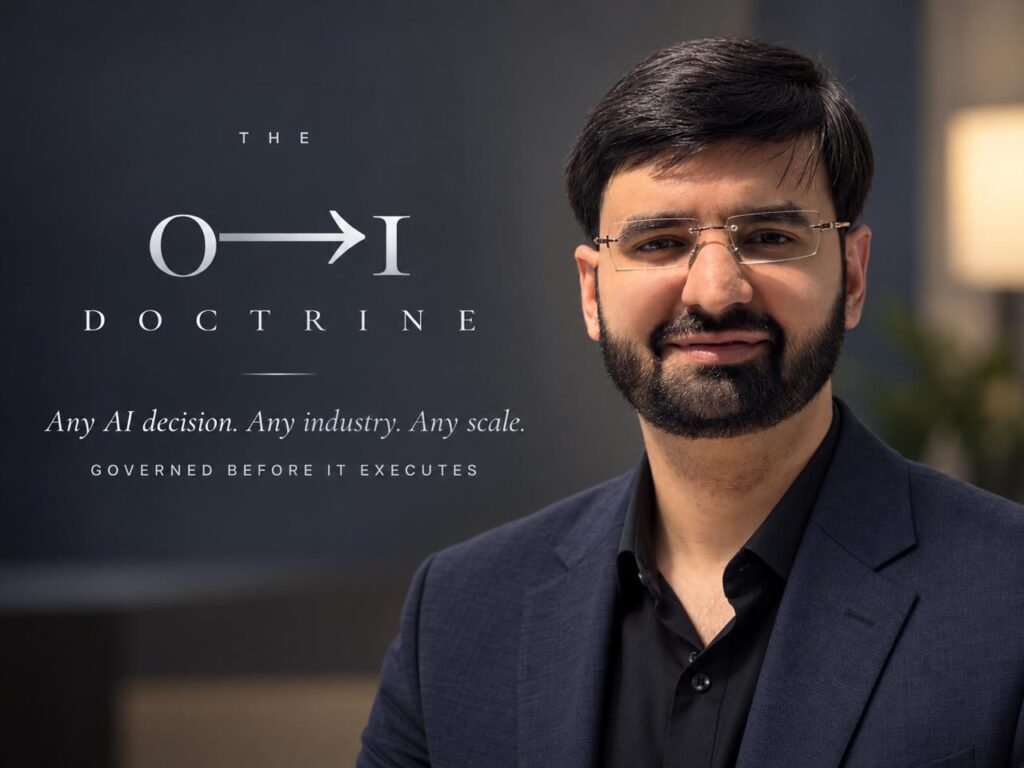
A NEW PATENT, THE SAME GOVERNING IDEA
Soin’s 0→1 Doctrine rests on one governing idea. Capability and authority are separate. Every consequential action is tested against an authorized boundary before it executes. This filing extends that idea into dormant data most organizations pay to keep but never touch.
BBAT SOLO: A STANDALONE GOVERNANCE LAYER
Used alone, BBAT — Band-Based Archive Triage — can sit in front of any existing storage system as an independent sorting layer, with no dependency on the rest of the 0→1 patent family. An institution with no other governance infrastructure in place can deploy it purely to answer one question at scale, across millions of records at once: Retain, Purge, or Promote, decided on metadata alone, without touching a single stored record’s actual content.
BBAT COMBINED: THE FULL 0→1 STACK
Paired with the core 0→1 Doctrine’s live-action governance, BBAT closes the other half of the picture. The core Doctrine gates what an AI agent is authorized to do right now, in real time. BBAT gates what an organization is authorized to keep, delete, or reuse from its own past. Together, a single enterprise governs both its future actions and its accumulated history under one shared mathematical grammar — not two separate systems bolted together.
BBAT: METADATA-ONLY TRIAGE, NEVER THE CONTENT
Band-Based Archive Triage examines only a record’s metadata — age, category, jurisdiction — never the stored content itself. Each record is sorted toward retention, lawful deletion, or promotion. The triage decision is made from metadata without opening the stored content.
DDME: TURNING DORMANT STORAGE INTO REVENUE
What clears BBAT moves to the Dark Data Monetisation Engine. This is where cost becomes income. DDME derives a normalized signal inside a sealed environment, then deletes the source before anything transmits outward — the same dormant archive, now a revenue line rather than a standing liability.
BDTS: A SMARTER MODEL, FED BY THE WHOLE WORLD
The Band-Derived Training Signal takes normalized bands further, toward AI training. It can receive bands from multiple contributing sources and combine them into filtered, population-level training signals. A band produced through DDME may contribute to BDTS, but BDTS does not require DDME to run first. The result is a governed training pathway designed to use distributed signals without exposing individual raw records.
CAAD: WATCHING PATTERNS ACROSS SWARMS OF RECORDS
Cross-Agent Aggregation and Deconfliction watches for patterns across swarms of records or agents — in data lakes, warehouses, or centres — the kind no single record reveals alone, without ever opening any one record individually.
MICA, VOID, PACE: THE SAFEGUARDS BEHIND THE SCENES
Metadata Inconsistency Check catches a mismatched label before any decision relies on it. Verified Omission of Invalid Data marks an unreadable record as skip-this-attempt, not delete-forever. Permission and Authorisation Change Evaluation halts a step mid-process if consent is withdrawn — three quiet checks most triage systems never build in.
SIGHT AND SPAR: SUPERVISION WITHOUT INTERFERENCE
Signal-based Insight Generated from Historical Trajectory watches one record’s own history for drift. Systemic Pattern Analysis from Receipts watches patterns across many records at once. Neither can alter a token or a rule — each can only raise a flag for human review.
WHY BILLIONAIRE ALLOCATORS SHOULD CARE
Dormant data is a balance-sheet liability most boards have never priced, sitting alongside compute infrastructure that receives the entire spotlight. A governed triage layer changes that calculation: liability becomes either eliminated through lawful deletion or converted into a measured, receipted asset. Whether capital markets ultimately price that distinction remains open — but the filing gives allocators a testable mechanism to evaluate, not an unverifiable promise dressed up as one.
A NARROWER ANSWER TO A BROADER DEBATE
The filing does not claim AGI has arrived, or that superintelligence has been achieved by any system. Its proposition is narrower: one specific proposed action can still be tested against a defined boundary before it executes, regardless of how that larger debate resolves.
ILLUSTRATION ONE: A SOVEREIGN DEFENSE ARCHIVE
A fifteen-year-old logistics archive normalizes to [0.74, 0.79] against a retention ceiling of [0.00, 0.65]. The ceiling is breached. MICA confirms metadata consistency. The record is flagged for lawful deletion, sealed under the ACR Governance Layer.
ILLUSTRATION TWO: A SOVEREIGN WEALTH FUND’S REUSE REQUEST
A decade-old transaction archive is queried for reuse, normalizing to [0.61, 0.66] against an authorized band of [0.00, 0.60] under DDME. The ceiling is exceeded. The Clarification Loop, Explicit Authorised Response module, short form CLEAR, requests one bounded round of clarification, then the request is held for review, not defaulted to approval.
ILLUSTRATION THREE: A NATIONAL HEALTH ARCHIVE UNDER LOAD
A pharmaceutical research agent pulls a national health archive across hundreds of concurrent deployments, normalizing to [0.79, 0.85] against a ceiling of [0.00, 0.55] evaluated by SPAR. The breach is unambiguous. The request is blocked outright, sealed to a governance receipt.
QUICK Q&A
Can BBAT be deployed without the rest of the 0→1 Doctrine?
Yes. As a standalone layer, it governs archived data. Combined with the core Doctrine, it can also operate alongside live-action governance — bringing past and future actions under one governance framework.
Does DDME actually generate income, or just cut cost?
Both are possible. The same dormant record that incurs storage costs can be transformed into a governed, potentially saleable signal.
Does this filing respond to the global AI race specifically?
No single national policy. It responds to a broader pattern visible across the world: capital and attention flowing toward compute and model scale, with comparatively less attention toward governing the data already sitting stored.
What can a live demonstration actually prove?
Whether a specific proposed action clears or fails its defined governed boundary under the conditions being tested — nothing broader.
CLOSING NOTE
“The world is racing to build the future of AI. Almost no one is governing its past. This filing does.”
Live: www.0to1doctrine.co
THE INVENTOR
Vatsal Soin is a system theorist, serial inventor and entrepreneur whose work spans AI decision governance, biometric authorization, and — with this filing — dormant data governance globally. His domain-agnostic portfolio also reaches into apparel: an August 2026 grant introduced an AI-powered footwear system and the Global Sharable Size Card invention. His filings span six continents, with grants in the US, India, Japan, and South Africa. He is a SIM–RMIT and NTU alumnus.




More Stories
IHM Hyderabad Students Bring Hyderabad’s Nizami Culinary Heritage To Life At Traditional Chowki Lunch.
Minister Of State For Social Justice & Empowerment Shri Ramdas Athawale Addresses Media In Guwahati.
HCL Group’s 50th Anniversary Celebrations Continue In Hyderabad With Devi Sri Prasad Concert.