




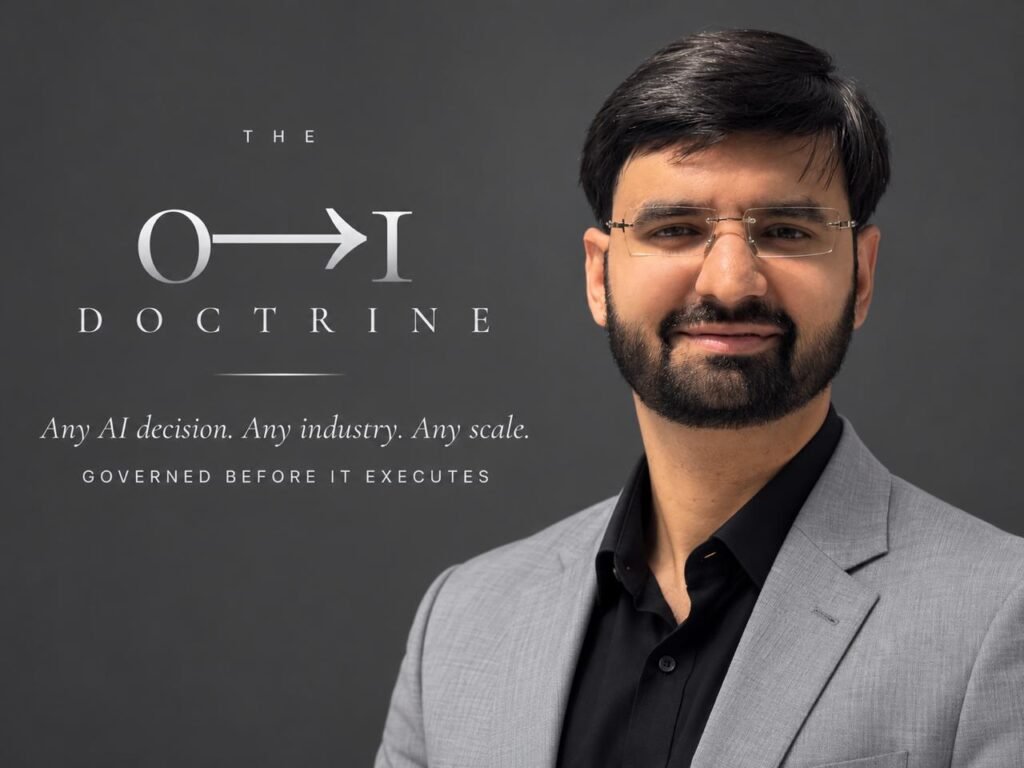
Mumbai, Maharashtra, 11th of October, 2026 : Start-To-Finish Human-Vetted AI Chain: Inventor Vatsal Soin Files Patents, Scales 0→1 Doctrine To Superintelligence.
THE IDEA IN BRIEF
Picture an intelligence still in training. A provider chooses which old knowledge is worth passing on. Once the intelligence has learned, an authoriser decides whether its proposal may touch the real world.
That is the pairing proposed here, built from two separate inventions. BBAT, short for Band-Based Archive Triage, governs what goes into the AI. The 0→1 Doctrine governs what comes out as action. Together they sketch one possible chain from data to a checked decision.
By AI we mean the everyday kind: assistants that answer questions, write and increasingly act for us.
THE PROVIDER: WHAT BECOMES OF OLD DATA?
Organisations sit on years of medical, financial and industrial records. Some must be kept by law. Some are duplicates. Others hold valuable patterns but are too sensitive to move in their original form.
BBAT begins by reading only the labels on each record, such as its age, type and legal status, never its contents. Each record then goes one of three ways:
RETAIN: keep what the rules require.
PURGE: destroy what the rules allow to be destroyed.
PROMOTE: send selected records into a protected room, where something useful can be drawn out.
FROM RECORD TO BAND
Inside the protected room, promoted records are condensed into a band. Rather than names, documents or exact figures, the result is a low end and a high end.
Think of a 0-to-1 scale. A band might say the result lies between 0.45 and 0.55. It does not claim that every industry means the same thing by those numbers; a hospital, a factory and a bank each keep their own meanings and rules.
Safeguards come before anything leaves. Could outside information single out an individual? Is the band too narrow to be safe? The originals are then destroyed within limits agreed beforehand, and a sealed record of the process is kept.
THE INTELLIGENCE: THE AI
The band then becomes part of what the AI learns from. From it, the AI can spot patterns and put forward a proposal.
A delivery system might propose a new route. A finance system might propose a payment. The AI may be highly capable and entirely confident. But confidence is not permission
THE AUTHORISER: A CHECK BEFORE ACTION
The 0→1 Doctrine adds a check between what an AI proposes and what happens in the real world. Its idea is simple: place the rule and the proposal on the same 0-to-1 scale, then compare them.
A third outcome is possible: approval with conditions, such as a lower speed limit for a machine. Afterwards, a sealed record keeps what was decided and what happened.
WHERE A HUMAN STEPS IN
Real life is not always clean. Some cases are unusual, risky or depend on judgement, and a number should not settle those alone.
That is where humans come in. BBAT passes unclear records to a human reviewer and flags unusual patterns across many AI agents. For actions, the second invention can approve, add conditions or stop; sending a doubtful case to a human is a natural step in any real deployment.
THE WHOLE CHAIN IN ONE PICTURE
Put the two together and the path is easy to follow. Old data is sorted. Useful records become bands. The AI learns and proposes. The authoriser rules. The action goes ahead, changes or stops.
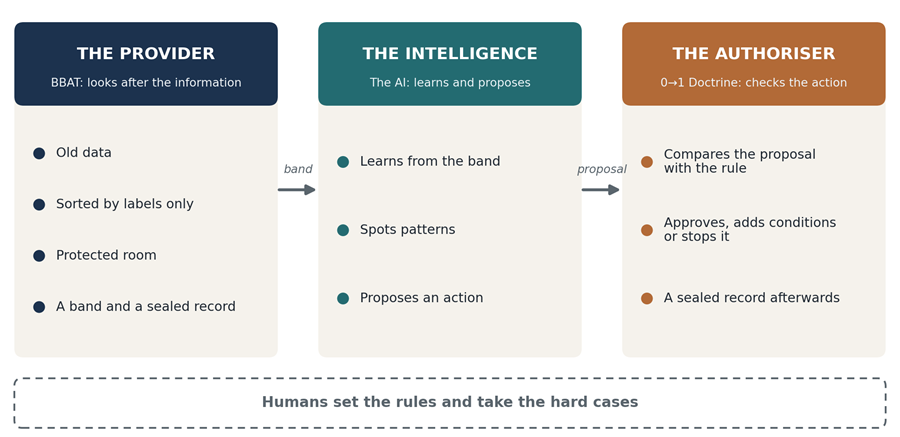
The provider, the intelligence and the authoriser: one possible path from old data to a checked action.
THE SAME 0→1 RULE AT DIFFERENT SIZES
These are illustrations, not test results.
ONE INDIVIDUAL: Humans set an authorised range of 0.40–0.70. An AI proposal scores 0.56 and falls within the range, so it may be approved.
ONE FACTORY: A machine proposal scores 0.68 against an authorised range of 0.60–0.75 and may pass. A score of 0.82 falls outside and is stopped.
ONE CITY: Thousands of transport measurements can be normalised and assessed against agreed rules before a policy proceeds.
MANY ORGANISATIONS: Each keeps its own data and rules while following the same sequence: prepare → compare → decide → record.
THE RIPPLE EFFECT
Neither invention reduces AI’s intelligence, reasoning capability or underlying computational speed. They govern the information available to the system and the actions it is permitted to take. A human HOLD may require additional time for a decision, but that is governance time—not slower AI reasoning.
WHY IT MATTERS FOR SUPERINTELLIGENCE
The superintelligence debate asks how much a machine could know, how fast it could think and how freely it could act. A second question matters just as much: who sets the limits on what that intelligence can use, and on what it can do?
This pairing speaks to two moments: information going into an AI, and an action coming out. Neither invention claims to govern superintelligence itself, and no combined system has been tested.
ONE THING TO KEEP CLEAR
These are two separate inventions with two separate filings. Showing them together offers one possible way to fit them; it is neither a single patent nor a working system. Cost, take-up and regulation are undecided, and each invention still has to prove its worth.
CLEARLY EXPLAINED
Are the two inventions one?
They are separate. They can be used alone or together.
What actually goes out?
Only the band, with a sealed record attached. The originals are gone before that.
Who handles the hard cases?
Humans. Unclear records and unusual patterns are passed to them, not settled automatically.
Does a high score mean an AI is right?
It means the proposal fits the rule. Whether the rule is wise is for humans to decide.
Can it handle different futures?
Yes. Its universal structure can cover different events, options and contingencies across domains and scales. Each can be checked against human-defined rules, with clear outcomes: approve, reject or hold for human judgment.
LIVE www.0to1doctrine.com
This can be tested, live, via API, governed against ungoverned, side by side.
THE INVENTOR
Systems theorist, inventor, and serial entrepreneur Vatsal Soin holds grants in the US, Japan, India and more; filings span six continents; latest grant, AI footwear, August 2026. Inventions: footwear, apparel fit, Sharable Size Cards, digital twins, robotics, global governed data, archive triage, quantum-resilient cryptography, AI governance. SIM–RMIT and NTU alumnus. Every prior invention was a step; 0→1 is the destination.


More Stories
Ashoka University And Iron Pillar Launch India–Japan Economic Corridor Report, Examining New Pathways For Trade, Technology And Talent.
Union Minister Dr. Mansukh Mandaviya Leads Youth In Fitness Activities, Anti-Drug Pledge And A 5.5-Km Cycle Rally.
Tata Steel Colors Introduces Colorcoat® Pre-Painted Steel In India.