





Mumbai, Maharashtra, 3rd of July, 2026 : Skyroot Aerospace today announced that the launch window for the maiden test flight of its Vikram-1 launch vehicle has officially opened. Vikram-1 is India’s first privately developed orbital-class rocket. The Test Flight-1 is targeted no earlier than July 12, subject to the completion of vehicle assembly and testing, as well as favorable weather, safety, and range clearance conditions at the Satish Dhawan Space Centre (SDSC-SHAR), Sriharikota. The launch window will remain open until August 4.
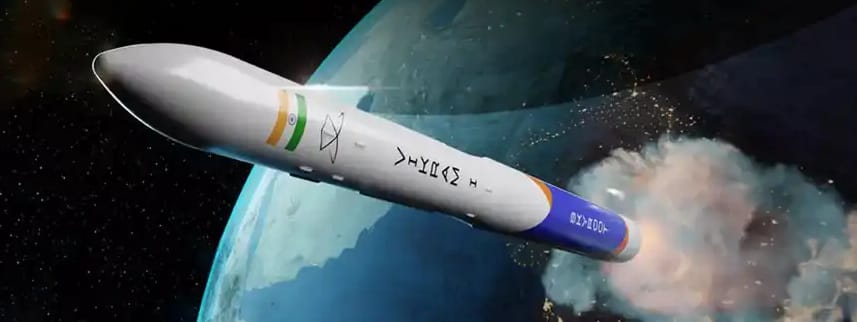
All stages of the Vikram-1 launch vehicle have been successfully integrated and erected on the launch pad. The mission is designed to gather critical flight data related to propulsion, stage separation, guidance, navigation, control, and overall vehicle performance. These insights will help Skyroot advance toward becoming a fully operational commercial launch service provider.
Pawan Kumar Chandana, Co-founder and CEO, Skyroot Aerospace, said, “The primary objective of Mission AgniVaan is to collect real-flight performance data from every system aboard Vikram-1. We want to understand how the rocket performs throughout every phase of ascent after liftoff. Such data cannot be obtained solely through ground testing. It will help us validate our designs and accelerate future rocket development. The moment Vikram-1 lifts off, India’s private space industry will reach a milestone it has never achieved before.”
Naga Bharath Daka, Co-founder and COO, Skyroot Aerospace, said, “The journey from dreaming of building a launch vehicle in India to attempting an orbital launch has been truly extraordinary. With Vikram-S in 2022, we laid the technological foundation. Now, with Vikram-1, we are taking our biggest step toward establishing a reliable, high-frequency launch capability built in India for India and the world.” Vikram-1 is a seven-storey-tall, multi-stage orbital launch vehicle built with a fully carbon-composite structure. It incorporates Skyroot’s indigenously developed propulsion systems, 3D-printed engines, and high-performance solid rocket boosters. The rocket is designed to deploy small satellites weighing up to 350 kilograms into Low Earth Orbit (LEO). Its maiden mission aims to achieve a 450-kilometre orbit with an inclination of 60 degrees.
The flight-ready Vikram-1 vehicle was unveiled by Prime Minister Narendra Modi during the inauguration of Skyroot’s Infinity Campus in November 2025.
The mission also carries significant economic importance. India’s space economy, currently valued at approximately US$8.4 billion, is expected to grow to US$44 billion by 2033. Indigenous launch capabilities will play a crucial role in driving this growth and unlocking new opportunities for India’s rapidly expanding private space ecosystem.



More Stories
Union Environment Minister Releases Two Male Great Indian Bustards Into The Wild At Desert National Park, Jaisalmer.
Smile Train India Brings Smile Walls To Communities Across The Country For World Smile Day.
Gurjinder Singh Gavy Congratulates Pargat Singh On Appointment As Punjab Congress President, Extends Best Wishes To Sachin Pilot.