




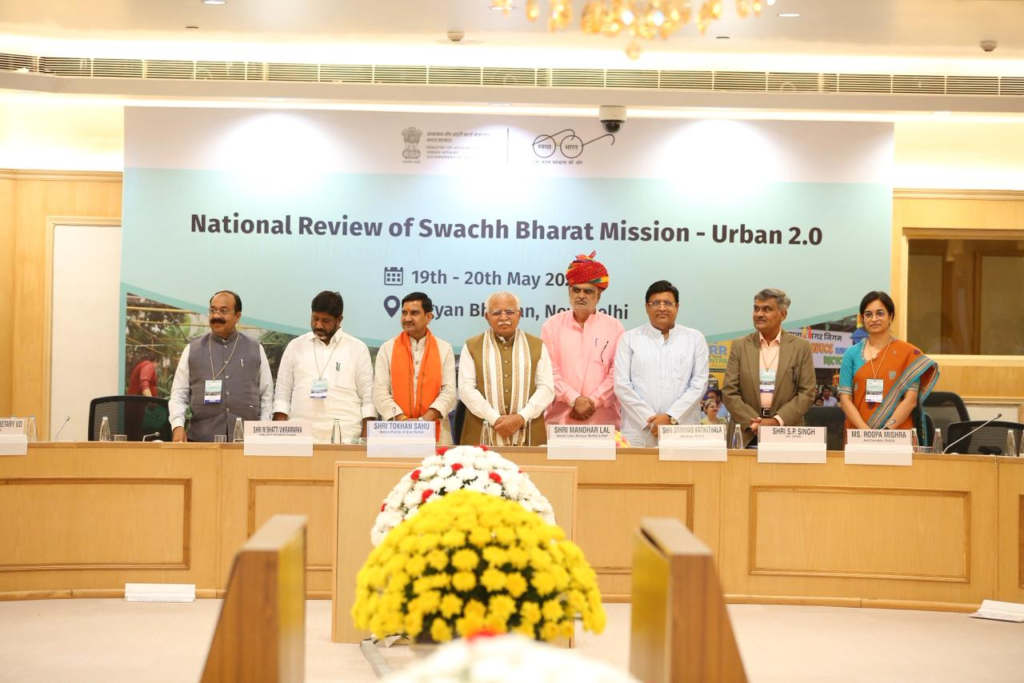
New Delhi, Delhi, 20th of May, 2026 : The Ministry of Housing and Urban Affairs (MoHUA) convened a two-day National Review of Swachh Bharat Mission-Urban 2.0 at Vigyan Bhawan, New Delhi on 19–20 May 2026 under the chairpersonship of Sh. Manohar Lal, Hon’ble Union Minister for Housing and Urban Affairs.
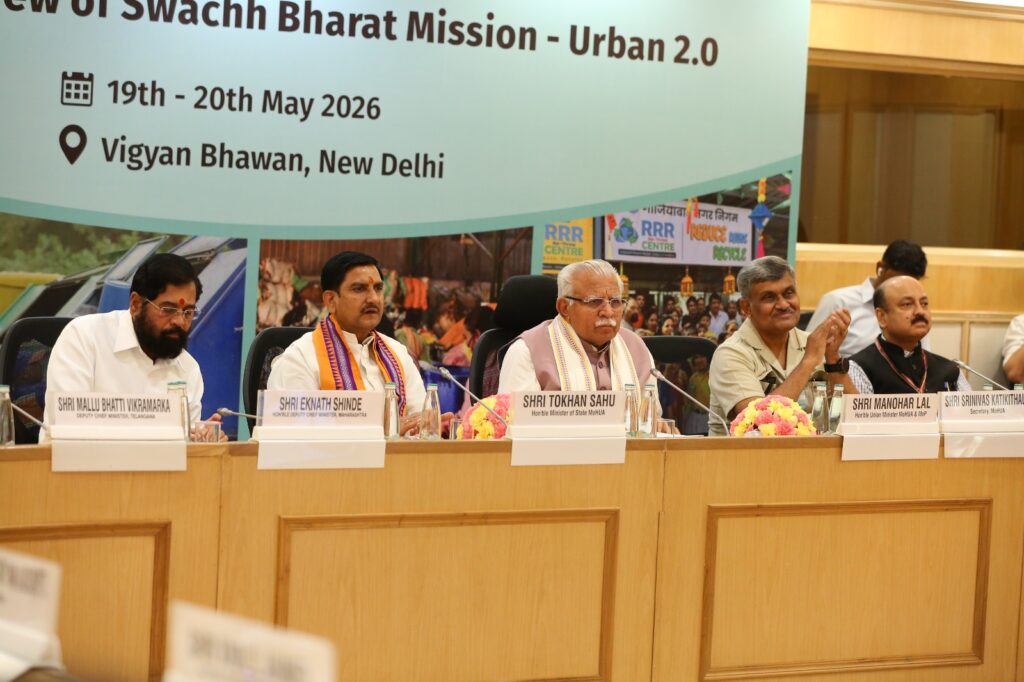
The progress of SBM-Urban has been significant, with 97% of wards now covered under door-to-door waste collection and communities increasingly adopting source segregation through two-bin, four-bin and even six-bin systems. Waste processing has improved substantially from 16% in 2014 to 81% in 2026. Legacy waste remediation has also gained strong momentum, with 65% of the 26 crore metric tons of waste across 2,482 dumpsites already remediated, reclaiming nearly 9,000 acres of valuable urban land.
Mentioning the key takeaways from the 2-day National Review on SBM-U 2.0, Union Minister, Sh. Manohar Lal said, “We need to focus on what we need to change, whether it is financial challenges, matching State/UT shares, resolving implementational bottlenecks like tendering delays, land allocation or augmenting institutional capacities. We have only 10 months to prepare a focussed plan and achieve allotted targets. The Mission requires strong high-level ownership and detailed planning; please remember, the strength of the chain lies in the weakest link of the chain.”
The Union Minister emphasized the need for State-wise mapping of key issues and challenges. States were directed to update progress daily on the Swachhatam Portal to enable regular reviews and rigorous tracking by the Ministry. He also stressed the importance of behavioural change, noting that “Swabhav Swachhata, Sanskar Swachhata” should be integrated into the curriculum. The Minister highlighted that strong political ownership, particularly among Chief Ministers, Union Development Ministers and other political representatives would be critical in accelerating implementation by providing the necessary push and achieving goals swiftly, particularly legacy dumpsite remediation.
The 2-day conference brought together Senior-level dignitaries including Deputy Chief Minister of Telangana, Shri. M. Bhatti Vikramarka, Shri Eknath Shinde, Deputy CM of Maharashtra, Shri. Arun Sao, Deputy CM, Chhattisgarh, along with other Urban Development Ministers from 12 States of Andhra Pradesh, Arunachal Pradesh, Bihar, Haryana, Madhya Pradesh, Rajasthan, Sikkim, Uttar Pradesh, Delhi, West Bengal, Uttarakhand and Jammu and Kashmir; along with their Principal Secretaries and other senior officials. Representatives from 14 Central Ministries like MOEFCC, DDWS, MoRTH, MoPR, MeiTY, MoRD, MoP also joined the conference in deliberating on convergence and inputs on sanitation and waste management ecosystem.
The conference was a thematic review and knowledge-sharing platform, with 11 focused sessions across various aspects of SBM on institutional strengthening, visible cleanliness, scientific waste processing, source segregation, waste-to-energy systems, sanitation and Used water management, worker safety, and implementation in special geographical regions. The consultative process and discussions brought forth several important points like Fast Tracking on-ground processes, Smart Monitoring through Integrated Command Control Centres and other mechanisms, promotion of regional planning and cluster-based waste management strategies, the requirement of infrastructure push in Mega and large cities, and development of robust financial models for project sustainability.
The two-day national review meeting was part of a cascaded review mechanism prior to PRAGATI – Pro-Active Governance and Timely Implementation review and was supported by adequate field level examination, inter-governmental consultations, clearly identified action points, thereby enabling more focused and outcome – oriented deliberations.
With the new Solid Waste Management (SWM) Rules coming into force from 1st April 2026, the evolving waste management landscape will require strategic interventions and strengthened institutional responsibilities at all levels – (i) From 2- way source segregation to mandatory 4-stream source segregation (wet, dry, sanitary and domestic hazardous), (ii) Key focus on political representatives as lead facilitators for 4- way segregation (iii) Accountability of Bulk Waste Generators, enumeration, sensitisation and readiness (iv) Polluters’ Pay Principle (user charges and enforcement) and (v) Digital monitoring & transparent reporting through centralised unified portal. The same has also been reinforced by directions from Hon’ble Supreme Court. Union Minister, Sh. Manohar Lal emphasised upon the execution of the Rules in full spirit.
The National Review Meeting reinforced the “Whole of Government” approach, strengthening collaborative action across Ministries and States, towards achieving the vision of Viksit Bharat 2047.




More Stories
The Association Of People With Disability Launches ‘AS I AM’ – A National Movement To Redefine How India Sees Disability.
High-Rise Engineering Should Be Measured By How A Home Performs Over Time.
Union MoS Raksha Khadse Reviews Sports Ecosystem In Mizoram; Visits Sai Aizawl.