





New Delhi, Delhi, 14th of May, 2026 : Union Health Secretary Punya Salila Srivastava addressed the 12th Convocation of Nursing and Allied Health Sciences courses at the Jawaharlal Institute of Postgraduate Medical Education and Research, an Institution of National Importance under the Ministry of Health and Family Welfare, today.
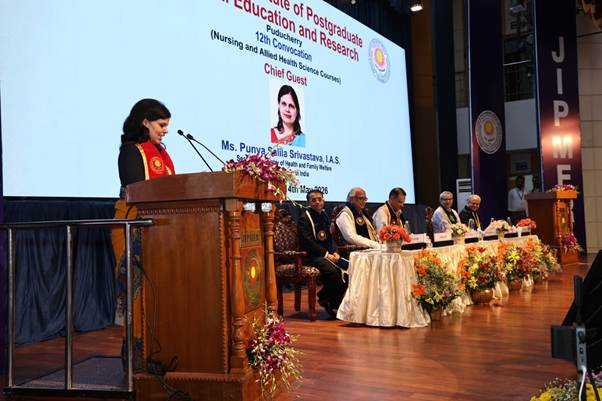
Addressing the gathering, Smt. Punya Salila Srivastava, Union Health Secretary, Government of India, described the convocation as a defining milestone in the lives of the graduating students. She urged them to dedicate their professional journey to service, compassion, and nation-building, noting that their contributions would significantly shape the future of the country’s healthcare system. She emphasised that as graduates of the prestigious Jawaharlal Institute of Postgraduate Medical Education and Research, they carry forward a legacy of commitment, competence, and ethical service, which must be upheld in their professional lives.
Highlighting the guiding principles of India’s public health system, she referred to the National Health Policy 2017, which envisions a comprehensive approach encompassing preventive, promotive, curative, rehabilitative, and palliative healthcare. She noted that each graduating student would play a vital role in advancing one or more of these critical dimensions of healthcare delivery.
Speaking about the transformative impact of Ayushman Bharat, she elaborated on its four foundational pillars. She highlighted the extensive network of Ayushman Arogya Mandirs, now numbering over 1.8 lakh, which represent a paradigm shift from a primary focus on reproductive and child health to a broader emphasis on screening, early detection, and management of non-communicable diseases (NCDs). She underlined that these centres are now envisioned to deliver at least 12 comprehensive service packages, including mental healthcare, palliative care, and screening for conditions such as diabetes and hypertension.
Emphasising quality in healthcare delivery, she spoke about the importance of Indian Public Health Standards (IPHS) and the National Quality Assurance Standards (NQAS). She noted that over 2 lakh public health facilities, including Ayushman Arogya Mandirs, Community Health Centres, and District Hospitals, are being assessed for infrastructure and service gaps. She further informed that about 64,000 public health facilities have already achieved NQAS certification, and encouraged the graduates to actively contribute towards quality improvement in the institutions they join.
Elaborating further, she outlined the remaining pillars of Ayushman Bharat, including Ayushman Bharat Pradhan Mantri Jan Arogya Yojana (AB PM-JAY), which provides financial protection and health assurance to beneficiaries; the Ayushman Bharat Digital Mission (ABDM), which enables creation of ABHA accounts for seamless digital health records and data-driven healthcare; and the Pradhan Mantri Ayushman Bharat Health Infrastructure Mission (PM-ABHIM), which is strengthening health infrastructure through initiatives such as critical care blocks and expansion of the Viral Research and Diagnostic Laboratories (VRDL) network.
The Secretary underscored that nursing and allied healthcare professionals form the backbone of India’s healthcare system, playing a crucial role in both public health and clinical care delivery. In this context, she highlighted key legislative reforms, including the enactment of the National Nursing and Midwifery Commission Act and the National Commission for Allied and Healthcare Professions Act, aimed at strengthening education, regulation, and professional standards in these sectors.
She also pointed to significant capacity-building initiatives, including the establishment of 157 nursing colleges co-located with medical colleges, and the Government’s commitment to developing 1 lakh healthcare professionals over the next five years.
Highlighting India’s growing global engagement in healthcare, she noted that the Government is entering into partnerships with countries such as Italy, United Kingdom, and France, creating opportunities for Indian healthcare professionals to serve globally. She described the graduates as “India’s ambassadors” in the global healthcare landscape.
Concluding her address, she stated that as India moves towards the vision of Viksit Bharat 2047, its foundation rests on achieving a Swasth Bharat. She expressed confidence that the graduating cohort would play a transformative role in realising this vision and lead the nation towards a healthier and more developed future.
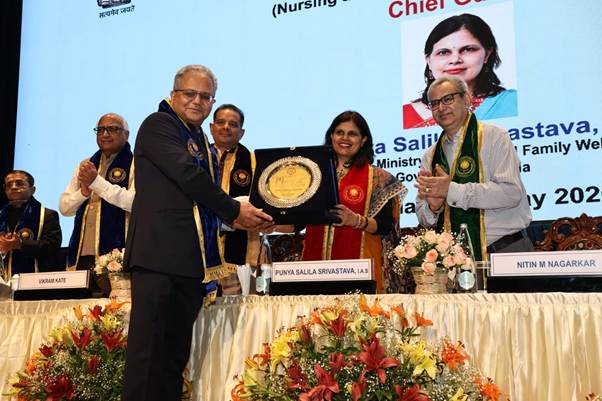
The convocation marked a significant academic milestone, wherein a total of 320 students were awarded degrees across multiple disciplines, including M.Sc. (Nursing), M.Sc. (Allied Health Sciences), Master of Public Health (MPH), B.Sc. Nursing, and B.Sc. (Allied Health Sciences). The distribution of graduating candidates included 55 in M.Sc. (Nursing), 49 in M.Sc. (AHS), 36 in MPH, 94 in B.Sc. Nursing, and 86 in B.Sc. (AHS).
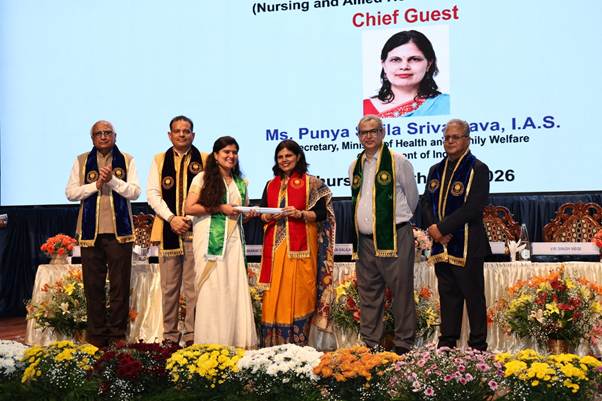
In recognition of academic excellence, 24 students were conferred medals and endowment prizes for securing the highest marks in their respective courses. This included 2 students from M.Sc. (Nursing), 8 from M.Sc. (AHS), 2 from MPH, 1 from B.Sc. Nursing, and 11 from B.Sc. (AHS).
Dr. Sharat Chauhan, Chief Secretary to the Government of Puducherry, Dr. Vir Singh Negi, Director, JIPMER, faculty members, distinguished guests and parents were present on the occasion.
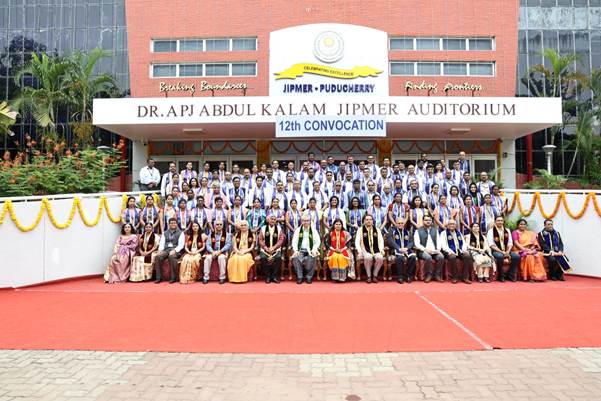
The convocation reaffirmed JIPMER’s commitment to excellence in medical education, research, and patient care, and its continued contribution to building a resilient and robust healthcare system in the country.




More Stories
Beyond Property Management: Stakeholders Discuss Need For Stronger Charitable Institutions In Assam.
IAF Commences Operational Phase At Jodhpur.
Vice-President Shri C. P. Radhakrishnan Graces The 15th Graduation Day Ceremony Of Sree Uthradom Thirunal (SUT) Academy Of Medical Sciences In Thiruvananthapuram.