




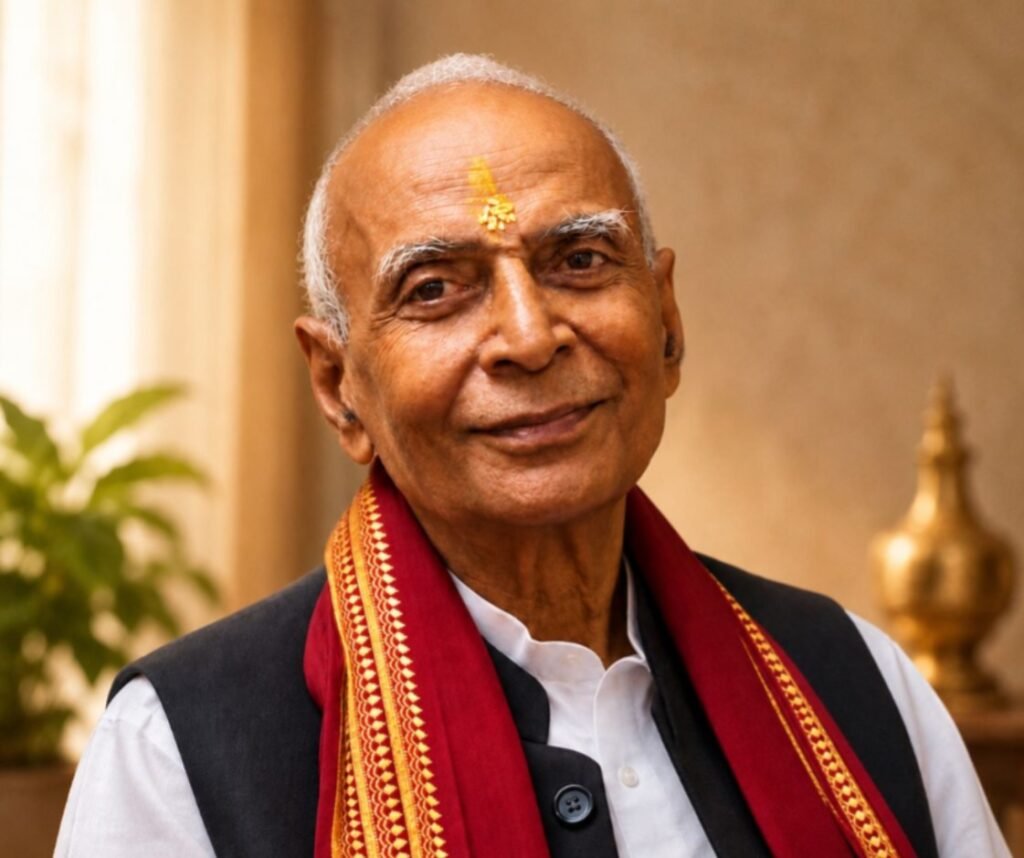
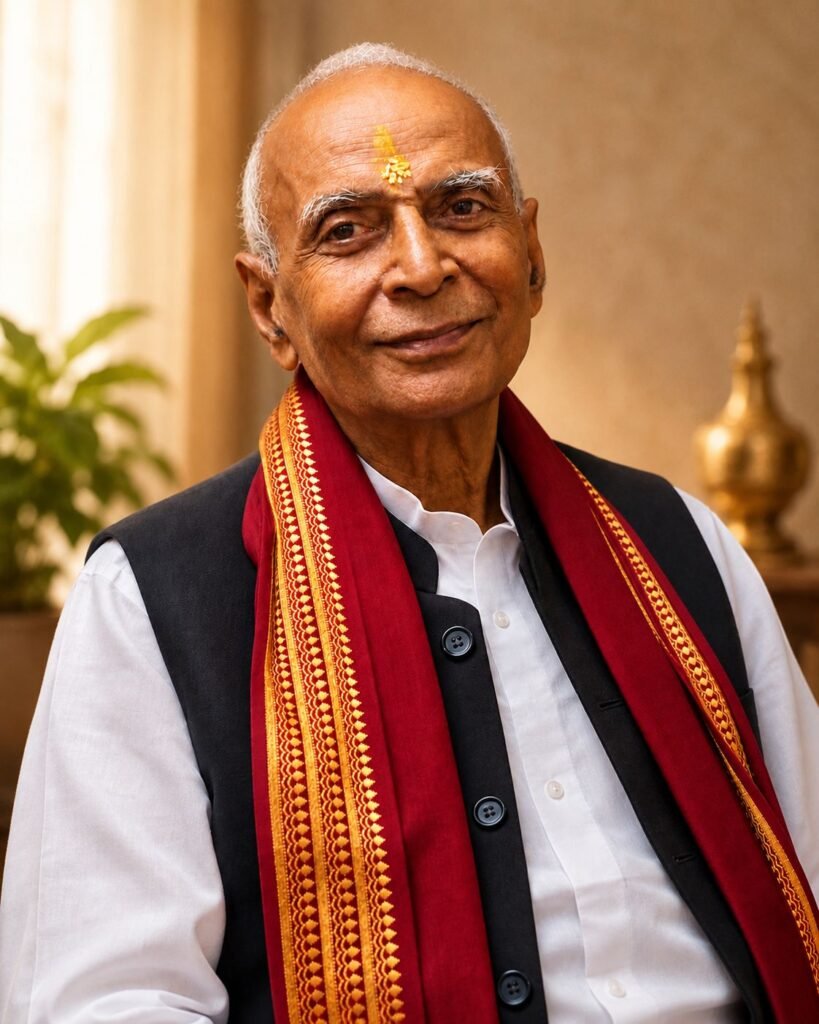
New Delhi, Delhi, 9th of September, 2026 : Veteran engineer, former public-sector leader and CyberPeace Director V.K. Roy passed away in August 2026 at the Army Hospital (Research & Referral), New Delhi. His passing brings to a close an extraordinary professional journey spanning more than five decades – from irrigation and heavy engineering to computerisation, space-linked infrastructure, cybersecurity, Artificial Intelligence security and the emerging challenge of Net Zero in the age of data centres.
Born into a farming family in Rampur, Bihar, Roy rose from modest beginnings to become one of the most versatile engineers of his generation. As a child, he travelled nearly 10 kilometres each day, barefoot, to attend a government school. He first wore shoes when he enrolled for intermediate studies at St. Xavier’s College, Ranchi. After completing his engineering degree in 1969 in First Division and standing third in order of merit, he began his career with the Irrigation Department of the Government of Bihar before joining Heavy Engineering Corporation Limited (HEC), Ranchi.
Nearly four decades of service at HEC
Roy joined HEC’s Heavy Machine Tools Plant (HMTP) in July 1971 as a Methods Engineer and Industrial Engineer. Over the next 36 years, he worked across methods and industrial engineering, systems, material management, production planning, operations and plant leadership. In September 2005, he became General Manager and Chief of HMTP – the same plant he had entered as a young engineer more than three decades earlier.
His leadership coincided with a significant period in HEC’s revival. In FY 2006-07, HEC returned to profitability after nearly 18 years, reporting a net profit of Rs 2.86 crore. Roy’s professional record notes that HMTP’s turnover increased by more than 100 percent during his tenure as General Manager, an improvement he consistently attributed to teamwork, mutual trust and speed of execution. He also served as Secretary of the Pay Revision Committee, helping conclude wage-structure negotiations in a record two-month period, and was a Certified ISO 9001 Auditor.
A mechanical engineer who embraced computing
Long before ‘digital transformation’ became corporate vocabulary, Roy was applying computing to the factory floor. Trained as a mechanical engineer, he began programming in the late 1970s, completed CNC programming training at CMTI, Bangalore, in 1977, and later trained in systems design and COBOL programming. His technical repertoire expanded to include COBOL, FORTRAN, BASIC, Pascal, C, Oracle RDBMS and Visual Basic.
Because he did not have a computer at home, Roy often wrote programs by hand on discarded dot-matrix paper after work, mentally checking the logic before entering and compiling the code at HEC the next day. From 1983 to 1997, as In-charge of HMTP’s Systems Department, he developed applications supporting inventory, financial management information systems, product design, production planning and control, marketing, stores and procurement.
At a time when many professionals remained defined by their original discipline, Roy repeatedly crossed technological boundaries. He had an opportunity to move to Canada but chose to remain in India, believing that his skills should contribute to his state, his institution and the country.
Part of the engineering ecosystem behind India’s space ambitions
Roy’s years at HEC also connected his career to India’s space programme. HEC supplied major launch infrastructure to the Indian Space Research Organisation, including mobile launching pedestals, cranes, folding-cum-vertically repositionable platforms and horizontal sliding doors; HEC-supplied facilities were used in support of Chandrayaan-1. Roy’s engineering journey has been remembered in connection with the launch infrastructure and essential ground equipment that enabled India’s lunar ambitions.
The association offered a powerful arc to his life: a boy who once walked barefoot to school in rural Bihar became part of an engineering institution whose work helped provide the steel and infrastructure beneath India’s reach for the Moon.
A father, teacher and lifelong student of technology
Beyond his formal responsibilities, Roy taught physics, mathematics, computers and technical subjects to students free of cost. He believed knowledge created opportunity and that access could change the course of a life – a belief rooted in his own childhood.
He brought the same conviction to his family. When his son Vineet became fascinated by computers at the age of eight, Roy encouraged after-school learning at HEC, arranged a second-hand computer for the home and later took a loan to support advanced technical education and certifications. Those early experiences became part of the formative story behind CyberPeace.
Major Vineet Kumar, Founder & Global President, CyberPeace Foundation said “My father believed that technology mattered most when it strengthened people, institutions and the nation. From handwritten code and the factory floor to cybersecurity and AI, he never stopped learning. But what defined him most was his willingness to teach, to create opportunities for others and to remain deeply connected to where he came from. His life reminds us that progress is not only about reaching farther; it is also about bringing knowledge and possibility back home,” said Vineet, his son.
From CyberPeace to AI security and Net Zero
After formally retiring from HEC in March 2007, Roy continued as an adviser and later served as a Director at CyberPeace and Autobot Infosec. His lifelong interest in systems evolved naturally from industrial operations to the security of the connected world. In his later years, he was researching Artificial Intelligence security – a remarkable transition for an engineer who had once written computer code entirely by hand.
His final area of exploration brought technology back to the concerns of rural India. Roy was developing grassroots thinking around Net Zero in the age of AI and data centres, examining the relationship between computing growth and electricity, cooling, water, land and material resources. He was particularly interested in how clean energy, efficient infrastructure and AI-led optimisation could benefit agriculture and rural communities without compromising the resources on which they depend.
At his final farewell, the Director General of the Territorial Army paid tribute by saluting Roy and laying a wreath – a fitting recognition of a life devoted to service through engineering, institution-building, education and technology.
From the soil of Rampur to the workshops of HEC, from handwritten software to the infrastructure supporting India’s lunar journey, and from cybersecurity to a sustainable AI-enabled future, V.K. Roy’s life reflected the technological transformation of modern India. The engineer is gone; what he built – systems, institutions, knowledge and opportunity – continues.


More Stories
IIT Mandi Rises In India Today–MDRA Rankings 2026.
India And Sri Lanka Reaffirm Commitment To Shared Progress & People Welfare While Ensuring Regional Security And Prosperity.
PETRONAS Lubricants India And Tata Motors Collaborate To Pilot A Scalable Used-Oil Recycling Model.