






New Delhi, Delhi, 1st of August, 2026 : The Union Cabinet, chaired by Hon’ble Prime Minister Shri Narendra Modi, yesterday approved “Samudra Manthan” the National Offshore Exploration Scheme, a Central Sector Scheme of the Ministry of Petroleum & Natural Gas carrying an approved outlay of ₹84,084 crore for implementation through FY 2030–31. It is India’s most ambitious offshore exploration mission to date.
This approval marks the culmination of a series of transformative reforms undertaken under the leadership of the Hon’ble Prime Minister to strengthen India’s hydrocarbon exploration and production sector.
The National Offshore Exploration Scheme, Samudra Manthan, builds upon these reforms by translating policy into action and opening a new chapter in India’s journey towards energy security and Atmanirbhar Bharat.
India is the world’s third-largest consumer of crude oil, with an annual import bill of nearly USD 144 billion (approximately ₹13 lakh crore). As recent geopolitical developments have demonstrated, secure and uninterrupted access to energy resources is of strategic importance for a rapidly growing economy.
With India’s energy demand expected to rise steadily in the coming decades, enhancing domestic oil and gas production is essential for reducing import dependence, strengthening energy resilience, and securing the nation’s long-term economic growth.

Fig 1: Advanced Seismic Surveys Unlock India’s Offshore Potential
Since 2014, the Government has undertaken a series of structural reforms over the past few years to create an enabling ecosystem for hydrocarbon exploration and production:
- Opening Up Offshore Acreage: More than 99% of the earlier “No-Go” areas have been removed, making over one million square kilometres of India’s Exclusive Economic Zone available for exploration for the first time.
- Modernising the Contractual Regime: India transitioned from Production Sharing Contracts to Revenue Sharing Contracts, simplifying the fiscal framework and improving transparency while reducing administrative intervention.
- Legislative Reforms: The Oilfields (Regulation and Development) Amendment Act, 2025 modernised the legal framework governing the sector by providing contractual stability, recognising integrated petroleum operations, strengthening dispute resolution mechanisms, and establishing a contemporary regulatory architecture.
- Implementation Through New Rules: The Petroleum and Natural Gas Rules, 2025 operationalised these reforms by promoting ease of doing business, improving regulatory efficiency, and streamlining the administration of petroleum leases.
- Uniform Decision-Making Framework: The Government has also standardised the composition and mandate of the Empowered Committee of Secretaries across all contract regimes, ensuring consistency and a level playing field for all operators, irrespective of when their contracts were signed.
- Sharper Focus on Exploration: The performance parameters of ONGC and Oil India have been reoriented to place greater emphasis on exploration activities, reinforcing the Government’s commitment to expanding India’s domestic hydrocarbon resource base.
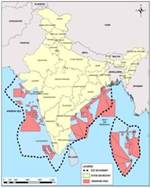
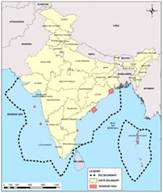
Earlier Offshore Areas Restricted for Exploration Nearly 99% of India’s EEZ Now Open for exploration
Hydrocarbon exploration is a capital-intensive and long-gestation activity, with a typical period of 5–10 years from the award of an exploration block to the commencement of commercial production. This underscores the need for sustained exploration to meet India’s growing energy demand.
Further, existing oil and gas fields witness a natural production decline of around 6–7% every year, making continuous exploration and new discoveries essential to sustain domestic hydrocarbon production.
To address these challenges, the Government has reoriented policy towards exploration-led growth. Under the National Offshore Exploration Scheme “Samudra Manthan” the Government will provide financial support of up to 50% of the cost of drilling deepwater exploration wells, thereby reducing exploration risk, encouraging investment, and accelerating the development of India’s offshore hydrocarbon potential.
India’s future hydrocarbon potential lies largely in deepwater and ultra-deepwater basins such as Krishna-Godavari, Cauvery, Mahanadi and the Andaman region. Exploration in these frontier areas requires advanced technology and significant investment, with a single deepwater exploratory well costing approximately USD 125–150 million. Recognising the high-risk, high-cost nature of such exploration, the Government is adopting a risk-sharing approach to encourage sustained investment, accelerate exploration, and unlock India’s offshore hydrocarbon resources.

Fig 4: Accelerating Deepwater & Ultra-Deepwater Exploration
Samudra Manthan is therefore proposed as a strategic national intervention to de-risk offshore exploration, catalyse private investment, strengthen domestic production and build enduring national capability across the offshore exploration and production value chain.
The National Offshore Exploration Scheme “Samudra Manthan” marks the transition from policy reforms to mission-mode implementation. Approved as a Central Sector Scheme with a Phase-I outlay of ₹84,084 crore up to 31 March 2031, the scheme adopts an integrated approach to accelerate offshore hydrocarbon exploration and production.
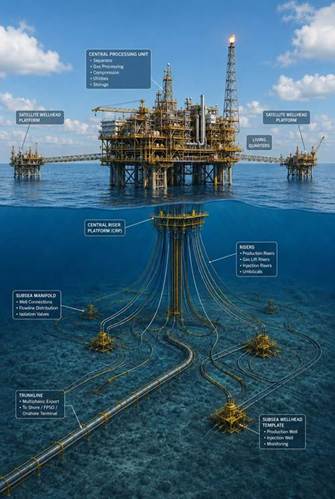
Fig 5 : Shared Offshore Infrastructure for Faster Production
The scheme comprises four key components: (i) acquisition and processing of modern offshore seismic data with an outlay of ₹28,534 crore; (ii) drilling of 60 deepwater exploration wells with an allocation of ₹43,200 crore, including Government support of up to 50% of eligible drilling cost or ₹675 crore per well, whichever is lower; (iii) development of common offshore infrastructure hubs with an outlay of ₹10,000 crore to facilitate commercialisation of discoveries; and (iv) establishment of Oil and Gas Manufacturing and Services Zones with an outlay of ₹2,000 crore to promote domestic manufacturing and localisation of critical equipment and services
Outlay by component (In Rupees Crore)
| SL | COMPONENT | AMOUNT |
| 1 | Offshore data acquisition | 28,534 |
| 1A | 2D seismic data acquisition for basin-wide coverage | 12,000 |
| 1B | 3D seismic data acquisition (and other techniques) | 12,534 |
| 1C | NDR data re-processing and AI tools implementation | 4,000 |
| 2 | Offshore exploration and infrastructure-led production | 55,200 |
| 2A | Offshore exploration acceleration | 43,200 |
| 2B | Infrastructure-led deepwater production and exploration | 10,000 |
| 2C | Development of oil and gas manufacturing and services zones | 2,000 |
| 3 | Monitoring and support activities (digital interventions, monitoring and evaluation, human resource, awareness and outreach, events, media) | 350 |
| TOTAL | 84,084 |
Subject to exploration success, the National Offshore Exploration Scheme – Samudra Manthan – aims to increase India’s domestic oil and gas production from around 62 MMTOE to 80 MMTOE annually and expand the country’s hydrocarbon resource base from 1.6 billion TOE to 2.2 billion TOE. The additional production has the potential to reduce crude oil imports by nearly ₹1 lakh crore annually, strengthening India’s energy security and reducing import dependence.
By creating a robust offshore exploration ecosystem through better data, risk-sharing, common infrastructure and domestic manufacturing capabilities, Samudra Manthan will enable India to build national capability in deepwater exploration and production, strengthen our energy-security resilience, and reduce our long-term dependence on imports.



More Stories
Mahindra University And Massey University Celebrate New Partnership With Delegation Visit To New Zealand.
In The Presence Of Union Home Minister Amit Shah And Union Jal Shakti Minister C. R. Patil, CMs Of Uttar Pradesh, Uttarakhand, Himachal Pradesh, Rajasthan, Delhi & Haryana Signed The Kishau Project Agreement.
The Association Of People With Disability Launches ‘AS I AM’ – A National Movement To Redefine How India Sees Disability.