





New Delhi, Delhi, 19th of September, 2026 : The apex body of agrochemical industry Agro Chem Federation of India (ACFI) has urged the government to introduce a targeted and time-bound policy framework for the sector, including an estimated ₹5,000-7,500 crore support programme for upstream manufacturing in order to achieve self-reliance in upstream agrochemical technicals and intermediates, neutralize Chinese advantages in utility costs and promote backward integration.
ACFI and global consultancy firm KPMG released a knowledge paper titled: Redefining Indian Crop Protection through Innovation: From Scale to Science. The report emphasised that the objective of the industrial policy should not be permanent protection or subsidy dependence but must focus on correcting clearly identifiable ecosystem disadvantages that reduce manufacturing competitiveness relative to global peers.
ACFI Chairman Shri Rahul Dhanuka said, “Our focus should remain on what farmers actually need – supporting innovation through an enabling regulatory framework, strengthening domestic capabilities and resilient supply chains, promoting digitalisation, and advancing sustainable agriculture. Ultimately, the success of innovation will depend on how effectively these efforts are translated into practical, accessible and trusted solutions for farmers”.
The ACFI-KMPG report recommends a seven-to-eight-year support period, allowing two-three years for plant commissioning followed by sustained production support. The proposed framework must include graded investment thresholds to cover both large companies and MSMEs, for greenfield and brownfield expansion. It has also called for PLI-style incremental sales incentives, utility subvention like power/effluent subsidies and capital grants for specialized R&D.
The report also suggests 5-8% incentive on incremental sales, 30- 40% subsidization on industrial electricity and shared Common Effluent Treatment Plant (CETP) usage to directly counter China’s OPEX advantage.
“India’s next phase of growth in crop protection should be anchored in strengthening ecosystem competitiveness, accelerating innovation commercialization, enhancing supply-chain resilience and reducing structural cost disadvantages,” the report said.
Among its recommendations, the report calls for specialised agrochemical manufacturing parks with shared utilities, cluster-based environmental infrastructure, long-term financing and selective backward integration in strategically important intermediates.
The report also calls for a single-window regulatory framework with a unified digital platform for Centre and state approvals, transparent and time-bound processes, and clearer regulatory pathways for biological crop-protection products.
It argues that India’s next phase of growth cannot depend solely on adding manufacturing capacity. Despite its strengths in process chemistry, formulations, technical manufacturing and regulatory execution, the country needs to build capabilities in product development, biologicals, advanced formulations, regulatory science and digital agriculture.
The report identifies biological crop protection as a significant opportunity for India, citing its biodiversity, agricultural base, fermentation expertise and scientific talent. However, it cautions that commercialisation will depend on batch consistency, formulation stability, scalable manufacturing, multi-location field validation and farmer adoption.
It further recommends strengthening pilot-scale facilities, field-validation networks, GLP laboratories, residue-testing infrastructure and formulation-development platforms to bridge the gap between research and commercial deployment.
The report said India’s future competitiveness would increasingly depend on its ability to develop, register, manufacture and commercialise differentiated crop-protection solutions for global markets.
India’s emergence as a globally competitive crop protection ecosystem will require coordinated action across government, industry, research institutions, investors and farmers.
“While policy support can create enabling conditions, long-term competitiveness will ultimately depend on how effectively stakeholders collaborate to strengthen manufacturing, innovation, commercialization and market access.”
While India’s agrochemical industry has already established itself as a globally relevant manufacturing base, the report emphasised that the future of crop protection is increasingly being shaped by innovation, sustainability, precision agriculture, biological solutions and integrated crop-management approaches.
“Success will depend not only on the ability to manufacture products efficiently, but also on the ability to develop, register, commercialize and scale differentiated solutions across global markets.”
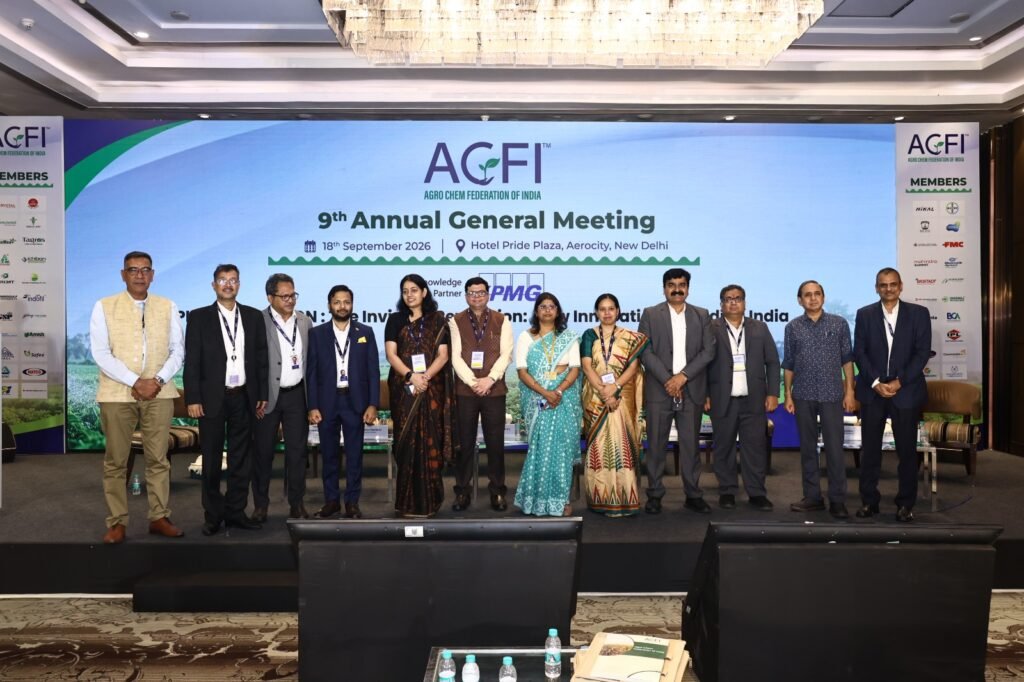
Following the AGM, ACFI also organised a panel discussion, The Invisible Revolution: How Innovation is Feeding India where eminent luminaries from the government, industry and academia converged to throw light on the innovations and challenges in the agrochemical industry.
Dr Vishal Chaudhary, an eminent Scientist to Government of India said, “India has already established a strong position in agrochemical manufacturing. The next step is to complement this manufacturing strength with greater focus on research, innovation and technology development.This will require stronger collaboration through public-private partnerships and structured engagement between research institutions, academia and industry.”
Dr. Sweety Behera, Director, FSSAI said, “While innovation in agriculture has traditionally focused on increasing productivity, scientific advancement now requires us to give equal priority to sustainability and consumer safety. Regulatory decisions must therefore be based on sound scientific evidence, risk-based approaches and effective surveillance. Innovation and regulation should complement each other.”
Dr Kavya Dashora, Professor, Indian Institute of Technology, Delhi said, “Nanotechnology can improve crop protection through targeted delivery, controlled release and reduced input use. However, field application faces challenges around nanoparticle behaviour, persistence and toxicity. Wider adoption requires stronger data, tracking mechanisms and “safe-by-design” nanomaterials to ensure environmental and consumer safety.”
Pushplata Singh, Director, TERI said, “Biotechnology and nanotechnology can play an important role in making Indian agriculture more sustainable and climate-resilient. Safe-by-design approaches, including the use of biogenic materials to develop nanopesticides, can improve biocompatibility and safety for plants, humans and the environment. Together, biotechnology and nanotechnology can support more precise input use while helping agriculture respond to increasing climate and resource pressures.”
Dr. Rajvir Rathi, Director- Agricultural Affairs, Bayer CropScience said, “Effective technology licensing and access frameworks can help bridge the gap between agricultural innovation and its adoption by Indian farmers by making proven technologies widely and affordably available.”
Srinivasa Karavadi, Founder & CEO, KshetragnaFarm Solutions said, “The future of Indian agriculture lies in integrating crop protection, biologicals, crop nutrition, seeds and digital technologies rather than developing solutions in silos. Improving nutrient-use efficiency, restoring soil health and developing stress-tolerant seeds will be critical for achieving greater productivity with lower environmental and resource costs. Digital tools, AI and stronger field-level capabilities can help standardise advice and enable farmers to make more informed choices amid an increasingly complex marketplace.”
Gopinath Koneti, Partner and Senior Advisor KPMG India said, “Agricultural innovation must ultimately pass the test of economic viability, because farmers value solutions that are visible, measurable and, most importantly, profitable. Innovations should therefore be evaluated not only for their scientific merit but also for their practical impact, cost and returns to the farmer. Given the importance of every rupee invested in Indian agriculture, science and economics need to go hand in hand to ensure that innovations deliver meaningful outcomes at scale.”
Prabhudutta, Deputy Editor, Hindu Businesslinesaid, “The industry must anticipate how consumer preferences and farming practices may evolve over the next decade and develop solutions that align with those changing expectations. Farmers are willing to adopt new technologies when they see clear benefits, but companies must ensure that products are reliable, responsibly developed and do not compromise farmer interests or soil health. Building long-term farmer trust is key.”
Dr. Kalyan Goswami, DG, ACFI said, “Innovation in agriculture cannot succeed in isolation. Biotechnology, crop protection, biologicals, nanotechnology, digital technologies, improved seeds and crop nutrition must converge to create solutions that are scientifically sound, economically viable and relevant to farmers. Equally important is building and preserving farmer trust. As an Association, we remain committed to bringing together industry, academia, government and the scientific community to create an ecosystem where innovation can move from research to the field and ultimately benefit the Indian farmer.”
About Agro Chem Federation of India
Agro Chem Federation of India (ACFI) is an apex industry body representing 85% of the Indian Agrochemical Industry at the PAN India level. ACFI has partnered with many Academic Institutions, Farmer Associations, and Associated Government & Non-Government Organisations. We work in the interest of Farmers by educating them about Plant Protection Chemicals (Pesticides) to achieve higher yields and better quality of agricultural produce across various crops, including the right dose, timely and appropriate application methods, and the use of PPEs.




More Stories
NE STAR 2026 Announces Shortlisted Finalists For The Grand Finale In Guwahati.
IVPA Strengthens Leadership for a Changing Vegetable Oils Landscape.
From Mumbai To Melbourne: BITS Design School Students To Get Opportunity To Study At RMIT University.