




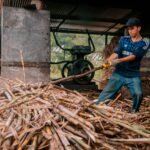

Agartala, Tripura, 26th of August, 2026 : Long before “natural farming” became a national policy priority, India’s Northeast was quietly practising many low-input, ecologically adapted farming systems. Shaped by heavy rainfall, rich biodiversity, diverse agro-climatic conditions and generations of indigenous knowledge, the region never underwent the same scale of agricultural intensification seen in India’s Green Revolution belt. Fertiliser and pesticide use remains relatively low in many parts of the region—not necessarily because of a deliberate “chemical-free” policy, but because of geography, traditional knowledge, smallholder systems and limited access to external inputs.
What was once viewed largely as a development constraint could now become a competitive advantage. As India promotes natural and sustainable farming through initiatives such as the National Mission on Natural Farming, the Northeast has an opportunity to convert its distinctive agricultural heritage into premium, traceable and marketable products. One particularly powerful instrument for doing so is the Geographical Indication (GI).
The Northeast’s Emerging GI and Specialty Crop Basket
The Northeast has an extraordinary diversity of crops and food products associated with specific places, communities, traditional practices and agro-ecological conditions. Among its GI-tagged or GI-worthy products are:
- Assam Lemon (Kaji Nemu): valued for its distinctive aroma, juiciness and culinary uses.
- Joha Rice: Assam’s aromatic rice varieties, traditionally grown through local production systems and increasingly suited to premium food markets.
- Lakadong Turmeric: a premium variety of turmeric grown in the Jaintia Hills of Meghalaya, India.
- Kachai lemon: is a unique, highly prized citrus fruit grown almost entirely in Kachai village within the Ukhrul district of Manipur, India.
- Naga Tree Tomato: a distinctive fruit associated with Nagaland’s traditional food culture and hill agriculture.
- Arunachal Orange and Khasi mandarin: a regionally distinctive citrus crop associated with the state’s mid-hill agro-ecologies.
- Sikkim Large Cardamom: one of the Northeast’s best-known high-value spices and an important component of Sikkim’s agricultural economy.
The opportunity extends well beyond these products. The Northeast contributes a substantial share of India’s pineapple production and has considerable potential in passion fruit, citrus, ginger, turmeric, chillies, medicinal and aromatic plants, traditional rice varieties and other specialty crops.
The significance of this diversity lies not simply in the number of crops produced, but in their ability to occupy high-value market niches where origin, authenticity, traditional knowledge, sustainability and quality influence consumer choice.
Why GI and Natural Farming Can Reinforce Each Other
A GI establishes a product’s connection with a specific geographical territory. It protects the identity associated with that place and helps distinguish an authentic regional product from generic alternatives. Natural farming can complement this identity by communicating how the product is grown. A GI does not, by itself, certify that a product is organic, natural or chemical-free. Such claims require appropriate verification. However, credible production standards, certification, residue testing and traceability can strengthen the value proposition.
Together, they create a compelling three-layer proposition:
Place + Production + Proof
- Place: Where is the product from? → GI and geographical identity
- Production: How was it produced? → Natural, organic or sustainable practices
- Proof: Can the claims be verified? → Certification, testing, traceability and digital records
This combination can give Northeast products the attributes sought by premium food markets: authentic origin, responsible production and verifiable quality.
For the Northeast, this matters because small landholdings and difficult terrain make the region less suited to volume-driven, low-margin commodity exports. It is potentially better positioned for a low-volume, high-value model in which differentiated products command premium prices.
The Southeast Asian Advantage
Geography adds another layer of opportunity. The Northeast is India’s natural bridge towards Bangladesh, Bhutan, Nepal, Myanmar and Southeast Asia. Improving road, rail, inland-waterway and border infrastructure, alongside the Act East policy, could convert this geographic advantage into shorter transit times and more efficient access to regional markets.
However, proximity alone does not guarantee export competitiveness. The real opportunity lies in combining geographic proximity with trade connectivity, export infrastructure, quality assurance, cold chains, aggregation and branding. If these elements come together, the Northeast could develop a distinctive “Northeast India” premium-food identity for selected products in South Asian, Southeast Asian, Gulf and other specialty markets.
The Missing Link: From Farm to Global Shelf
The region’s natural and cultural advantages do not automatically translate into export earnings. Five structural gaps require attention.
1. Certification and Verification
Many low-input farmers lack access to affordable certification and verification systems. The answer is not simply more certification, but locally appropriate, affordable systems supported by farmer aggregation, testing and traceability.
2. Post-Harvest Infrastructure
Perishable horticultural products can lose significant value without collection centres, grading and sorting facilities, pack houses, pre-cooling, cold storage, refrigerated transport and modern packaging.
3. Fragmented Production
Smallholders cannot individually fulfil large and consistent export orders. FPOs, cooperatives and producer clusters can aggregate produce, standardise quality, ensure traceability and negotiate with buyers. Small farms do not necessarily need to become large farms; they need to become part of organised value chains.
4. Limited Market Awareness
Many Northeast products remain relatively unknown outside their home states. GI registration alone does not create demand. Branding, attractive packaging, digital marketing, trade fairs, buyer-seller meets and sustained market development are essential.
5. Logistics and Border Trade Constraints
Difficult terrain and dependence on multiple transport modes can increase costs. Better border infrastructure, testing facilities, warehousing and customs facilitation are needed to reduce not only distance, but also the time and uncertainty involved in moving products to market.
What the Northeast Needs: A GI + Natural Farming + Export Strategy
A coordinated strategy could rest on six pillars: (1) Production: Promote suitable natural and low-input farming systems, (2) Identity: Strengthen GI protection and regional branding, (3) Verification: Certification, residue testing and traceability, (4) Aggregation: FPOs, clusters and producer organisations, (5) Infrastructure: Cold chains, pack houses, processing and logistics, and (6) Markets: Export promotion, branding and buyer linkages. The key is integration. A farmer practising natural farming without market access may receive little additional income. A GI-tagged product without quality control may fail to command a premium. An export market without reliable supply cannot sustain buyer relationships. A processing plant without organised raw-material procurement may remain underutilised.
These interventions must therefore operate as a single value-chain strategy, rather than as isolated schemes.
From “Natural” to “Naturally Premium”
The Northeast should not try to compete with India’s major agricultural regions solely on volume. Its competitive proposition can instead be built around:
Biodiversity + Origin + Traditional Knowledge + Sustainable Production + Quality + Traceability + Storytelling
This could create a new category of “naturally premium” Northeast Indian foods—products whose value comes not merely from being inexpensive, but from a compelling story of place, people and production.
The Way Forward
If India wants to demonstrate that natural farming can be more than a subsidy-supported transition and can become a genuine economic opportunity, the Northeast offers a compelling test case. The region already possesses many of the necessary ingredients: distinctive crops, traditional knowledge, biodiversity, low-input production systems and geographic proximity to growing Asian markets.
What is missing is the connective tissue—affordable verification, cold-chain investment, GI-linked branding, organised producer networks, modern processing and packaging, and efficient trade facilitation. Get that architecture right, and Sikkim large cardamom, Assam lemon, Joha rice, Naga tree tomato and Arunachal orange could move beyond being regional specialities to becoming globally recognised, small-volume, high-value products—much like Ceylon cinnamon or Kashmir saffron—where a place name itself carries authenticity, identity and premium value.
[This article is written by Dr. Shristi Bilaiya and Prof. Dwipendra Thakuria, CPGSAS (CAU-Imphal), Umiam, Meghalaya for publication on the occasion of the forthcoming three-day National Conference on “Natural Farming: Pathways to Self-Reliant Farming and Rural Prosperity”, with the motto “One Farm, One Ecosystem and One Health”, during 9–11 September 2026 under the aegis of Central Agricultural University (Imphal), Manipur, to be held at the College of Post Graduate Studies in Agricultural Sciences (CPGSAS), Umiam, Meghalaya.]




More Stories
Governor Of Tripura Indrasena Reddy Nallu, Attends Adivasi Boul Utsav-2026 In Jampuijala.
Civil Service Officers Play Key Role In Welfare Delivery : Chief Minister Of Tripura Dr. Manik Saha.
Bir Bikram Ekta Camp–2026 Concludes With A Grand Closing Ceremony At Agartala, Jammu & Kashmir And Ladakh Secure First Position In NIAP.