

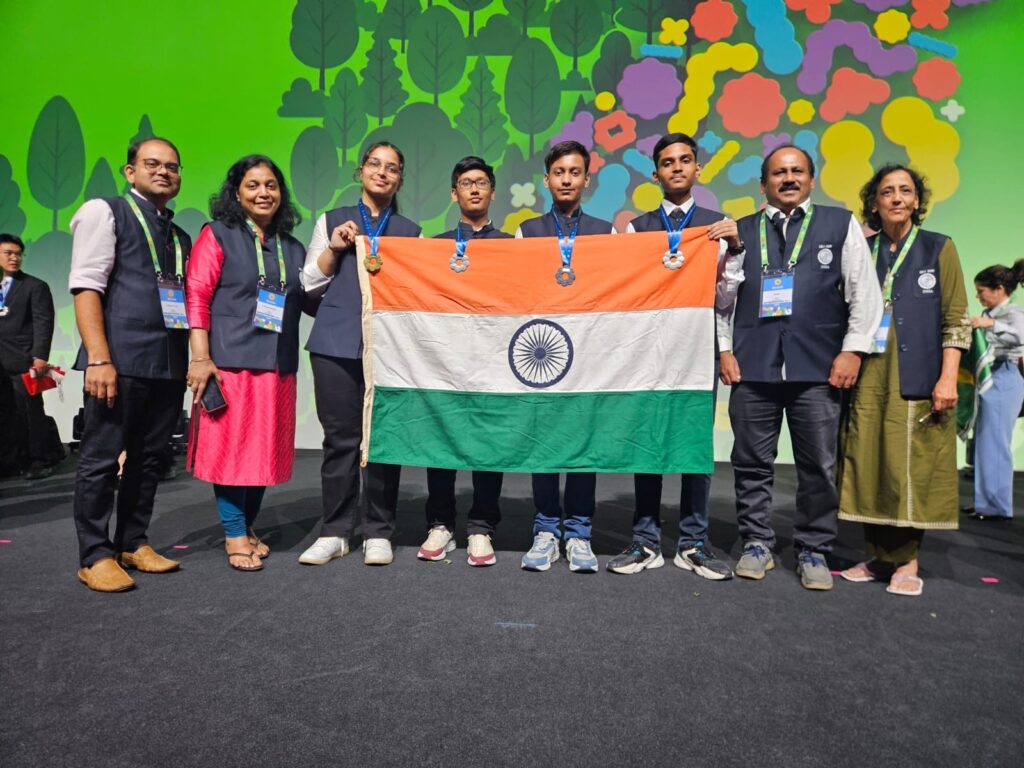
New Delhi, Delhi, 19th of July, 2026 : India performed very well at the 37th International Biology Olympiad (IBO) 2026 held in Vilnius, Lithuania from 12 July to 19 July 2026, with all 4 students winning medals – 1 Gold and 3 Silver.
The medallists were:
Bhavyaa Gunwal (GOLD) from Mahendragarh, Haryana
Soumil Maity (SILVER) from Howrah, West Bengal
Nishit Kalani (SILVER) from Pali, Rajasthan
Anmol Kumar (SILVER) from Mansa, Punjab
The team was accompanied by two leaders: Prof. Rekha Vartak (Retd. HBCSE-TIFR, Mumbai) and Dr. Anupama Ronad (HBCSE-TIFR), and two Scientific Observers: Dr. Ranjithsinh Devkar (M. S. University, Baroda) and Dr. Siddhesh Ghag (UM-DAE Centre of Excellence in Basic Sciences, Mumabi).
There were 307 students from 78 countries in this year’s IBO. In all 31 gold, 61 silver, and 91 bronze medals were awarded.
The IBO 2026 examinations pushed the boundaries of secondary school biology through grueling exams expertly designed by the Vilnius University Life Sciences Centre. The practical examinations, lasting six hours in total, required students to tackle complex, hands-on experimental tasks across four highly specialized domains. In the Molecular Biology & Biochemistry lab, students performed restriction digestion and agarose gel analysis of plasmids alongside a biochemical enzyme assay. The Animal Physiology lab had them evaluate the pharmacokinetics of aspirin and quantify breakdown of the product in simulated blood samples using an in-house developed app and light box colorimeter. The Animal Morphology & Systematics lab required competitors to analyze the systematics of insect specimens for classification, which included precise mouth-part dissections. Finally, the Plant Computational Biology lab introduced cutting-edge digital analysis, tasking students with utilizing ImageJ software to evaluate plant root lengths, perform high-dimensionality macrophenotype analysis of distinct plant ecotypes, and conduct complex transcriptome analysis.
Complementing the practical section was an equally intense six-hour theoretical examination divided into two separate three-hour sessions. The theory portion featured 100 highly challenging test items that relied heavily on real-world research data and field study analysis. Rather than testing simple recall, these questions evaluated advanced problem-solving skills across the core biological sciences, including Cell & Molecular Biology, Plant & Animal Sciences, Genetics & Evolution, Ecology, Ethology, and Biosystematics.
We congratulate all the Indian students, and the rest of the Indian delegation for this excellent performance. The teachers and mentors from across the country and the Biology Olympiad cell of HBCSE deserve appreciation for training the students during the orientation and pre-departure camps at HBCSE. We thank the National Steering Committee, all the teacher organisations and the funding agencies of the Govt. of India for their continued strong support of the Olympiad programme.
This was India’s 26th appearance at the IBO. Of the 104 students so far, 17 have received gold medals, 69 silver, 17 bronze, and 1 honourable mentions. In the last ten years, the gold and silver strike rates have been 25% and 68%, respectively.

More Stories
Gulf Medical University Commences 2026–2027 Academic Year.
Union Home Minister And Minister Of Cooperation Shri Amit Shah Chairs The 28th Meeting Of The Western Zonal Council In Panaji, Goa.
Synopsys, COEP Technological University, CADFEM To Advance Engineering Education With Strategic Digital Twin & Multiphysics Collaboration.