
Agartala, Tripura, 8th of August, 2026 : National Award-winning teacher Anjan Banik visited the first three households of a remote village—located in the western district of Tripura and cut off from road connectivity—where life is sustained by reliance on sunlight. Deep-rooted scientific practices thrive in the daily lives of forest-dwelling tribal communities, often without them even realizing it. Sharing his travel experiences,
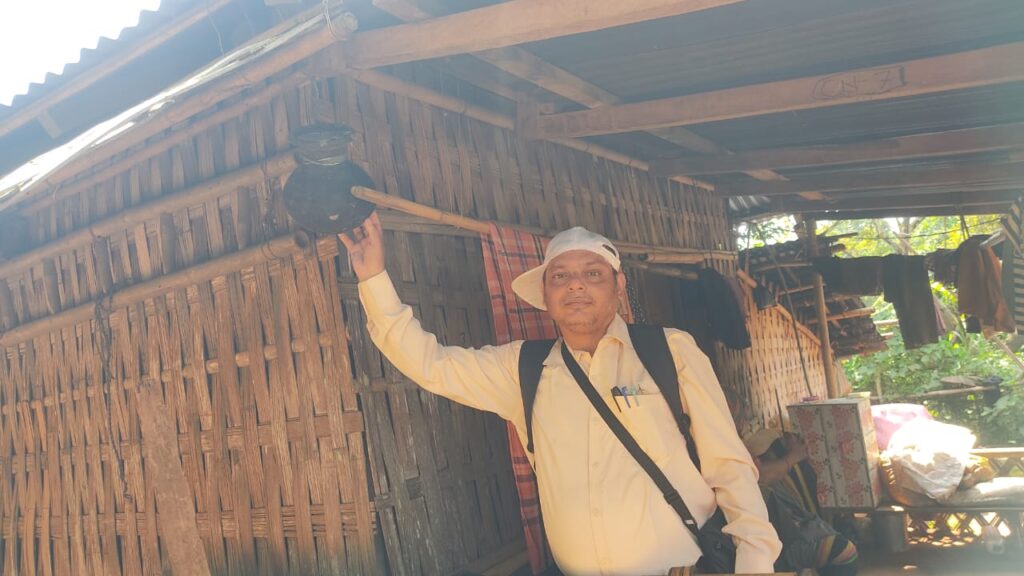
Mr. Banik described how these communities hang earthen pots on the eaves of their homes, coating the insides with a little honey. Attracted by the scent, bees build hives inside the pots, creating a natural method for cultivating honey in abundance.
This Pot (in photo in my right hand in hanging) oriented nature friendly honey bee cultivation is locally known as “Kushumai Madhu”, which is highly potential to the pharmaceutical companies even beyond the borders for it’s health and medicinal effectiveness. This honey purchased by intertional traders from innocent tribes in return of so less finance, but sold it to world pharmaceutical market against high price due to negligence of State and innocence of tribes.
Such beekeeping practices are flourishing at the home of Buddhi Debbarma in a village situated at the junction of the Amisha Dangar-Bottala road in the Domra Karidok, under the Hezamara Block.
Meanwhile, the keen eye of Subal Debbarma from Dugrai village has identified vast opportunities for the natural cultivation of various bamboo species across the slopes of the Baramura Hills; this bamboo serves as raw material for paper and incense-stick mills both within and outside Tripura, with the resulting paper products eventually reaching as far as the United States—the country of President Donald Trump. Thus, the state’s forest resources are finding their way to international markets, yet the tribal communities and the state itself remain unaware of this—or fail to reap the benefits—due to neglect.
Reliable sources from Hezamara Block—known as the most remote block in the West District—report that census officials finally reached the first three households of Gatichhara, a village situated on the extreme periphery. Gatichhara lies near one of the highest peaks of the Baramura Range; even in this era of ‘Viksit Bharat’ (Developed India), the village remains completely cut off, lacking any proper roads or transport links. Driven by dedication to his duty, Anjan Banik—like many other teachers—navigated rugged mountain trails on foot to reach the homes of these forest-dwelling communities. Banik told our correspondent that Mahesh Debbarma (a reputed teacher at Radhanagar High School of Thamakari village under Hezamara Block) and Krishnakishor Debbarma (the local ward member) provided invaluable assistance in reaching this remote village. He also acknowledged the sincere support received from Manas Murasing, the Block Development Officer (BDO) and census charge officer of Hezamara.
In an interview, he described the journey: a trek lasting over an hour through completely uninhabited, dense forest and mountainous terrain. There are no established paths in that area; the only signs of human movement are faint traces of footprints, which have largely been obliterated by the lush vegetation that springs up during the monsoon season. To navigate the route, one must use both hands and a takkal (a local cutting tool) to clear away branches and foliage. The journey begins at the end of the main road—known as the ‘Amisha Dangar Bottala’ point—and involves a trek of one to one-and-a-half hours through rugged, pothole-ridden terrain to finally reach Gatichhara village in the Domra Kari Dok area of Hezamara Block.
Anjan Banik describes the experience of reaching this village as akin to an episode of Bear Grylls’ Man vs. Wild on the Discovery Channel; one had to tread with extreme caution, pushing aside foliage to make way through the dense jungle, or—when standing alone at a fork in the path, bewildered and unsure of the route—rely on the distant barking of dogs (from one and a half to two kilometers away) to confirm the correct direction. Beyond Gatichhara village, a trek of another hour to an hour and a half—crossing a river in the opposite direction—leads to Chhankhala Bazaar in the Khowai subdivision. The three families living here sustain themselves by cultivating organic vegetables and Jhum (shifting cultivation) paddy.
Banik further notes that the greatest challenges to living in Gatichhara are the menace of snakes and wild bears, along with the associated healthcare difficulties. Shubhalakshmi Debbarma, a resident over fifty, has suffered multiple snakebites; instead of conventional medical treatment, she now lives with a series of knotted threads tied around her left leg up to the knee, enduring the lingering effects of the bites. Alongside the threat of snakes, their isolated lives are constantly imperiled by the risk of wild bear attacks. Yet, amidst these hardships, there is a promising ray of hope: two of the three households in this village—located in the West Tripura district—are equipped with solar lighting, a facility that continues to sustain the lives of the six people residing in these homes atop the jungle-clad hills. Meanwhile, Ayan Debbarma—the ten-month-old son of Jyotish Debbarma and Ajanta Debbarma—continues to grow day by day.
Regarding Gatichhara, Banik adds that while hill settlements were initially clustered together, residents later established scattered homesteads on various hilltops to better meet their water needs; this is because the forest-dwelling communities often create natural water wells near the hill streams to satisfy their water requirements. However, there came a time when the water from that single well could no longer meet the needs of the entire community; consequently, due to the water shortage, each family dug its own separate well near the stream and established its settlement on a distinct hilltop, at some distance from the others. From a geological perspective, Shribanik has identified these families as possessing profound expertise regarding the local hills, forests, and forest resources—knowledge that remains rich but currently awaits either systematic documentation or the risk of being lost forever.
Following a visit to Gatichhara village, local representative Krishna Kishore Debbarma advocated for the road stretching from Dumra Karidok in Hezamara Block to the Amishadangar Bottala junction to be officially recognized as a primary road in the West District. He urged the government to undertake the renovation of this road to ensure connectivity to the three households located in Gatichhara village. He further proposed extending the route to Chhonkhola Market in Khowai, thereby linking the two districts. In his view, this road would serve as a vital pathway toward building a ‘Shrestha Tripura’ (an exemplary Tripura), facilitating access to education, healthcare, and other essential amenities for daily life
Krishna Kishore Debbarma has drawn the attention of the Chief Minister and other concerned authorities to this matter and expressed sincere gratitude to the teachers who, through the implementation of government programs, have reached out to people at the grassroots level in this remote region.
It is worth noting that Anjan Banik—a science teacher under the West District Education Office and the Secondary Education Directorate—was the only teacher from Tripura and the entire Northeast India to receive the prestigious ‘National Award for Science and Technology Communication’ in 2022. Presented by the Ministry of Science and Technology and the NCSTC, this is one of India’s highest honors in the field. He earned this recognition for his efforts to foster scientific interest among students—such as implementing programs for ‘Vigyan Prasar’ (an autonomous body under Ministry of Science & Technology of the Government of India)—and for conducting over twenty NCERT-recognized educational research projects utilizing innovative teaching methods. Prime Minister Narendra Modi Ji has also commended Mr. Banik for his various public welfare initiatives and has issued personally signed several letters in appreciation and motivation from his office on multiple occasions.
More Stories
Chief Minister Dr. Manik Saha Inaugurates ICU, CSSD at GBP Hospital.
Where Is Dharmanagar’s Development? Congress Raises Explosive Questions Over MLA’s Claims.
Ganesh Utsav Committee In Dharmanagar Honored As ‘Best Of The Best’ By Refresh Entertainment.