



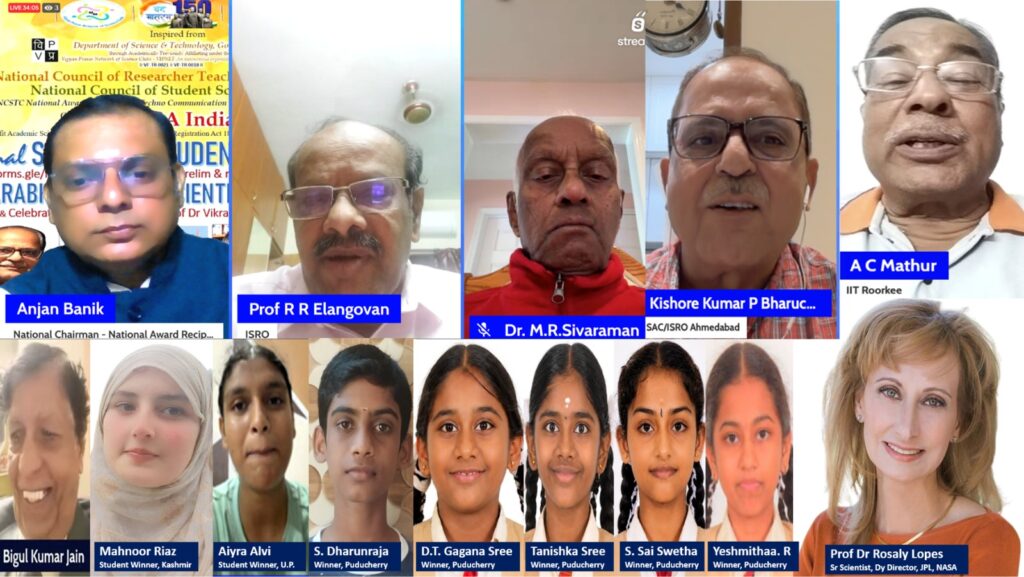
Agartala, Tripura, 16th of August, 2026 : Tripura pride National Awardee Science Teacher Anjan Banik, being nominated as Hon. National Chairman to National Council of Researcher Teacher Scientist VIPNET India (then knowingly affiliated to VIPNET Vigyan Prasar under Ministry – Dept of Science and Technology of Govt of India) presided over the Online International event Dias of celebration of 107th Birth anniversary of Dr Vikram Sarabhai, father of India’s Space Programme on 12th August 2026 under webcast at [ https://www.youtube.com/watch?v=4eeFSkrdu4k ] , where the galaxy remain twinkled with the active virtual presence of former ISRO Star Scientists with Deputy Director of Planetary Div of JPL NASA remain an attraction to the aspirant space science loving future scientists & students from India.
A gathering of veteran Indian space scientists, a NASA planetary scientist and young science learners turned the 107th birth anniversary of Vikram Sarabhai into a vivid reflection on the vision, leadership and scientific culture that shaped India’s space programme. The virtual programme, organised to commemorate Sarabhai and to confer young selected winner – participants with the 8th India International Sarabhai Student Scientist Award 2026 from its organizing team of National Council of Researcher Teacher Scientist India (VIPNET DST Govt of India) academic partnership with the National Council of Student Scientist India and DASA India, brought together scientists who had directly experienced the formative decades of India’s space journey. The India International Sarabhai Student Scientist Award is a national-level science competition and platform in India. It honors young space science loving student achievers and mentors in science education, inspired by the legacy of Dr. Vikram Sarabhai, the pioneer of India’s space program, which has been mentored, designed and coordinated by Anjan Banik.
ANJAN BANIK is an national award-winning science teacher, educational researcher, science communicator and teacher mentor from Agartala, Tripura, whose work has contributed significantly to science education, scientific communication and educational innovation at the state and national levels. He is widely recognized as the sole recipient from Northeast and East India, even from his state Tripura to win the prestigious National Award for Science and Technology Communication 2022 to 2023 in Category E for outstanding efforts in science and technology communication through innovative and traditional methods, conferred by the National Council for Science and Technology Communication under the Department of Science and Technology, Government of India. The official award conferred to Shri Anjan Banik of Agartala on the National Science Day 2023 at Vigyan Bhawan, New Delhi and was presented on National Science Day at Vigyan Bhawan New Delhi by Union Minister Dr Jitendra Singh in the presence of senior national scientific leadership including the Union Secretary of the Department of Science and Technology Dr S Chandrasekhar, Principal Scientific Adviser to the Government of India Professor A K Sood, former Principal Scientific Adviser Professor K Vijayaraghavan, Head Scientist of NCSTC Dr Manoranjan Mohanty, and Director of Vigyan Prasar Dr Nakul Parashar. He has subsequently been selected as a National Mentor Resource Person under the National Mission for Mentoring of National Council of Teacher Education (NCTE), Ministry of Education, Government of India, and has continued to contribute to teacher mentoring and science education.
There are more then 29 science educational research work in his credit which has been presented or published up on him by NCERT, its RIEs at Ajmer, Bhopal, Bhubaneswar, Shilong and Mysore, CSIR NiScPR. His landmark educational research undertaken for IGNOU analysed approximately 45 years of Tripura Board of Secondary Education results, examining the movement of students from Madhyamik to Higher Secondary education and particularly their choice and achievement in Science, Humanities and Commerce. A major finding of the study reported that only 7.97 percent by mean score of Madhyamik enrolment ultimately pursued Science education through Higher Secondary, highlighting the need for stronger scientific orientation, career guidance and educational interventions. His professional contribution has also extended to science textbook authorship for NCERT oriented school education, innovative science communication and the use of puppetry and digital cultural approaches for communicating science and mathematics. In February 2026, ANJAN BANIK was invited as a delegate to the India AI Impact Summit 2026 at Bharat Mandapam, New Delhi, representing Tripura in a major international forum on responsible, inclusive and research driven artificial intelligence. His continuing work reflects a sustained commitment to scientific temper, experiential learning, teacher empowerment and the wider national objectives of science education.
The mega event Organized by its organizing team of National Council of Researcher Teacher Scientist India (VIPNET DST Govt of India), National Council of Student Scientist India and DASA India (an Agartala, Tripura-based national voluntary organization) under the administrative and academic Leadership of its National Chairman Anjan Banik which has been knownly affiliated with VIPNET, Vigyan Prasar (Department of Science and Technology, Government of India).
The Star gathering conferred this year’s 8th India International Sarabhai Student Scientist Award 2026 to Top 11 scorers who compete with nearly about 1 lac students gathering for a long period of last 7 months and the winners are :
1st : Aiyra Alvi (U.P.) of SMS Dutta Memorial Nosegay Public School, Khatima, U S Nagar, Uttarakhand
2nd : S. Dharunraja (Puducherry) of Shree Bharath Vidyaashram CBSE, Puducherry
3rd : DT Tanishka Shri (Puducherry) of Shree Bharath Vidyaashram CBSE, Puducherry
4th : DT Gagana Sree (Puducherry) of Shree Bharath Vidyaashram CBSE, Puducherry
5th : Yeshmithaa R. (Puducherry) of Shree Bharath Vidyaashram CBSE, Puducherry
6th : S. Sai Swetha (Puducherry) of Shree Bharath Vidyaashram CBSE, Puducherry
7th : Mahnoor Riyaz (Kulgam Kashmir) of Radiant Public Hr Sec School Batengoo Anantnag Kashmir and under guidance of Aloha Anantnag
8th : Priya Joshi (Uttarakhand)
9th : Pratiksha Rath (Puducherry) of Shree Bharath Vidyaashram CBSE, Puducherry
10th : Tai Nanam (Arunachal Pradesh) of Vivekananda Kendra Vidyalaya CBSE Arunachal Pradesh
11th : Aryan Parasar (Arunachal Pradesh) of Vivekananda Kendra Vidyalaya CBSE Arunachal Pradesh
The President of event National Chairman National awardee Anjan Banik as part of The event also declared to honour the three mentor guide teachers Dr Sir Ariz Alvi (U.P.) being guide teacher of 1st position holder, Shahnawaz Ahmad Shapoo Sir (Kashmir) being guide teacher of 7th position holder, Sir Avinash Sonar of Vivekananda Kendra Vidyalaya of Itanagar, Arunachal Pradesh being guide teacher of 10th & 11th position holder and Sir Arun Kumar R (Puducherry) being the guide teacher of both 2nd, 3rd, 4th, 5th, 6th, and 9th position holders by conferring the prestigious India International Sarabhai Teacher Scientist Award 2026 for their contribution towards students, which will be conferred on 30 Dec 2026 on death anniversary of Dr Vikram Sarabhai.
This event is a part of organisation’s objective to inspire science loving students and Participants to engage in assignments, spaceflight simulator tasks, and astronomy projects mentored by veteran scientists from ISRO and NASA, where scientists are directly and occasionally interacting with those selected students. This event conducted in every year starts as a prelim google e quiz session available at the link of [ http://forms.gle/nnZrKVZEuZbNAXMw9 ] during 1st January (Birth anniversary of Sir Meghnath Saha) every year to 28th February (National Science Day in India).
The most striking message came from veteran ISRO scientist Professor R R Elango, who recalled Sarabhai’s philosophy of moving rapidly beyond existing technology rather than repeatedly rebuilding what the world had already developed. Referring to the principle as a form of technological leapfrogging, Elango said that Sarabhai believed India should use existing technological knowledge as a foundation and move forward to create new capabilities. “Do not try to redo it again what you have done already. Use that technology and go further,” he recalled. According to Elango, this approach remains deeply connected with the remarkable achievements of ISRO today.
The programme began with a tribute to Vikram Sarabhai, widely regarded as the father of the Indian space programme. The speakers highlighted how the name Vikram has subsequently become associated with several landmarks of Indian space exploration, including the Vikas engine and the Vikram lander associated with the Chandrayaan programme. This Mega event Dr M R Shivaramans memories of Sarabhai and the evolution of satellite navigation
Dr M R Shivaram, a veteran space scientist and former Deputy Project Director associated with the GAGAN programme, joined from the United States. Dr M R Shivaram born on 6th March, 1944 and did his MSc (Applied Physics) in 1966 from University of Kerala, PhD (Physics) on the subject “Topside Sounding of the Ionosphere” from University of Gujarat in 1975. His professional journey began in 1966 at the Physical Research Laboratory, Ahmedabad, founded by Sarabhai, before he moved to the Space Applications Centre of ISRO and continued till 1975.
He Joined Space Applications Centre (SAC), Ahmedabad in 1975 and started working in Satellite Geodesy Division. While in SAC, he contributed in Development of Geo-receivers and its applications, Development of GPS Receivers and its Applications, Satellite Navigation Programmes viz. GAGAN and IRNSS (NavIC), Development of Time Synchronisation Techniques, Development of Ionospheric and Tropospheric Models for GAGAN, and Ka Band Radio Wave Propagation. He has been superannuated in 2004 from SAC. But later also he contributed as a Visiting Scientist in SAC till 2007. Dr M R Shivaram was Deputy Project Director for “GAGAN” Project from 1998 to 2007. Dr M R Shivaram had also worked in IRNSS Programme, in its initial stages of development. From 2002 to 2007, he contributed to publish more than 50 Scientific papers and also guided some PhD students in Dharam Sinh Desai University, Nadiad.
Recalling his encounters with Sarabhai during the late 1960s, Dr Shivaram said Sarabhai had an unusually simple and approachable personality despite his enormous responsibilities. Sarabhai would visit students, interact with them directly and listen to their problems. Dr Shivaram recalled an occasion when a disparity in scholarships affecting research students came to Sarabhai’s attention. Sarabhai immediately intervened and ensured that the students received a fairer arrangement.
Dr Shivaram also described Sarabhai’s contribution to building the foundations of satellite communication and space applications in India. He recalled how Sarabhai supported the development of experimental satellite communication facilities and encouraged Indian scientists to develop indigenous capabilities rather than remain dependent on imported technology.
Speaking about his own later work, Shivaram described his involvement in satellite navigation, including GAGAN and the early development of the Indian Regional Navigation Satellite System. He explained that GAGAN evolved into an advanced satellite based navigation capability designed to provide highly accurate navigation services and support aviation applications.
His account also highlighted an important dimension of Sarabhai’s legacy: the transformation of space science from a purely scientific pursuit into a technology serving communication, navigation, surveying and other national requirements.
Elango recalls Sarabhai’s leadership and Kalam connection
Professor R R Elango, who later worked with the Vikram Sarabhai Space Centre and became associated with launch vehicle development, recalled several stories about Sarabhai’s leadership style and his relationship with young scientists.
According to Elango, Sarabhai’s first major strength was team building. He brought scientists and specialists from different fields and countries to India and created an environment where expertise could be combined for national objectives.
Elango recalled an incident involving Dr APJ Abdul Kalam following a rocket development setback. Instead of simply criticising Kalam after a failed test, Sarabhai reportedly handed him an official envelope. Kalam expected disciplinary action, but the envelope contained a promotion order. The episode, Elango said, demonstrated Sarabhai’s ability to distinguish between failure and incompetence and to encourage scientists to learn from technical setbacks.
Elango further explained Sarabhai’s emphasis on system integration. Components could function successfully individually but still fail when assembled as a complete system. Sarabhai therefore encouraged the creation of systematic integration and testing facilities so that complete systems could be evaluated before launch.
He also recalled Sarabhai’s practice of listening to young engineers and scientists rather than restricting decision making to senior levels. According to Elango, Sarabhai valued technical competence, encouraged his colleagues and gave team members opportunities to present their own work.
The scientist said this leadership culture eventually became one of the foundations of ISRO’s institutional strength.
Kishor Kumar Barucha explains the camera behind space imagery
Kishor Kumar P Barucha, associated with optical imaging and camera technology at the Space Applications Centre in Ahmedabad, described another important but less visible part of the Indian space story.
Barucha explained how optical systems and multispectral cameras are essential for obtaining information from Earth and other planetary bodies. His work involved lens systems, beam splitters and imaging instruments designed for different spectral regions and orbital applications.
He described the demanding process of making space qualified optical systems. Components have to undergo environmental testing involving temperature variation, humidity, vacuum and other conditions before they can be considered suitable for space missions.
Barucha also discussed imaging systems used for Earth observation, weather applications, land use studies and planetary missions. He highlighted the importance of cameras not merely for obtaining spectacular photographs but for generating scientific information about agriculture, land, water bodies, vegetation and geological features.
He also stressed the educational value of space imagery. Through exhibitions, school programmes and science awareness activities, satellite images can turn abstract concepts of Earth and space science into something students can directly observe and investigate.
A C Mathur: Sarabhai wanted space technology to reach ordinary people
Former ISRO Group Director A C Mathur provided a broader account of the development of space applications in India. He recalled joining ISRO in 1978 and subsequently working with several scientists who had themselves worked closely with Sarabhai.
Mathur described Sarabhai as a visionary who understood that the ultimate value of space technology would lie in its applications for ordinary people. He recalled the development of experimental satellite communication earth stations and India’s gradual transition from imported technology towards indigenous design and manufacturing.
According to Mathur, one of the most important elements of Sarabhai’s vision was the creation of institutions capable of converting space research into practical applications. Remote sensing, satellite communication and other technologies were developed not simply as demonstrations of technological capability but as tools for national development.
He emphasised that the benefits of space science should reach ordinary citizens and that the fundamentals of space science should also reach school students. Such an approach, he suggested, would be crucial if India is to remain a global leader in space technology.
Mathur’s account also highlighted India’s growing indigenous capability in satellite antenna technology. He recalled how Indian engineers developed and tested antennas that were subsequently evaluated by NASA, marking an important step in building confidence in India’s ability to design sophisticated space hardware.
NASA scientist Rosaly Lopes highlights perseverance
The programme also featured Dr Rosaly M C Lopes of NASA’s Jet Propulsion Laboratory, a renowned planetary scientist and a leader associated with academic engagement at JPL.
Lopes congratulated the students and emphasised the importance of international scientific collaboration. She noted that India and NASA are partners in space exploration and highlighted India’s achievements in lunar exploration and planetary science.
But the most personal part of her message concerned perseverance. Recalling her childhood in Brazil, Lopes said that nobody in her family had been a scientist and that people initially found it unusual that a young girl wanted to study astronomy. She explained that perseverance was one of the most important factors behind her eventual scientific career and her association with NASA’s Jet Propulsion Laboratory.
“Students bring fresh ideas,” she said while stressing the importance of encouraging and recognising young learners. She also pointed out that NASA’s postdoctoral opportunities are open to students from different countries, underlining the international nature of modern scientific research.
Students demonstrate the next generation of scientific thinking
The programme also showcased the experiences of young participants selected for the India International Sarabhai Student Scientist Award. Their assignments included practical experiments involving light, shadows, observation, data collection and pinhole cameras.
The students repeatedly described how hands on activities helped them move beyond memorising scientific facts. One participant explained that the pinhole camera experiment helped demonstrate the straight line propagation of light and image formation. Another said that analysing shadows connected mathematics with physics and real life observation.
A student from Jammu and Kashmir summarised the learning philosophy particularly clearly by saying that science is not merely about learning concepts but about observing, questioning, thinking, experimenting and discovering.
Another participant expressed an aspiration to become an ISRO scientist and contribute to India’s space programme.
Sarabhai’s legacy continues through students
The programme ultimately connected three generations of Indian science. Veteran scientists recalled Sarabhai’s institution building and leadership, NASA’s Rosaly Lopes spoke about perseverance and international scientific cooperation, while school students demonstrated how practical experimentation can cultivate scientific curiosity.
The organisers emphasised that the objective of the Sarabhai Student Scientist initiative is not merely to confer awards but to inspire young people to remain curious, experiment independently and develop the confidence to ask how and why.
The central message emerging from the programme was therefore larger than a celebration of a historic scientist. Sarabhai’s legacy was presented as a continuing educational philosophy: build strong teams, listen to young minds, learn from failure, use existing knowledge intelligently, develop indigenous capability and take science to society.
For the young participants, the most enduring lesson may have been the one recalled by Professor Elango: India does not need to repeat every technological journey from the beginning. It can learn from what has already been achieved, adapt it, and move further.
At the final conclusion Anjan Banik, the National Awardee National Chairman of this event invites all the Ex ISRO-Scientists to contribute to inspire the future India and also invite the future India, the Gen Next to participate in this Science and scientists-oriented event for the next year as it beings on next 1st January at its exam link of [ http://forms.gle/nnZrKVZEuZbNAXMw9 ] .


More Stories
Collective Efforts Needed To Build TB-Free India: West Tripura Zilla Parishad Sabhadhipati.
New Multi-Level Parking Facility To Ease Agartala’s Traffic Woes : Chief Minister Of Tripura Dr. Manik Saha.
Computer Training Programme Launched For Rural Students.