




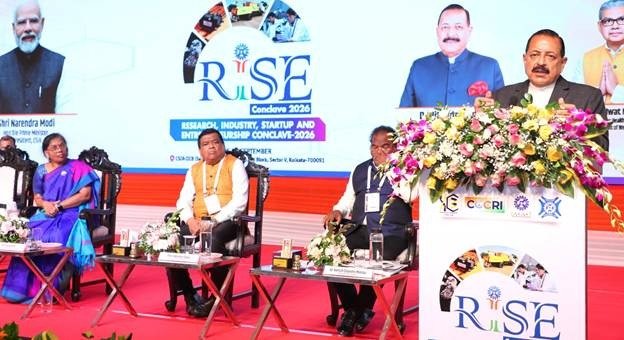
New Delhi, Delhi, 6th of September, 2026 : Union Minister of State (Independent Charge) for Science & Technology and Earth Sciences, Minister of State for Personnel, Public Grievances & Pensions, Department of Atomic Energy and Department of Space, Dr Jitendra Singh today called for taking India’s rapidly expanding startup ecosystem beyond metropolitan centres and creating stronger linkages between science, startups and industry to accelerate the journey of indigenous technologies from laboratories to the marketplace.
Addressing the inaugural session of the 6th RISE Conclave 2026 in Kolkata, Dr Jitendra Singh said there is a growing need to recognise the innovation potential of Tier-2 and Tier-3 cities, noting that more than 50–60 per cent of India’s startups do not belong to metros. Young innovators from smaller cities are increasingly matching and, in several cases, excelling their counterparts in bigger cities, he said, making it important for scientific institutions and the innovation ecosystem to reach out to them rather than expecting them to travel to established technology hubs.
The Minister said the RISE Conclave provides precisely such a platform by bringing startups, industry representatives, potential mentors, researchers and government representatives under one roof. He said this convergence is essential for ensuring that scientific research is not confined to laboratories but moves towards entrepreneurship, technology transfer, commercialisation and wider societal application.
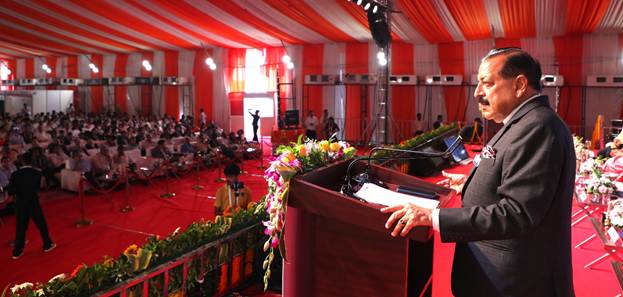
Dr Jitendra Singh said Kolkata’s selection as the venue for the RISE Conclave carries a special significance because of the city’s historic contribution to India’s scientific and academic journey. Recalling Bengal’s long tradition of scientific excellence and institution-building, he said Kolkata has produced and nurtured eminent personalities and institutions that have contributed significantly to India’s intellectual and scientific progress.
Referring to the legacy of Dr Bidhan Chandra Roy, Prof. U. N. Brahmachari, Sir C. V. Raman and Dr Syama Prasad Mukherjee, among others, Dr Jitendra Singh said the present generation has the responsibility to live up to this extraordinary legacy and help restore Kolkata’s position as a major centre of scientific and technological excellence. He said the city’s intellectual strength and academic aptitude provide a strong foundation for connecting its historic scientific heritage with frontier technologies and entrepreneurship.
Dr Jitendra Singh said the Government’s Whole-of-Government approach is increasingly translating into a Whole-of-Science approach, bringing different ministries, departments, research institutions, academia and industry together. He said the convergence of CSIR laboratories with institutions such as IIT Kharagpur, IISER Kolkata, NIT Durgapur and Atal Tinkering Labs, along with networks under the Department of Biotechnology, Department of Science and Technology, Department of Atomic Energy and Ministry of Earth Sciences, can create a strong knowledge corridor in eastern India.
The Minister said India has in recent years created new opportunities for private-sector participation in areas that were earlier largely closed to industry, including space, nuclear energy and biotechnology. The opening up of these sectors, he said, has created a new environment for startups and businesses to participate in national technology development.
Dr Jitendra Singh also referred to the Government’s decision to establish a ₹1 lakh crore Research, Development and Innovation (RDI) Fund, as well as the role of the AnusandhanNational Research Foundation (ANRF), in encouraging high-risk, high-reward research and stronger partnerships among academia, startups and industry.
The Minister urged industry to come forward to adopt, support, finance and commercialise indigenous technologies emerging from Indian laboratories. He said scientific projects and startups cannot be sustained in isolation and require a mutually beneficial relationship with business and industry. For technologies to reach the market at scale, he added, industry must see clear commercial value and become an active partner in the innovation process.
Dr Jitendra Singh also stressed that the outcomes of RISE Conclave should become part of a larger and continuous innovation ecosystem, rather than remaining confined to a single event. He called for taking the knowledge, technologies and opportunities emerging from such platforms to wider sections of society through communication in languages and formats that people understand and access, enabling the learnings of one RISE edition to feed into the next.
The 6th RISE Conclave 2026, being held on September 6–7 at CSIR-Indian Institute of Chemical Biology (CSIR-IICB), Salt Lake, Kolkata, is organised jointly by CSIR-CGCRI, CSIR-IICB, CSIR-CMERI and CSIR-IMMT under the theme “Driving Innovation & Entrepreneurship for Viksit Bharat 2047.” The conclave brings together startups, industry, academia, researchers, innovators, investors, incubators, MSMEs and policymakers to strengthen the interface between scientific research, entrepreneurship and industrial application.
The inaugural session was addressed by Dr N. Kalaiselvi, Director General, CSIR and Secretary, Department of Scientific and Industrial Research (DSIR). Dr SharadwatMukherjee, Minister-in-Charge, Department of Health and Family Welfare, Government of West Bengal, was the Guest of Honour. Prof. Vibha Tandon, Director, CSIR-IICB; Dr Ramanuj Narayan, Director, CSIR-IMMT; Prof. BikramjitBasu, Director, CSIR-CGCRI; Dr Naresh Chandra Murmu, Director, CSIR-CMERI; senior scientists, researchers, startup founders, industry representatives and other stakeholders were also present.
The Kolkata edition is the sixth edition of the RISE Conclave, following earlier editions in Mumbai, Lucknow, Hyderabad, Chennai and Bengaluru. Dr Jitendra Singh said taking the national RISE platform to different parts of the country is aimed at improving outreach and connecting scientific capabilities with innovators and entrepreneurs across regions.
At the centre of the conclave is the 4M framework: Minerals, Medicine, Materials and Machines, representing the complementary strengths of the four participating CSIR laboratories.
The participating CSIR laboratories also showcased indigenous technologies and products with potential for technology transfer, licensing, commercialisation and wider industrial application. The technologies span areas ranging from advanced materials, healthcare and machinery to sanitation, waste management and sustainable engineering solutions, demonstrating the potential of indigenous research to address both industrial and societal requirements.
The Startup Exhibition and S&T Pavilion provided a common platform for startups and entrepreneurs to showcase their technologies and products and engage with researchers, industry representatives, investors and dignitaries. The conclave brought together around 150 startups, with around 300 startup representatives and another 150 delegates from incubation and innovation centres forming part of the wider participation.
The technical programme comprises eight panel discussions involving 67 panelists, covering a wide range of issues including drug discovery and affordable healthcare; manufacturing technology, innovation and R&D for MSMEs; materials-led innovation; decarbonisation of steel and aluminium; critical minerals and new materials; science communication; opportunities for science-driven startups; and traditional wisdom and modern innovation.
A special lecture on “The Lab-to-Market Leap: Building Ventures from Breakthrough Research” further focuses on converting breakthrough research into ventures and market-oriented opportunities.
The conclave has also translated its focus on technology commercialisation into concrete outcomes, with eight Memoranda of Understanding (MoUs) and four technology transfer initiatives forming a key part of the programme. The event also features the launch of two products and inauguration of one facility, along with the launch of the CGCRI’s new logo, compendium and Bootcamp.
An Industry Meet has brought senior industry representatives and other stakeholders together for interaction with scientists and dignitaries, with a focus on strengthening industry–research linkages and identifying opportunities for collaboration, technology adoption and commercialisation.
Dr Jitendra Singh said the scientific and technological strengths of eastern India, coupled with its strong academic and industrial base, can play a major role in India’s technology-led growth. He said startups can serve as key vehicles for technology transfer, while established industries in sectors such as steel, aluminium, mining, jute, IT and software can become important partners in taking indigenous technologies to scale.
He also called for greater use of artificial intelligence and digital technologies to add new capabilities to indigenous machines, optical networks and other technologies emerging from Indian laboratories, creating new opportunities for industry and startups.
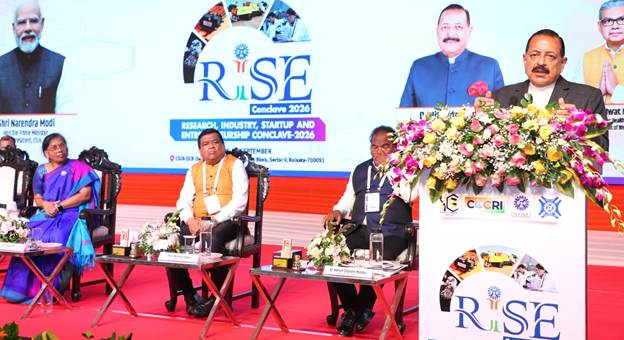
The Minister said India’s recent progress across space, biotechnology, nuclear energy and digital economy, along with indigenous developments in areas such as vaccines, therapeutics and other advanced technologies, demonstrates the potential of a science ecosystem when government, academia and industry work together. He said the next phase of growth requires this integration to become deeper, wider and more sustained.
Dr Jitendra Singh said the vision of Viksit Bharat 2047 requires India to combine its historic scientific legacy with indigenous technology, entrepreneurship, modern manufacturing and strong industry partnerships. He said the 6th RISE Conclave can serve as an important bridge between Bengal’s historic scientific spirit and the new energy of Indian entrepreneurship, helping the country to build, manufacture, heal and lead through indigenous innovation.
The conclave’s valedictory programme on September 7 includes an address by Dr Kalyan Chakraborti, Minister-in-Charge for Science and Technology and Biotechnology, Information Technology and Electronics, Food Processing Industries and Horticulture, Government of West Bengal.


More Stories
President Of India Smt. Droupadi Murmu Presents 65th National Exhibition Of Art And 3rd Print Biennale India Awards To Artists, Celebrating India’s Rich Artistic Heritage And Contemporary Creativity.
Union Home Minister Flagged Off A Nationwide Motorcycle Rally Organized Carrying The Message ‘Fight Against Drugs’.
DRI Seizes More Than 9 Kg Methamphetamine In Intensified Crackdown On Synthetic Drug Trafficking In Bhopal; One Held.