


New Delhi, Delhi, 7th of May, 2026 : CSIR-National Institute of Science Communication and Policy Research (NIScPR) signed a MoU with Research and Information System for the Developing Countries (RIS) on 6 May 2026 to strengthen collaboration in science, technology, innovation policy and diplomacy through joint research, policy analysis, capacity building and knowledge sharing. The partnership will promote work in science policy, communication, diplomacy and traditional knowledge, along with joint projects, publications, policy dialogues, workshops and outreach for inclusive and sustainable development.
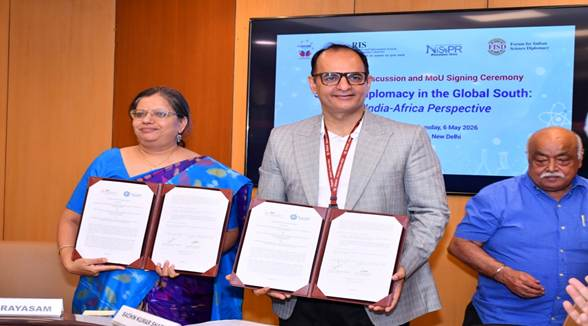
Prof. Sachin Kumar Sharma, Director General, RIS, in his welcome remarks, highlighted science diplomacy as a key tool for building trust and addressing global challenges such as climate change, health and technology inequalities, while emphasizing the Global South’s role in shaping scientific governance. He outlined RIS initiatives including ITEC courses, iGOT Karmayogi training, Forum for Indian Science Diplomacy publications and global partnerships through DAKSHIN and IBSA Fellowships.
Dr. Geeta Vani Rayasam, Director, CSIR-NIScPR, described the partnership as a collaborative, win-win effort for the Global South, focusing on working groups and joint publications. She highlighted NIScPR’s role in science communication and policy research, along with CSIR’s R&D ecosystem, affordable HIV drug innovations, traditional knowledge validation, rural innovations and 15 open-access journals.
Dr. S.K. Varshney, Science Consultant, RIS, emphasized the importance of South-South scientific cooperation based on equality, sovereignty and demand-driven partnerships for context-specific solutions, technology sharing and resilient health systems. Dr. Amit Kumar, Assistant Professor, RIS, termed the collaboration a key milestone combining RIS’s policy expertise with CSIR’s scientific strengths, further reinforced by the roundtable on science diplomacy.
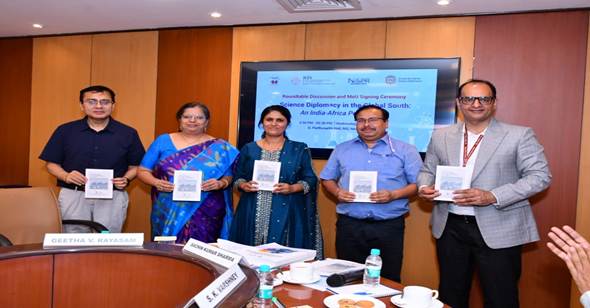
Dr. Rajan Sudhesh Ratna highlighted science diplomacy as a driver of development in the Global South and RIS’s role through DAKSHIN in strengthening cooperation. Dr. Yogesh Suman, Chief Scientist, CSIR-NIScPR, emphasized NIScPR’s role in disseminating CSIR technologies for rural livelihoods and sustainable development. Dr. Sarin N. S., Coordinator, Forum for Indian Traditional Medicine (FITM), highlighted traditional knowledge and medicine as pillars of South-South cooperation, while Dr. Monika Jaggi and Dr. Charu Lata highlighted NIScPR’s contributions to science diplomacy and traditional knowledge through initiatives like SVASTIK.
On the occasion, all the dignitaries released three valuable documents “India-Republic of Korea S&T Cooperation: Co-Creating the Future” (Sanjeev K. Varshney, Amit Kumar and Sneha Sinha); “Proceeding of Workshop on Strengthening India’s Semiconductor Ecosystem: Policies, Challenges and Opportunities” (Dr. Shiv Narayan Nishad, Dr. Vipan Kumar, Dr. Naresh Kumar, Dr. Sandhiya Lakshmanan) and policy bulletin: “The key drivers of particulate pollution from road transportation in Indian states” (Dr. Sandhya Lakshmanan).
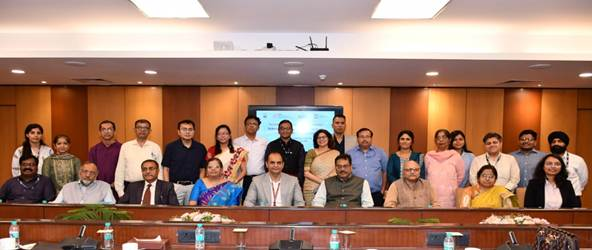
Dr. Sneha Sinha, Consultant, RIS, noted that previous collaborations, including workshops and research in science diplomacy, have laid a strong foundation for future engagement. She highlighted the significance of the roundtable on science diplomacy in the Global South, focusing on India-Africa cooperation ahead of the India-Africa Forum Summit, and emphasized technology sharing and integrating science diplomacy perspectives into a joint report.
More Stories
Vice-President Launches Various Humanitarian Initiatives Of Mata Amritanandamayi Math.
Nanomedicine To Drive The Next Generation Of Precision Medicine And Personalised Healthcare: Dr. Jitendra Singh.
Durga Puja 2026 : Kolkata Baguiati Rail Pukur United Club Durga Puja Celebrating It’s 73rd Year Of Durga Puja With The Theme ‘Collage’ – A Durga Puja Pandal Made From Recycled Newspapers.