



New Delhi, Delhi, 19th of July, 2026 : In the 135th episode of Mann Ki Baat on 28 June 2026, the Hon’ble Prime Minister called upon citizens to save every drop of rain and ensure that the momentum of water conservation continues across the country. Responding to this call, a focused nationwide campaign was undertaken from 4 July to 4 August 2026 to intensify rainwater harvesting, groundwater recharge, restoration of traditional water bodies, plantation activities, and public participation.
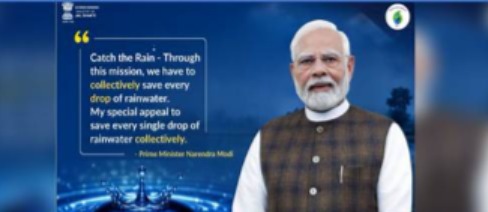
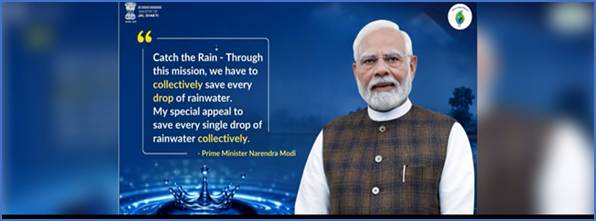
“Catch the Rain -Through this mission, we have to collectively save every drop of rainwater. My special appeal to save every single drop of rainwater collectively.” ~ Hon’ble PM. Shri. Narendra Modi
Tasks we have to perform:
- Adopt Rain Water Harvesting system in every home, society & workplace.
- Install Recharge Pit & Shaft at appropriate places & repair the unused borewells to enable groundwater recharge.
- Restore Baolis, Wells and Traditional Water Bodies and make them usable.
- Enhance Water Retention capacity by removing silt from ponds and water reservoirs in your vicinity for maximum Monsoon water conservation.
- Ensure maximum tree plantation to enhance green coverage in water retention areas.
Jal Sanchay Jan Bhagidari 1.0 (6 September 2024)
To further strengthen community participation in water conservation, Jal Sanchay Jan Bhagidari launched on 6th September 2024 in Surat, Gujarat, graced by Hon’ble Prime Minister virtually, reflecting his unwavering resolve to make water conservation a national priority.
Guided by the principles of Community, CSR, and Cost (3Cs), the initiative mobilized community participation, institutional support, Corporate Social Responsibility (CSR) contributions, and convergence with ongoing government schemes to accelerate water conservation efforts. The initiative focuses on constructing low-cost groundwater recharge and water storage structures, revival of defunct borewells, and adoption of scientifically designed, locally appropriate solutions through a Whole-of-Government and Whole-of-Society approach.
Implemented from 1 April 2024 to 31 May 2025, JSJB 1.0 surpassed its target of constructing at least 10 lakh groundwater recharge structures, with more than 27 lakh artificial recharge structures reported across the country.
Jal Sanchay Jan Bhagidari 2.0 (2025)
Building on the success, JSJB 2.0 was launched on 1 June 2025 with a special focus on accelerating groundwater recharge in Over-Exploited and Critical districts through low-cost, hyper-local interventions.
Against the target of constructing at least one crore groundwater recharge structures by 31 May 2026, more than 1.5 crore structures have been reported nationwide, exceeding the target by over 50 percent. These reported structures are presently undergoing physical verification and field validation.
Recognizing outstanding contributions under JSJB 1.0, the Government honoured exemplary performers during the 6th National Water Awards held in November 2025.
Jal Sanchay Jan Bhagidari: Catch the Rain (2026)
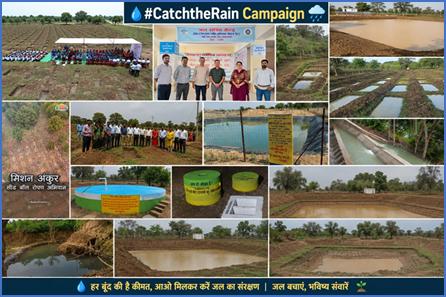
Jal Sanchay Jan Bhagidari: Catch the Rain (JSJB: CTR) was launched on 1st June 2026 enhancing the scope of the Jal Sanchay Jan Bhagidari (JSJB) initiative and simultaneously integrating it with the Jal Shakti Abhiyan: Catch the Rain (JSA: CTR) campaign.
With renewed emphasis on rainwater harvesting, groundwater recharge, water storage, and community participation, the campaign aims to transform every rainfall event into an opportunity for water conservation. It promotes locally appropriate, low-cost interventions and strengthens climate resilience through sustainable water management.
The campaign leverages convergence with several Central and State Government schemes, including:
- Viksit Bharat – Guarantee for Rozgar and Ajeevika Mission – Gramin (VB-G RAM-G)
- Per Drop More Crop (PDMC) under PMKSY
- Repair, Renovation and Restoration (RRR) of Water Bodies under PMKSY
- CAMPA
- Finance Commission Grants
- State Government Schemes
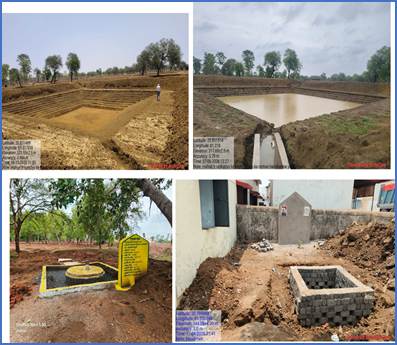
At its core, JSJB: CTR is driven by Jan Bhagidari, mobilizing Panchayati Raj Institutions, Urban Local Bodies, women’s groups, youth, educational institutions, civil society organizations, and local communities to actively participate in water conservation efforts.
Jal Shakti Abhiyan: Catch the Rain (JSA: CTR)
Jal Shakti Abhiyan: Catch the Rain (JSA: CTR) was launched by Hon’ble Prime Minister Shri Narendra Modi on World Water Day (22 March 2021) with the theme “Catch the Rain, where it falls, when it falls.”
The campaign builds on the success of the Jal Shakti Abhiyan 2019, which was implemented in 1,592 water-stressed blocks across 256 districts and promoted rainwater harvesting, groundwater recharge, watershed development, rejuvenation of water bodies, and afforestation through a Jan Andolan approach. Since then, the campaign has been implemented annually with evolving themes and focus areas.
2021 – Catch the Rain, Where It Falls, When It Falls
- Rainwater harvesting and water conservation
- Geo-tagging of water bodies
- Scientific water conservation planning
- Jal Shakti Kendras and awareness activities
2022 – Expanding Water Conservation Activities
- Restoration of traditional water bodies
- Groundwater recharge and watershed development
- Wetland and river rejuvenation
- Spring-shed development and catchment protection
2023 – Source Sustainability for Drinking Water
- Focus on 150 water-stressed districts
- Strengthening drinking water sources
- Groundwater recharge and source sustainability
- Field monitoring and community participation
2024 – Nari Shakti se Jal Shakti
- Women-led water conservation initiatives
- Desilting and cleaning of water bodies
- Revival of abandoned borewells for recharge
- Afforestation and rejuvenation of local water resources
Women-led initiatives across the country demonstrated how community leadership can strengthen water security. Their contributions continue to be recognized through the Swachh Sujal Shakti Samman, celebrating exemplary efforts in water conservation, sanitation, and hygiene.
Jal Shakti Kendras (JSKs)
A key institutional component of the campaign is the establishment of Jal Shakti Kendras (JSKs) in districts across the country. These centres serve as knowledge and facilitation hubs for water conservation. They disseminate information on water harvesting techniques, provide technical guidance to local communities and district administrations, and support planning and implementation of water conservation activities.
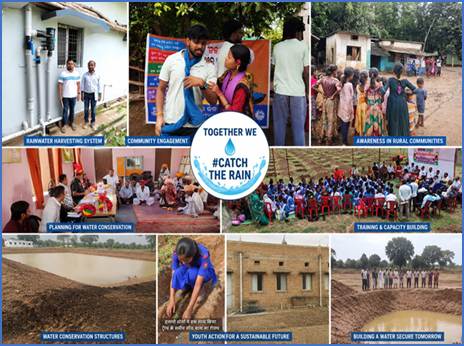
From Rainwater Harvesting to Rural Resilience
Under the visionary leadership of the Hon’ble Prime Minister, water conservation has emerged as a national priority and a people’s movement. Through initiatives such as the Catch the Rain and Jal Sanchay Jan Bhagidari, the Government has successfully transformed water conservation from a sectoral programme into a nationwide Jan Andolan driven by community participation, scientific planning, and convergence of resources.
As India advances towards the vision of Viksit Bharat, sustained efforts in rainwater harvesting, groundwater recharge, restoration of water bodies, and efficient water use will remain critical for strengthening agriculture, supporting rural livelihoods, enhancing climate resilience, and securing water resources for future generations.
By promoting scientific planning, local ownership, and collective action, the campaign is creating resilient water assets across rural India. As climate variability and water demand continue to increase, conserving every drop of rainwater remains essential for ensuring water security. It will further strengthen agriculture and support sustainable rural development.
The Prime Minister’s consistent emphasis on conserving every drop of water, reflected in platforms such as Mann Ki Baat, has inspired citizens, institutions, and governments at all levels to work collectively towards water security.

More Stories
HPS Ramanthapur Marks Dr. Sarvepalli Radhakrishnan’s Birth Anniversary With Teachers’ Day Celebrations.
India’s EV Boom Is Testing A Different Kind Of Partnership.
DEKA International And GeoBio Strengthen Their Presence Across India With Scientifically Backed Aesthetic Technologies.